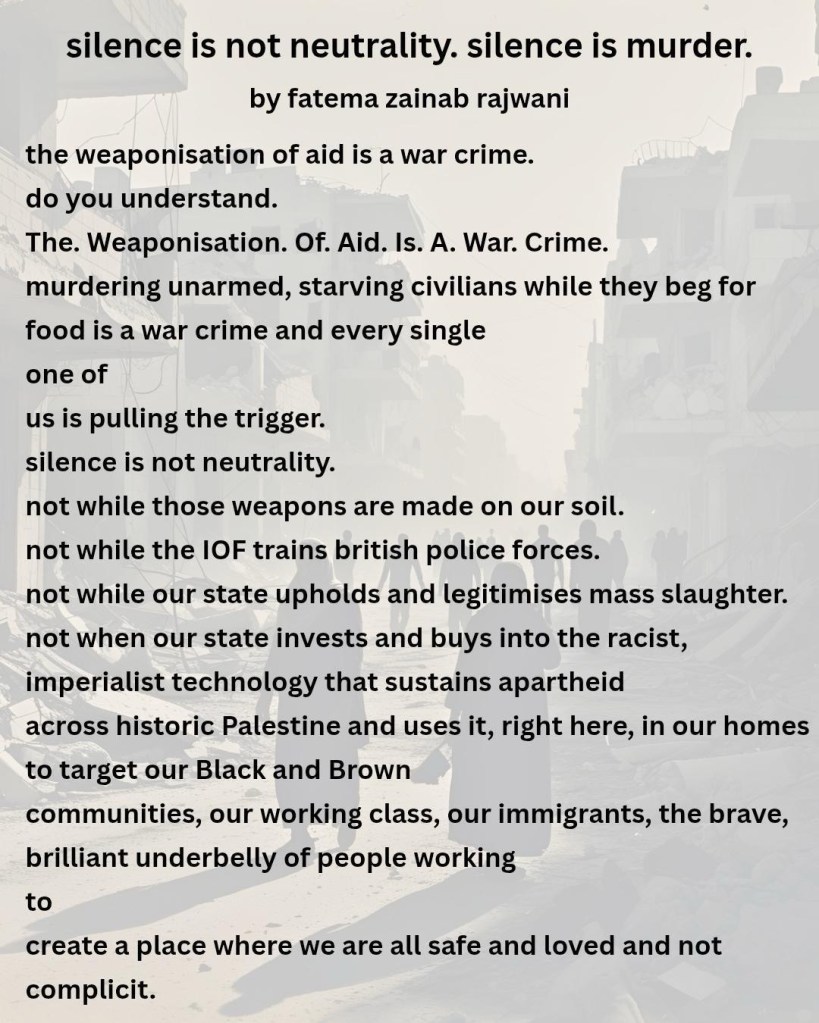
I translated this with Google Translate and ran it through Copilot to smooth the language. I hope it’s accurate, because the piece is powerful.
Reading it, I kept thinking of Madeleine Albright’s answer to Lesley Stahl’s question about the half‑million Iraqi children who died under sanctions: “The price is worth it.” I don’t have polite words for leaders who make decisions like that — then or now.
The capitalist will say (and do) anything that justifies the endless accumulation of profit. To this end, the emphasis of individualism is vital – as it is through this loss of collective identity that humanity learns to routinely brutalise its own existence and being. Inflicting pain and harvesting gain is the only permitted exchange which locks out all other modes of possible interaction. Love becomes a limited commodity which can be bought for a short time period before the clock runs out and its flow dries up.
I may – if you wish – lose my livelihood I may sell my shirt and bed. I may work as a stone cutter, A street sweeper, a porter. I may clean your stores Or rummage your garbage for food. I may lie down hungry, O enemy of the sun, But I shall not compromise And to the last pulse in my veins I shall resist.
I hate the indifferent. I believe, as Frederich Hebbel did, that ‘living means being partisan’. There can’t be men [sic] who are men alone and exist outside of the city. To really live means to be a citizen and to take part. Indifference is abulia, is parasitism, is cowardice. Indifference isn’t life. This is why I hate the indifferent.
Among the many problems that demand the consideration and attention of contemporary mankind, sexual problems are undoubtedly some of the most crucial. There isn’t a country or a nation, apart from the legendary “islands”, where the question of sexual relationships isn’t becoming an urgent and burning issue. Mankind today is living through an acute sexual crisis which is far more unhealthy and harmful for being long and drawn-out. Throughout the long journey of human history, you probably won’t find a time when the problems of sex have occupied such a central place in the life of society; when the question of relationships between the sexes has been like a conjuror, attracting the attention of millions of troubled people; when sexual dramas have served as such a never-ending source of inspiration for every sort of art.
The song “The Sound of Silence” by Disturbed is a powerful rendition of Simon & Garfunkel’s classic hit. It speaks of alienation, the loss of genuine communication, and the deep chasms created by our society’s reliance on superficial interactions. With its haunting delivery, Disturbed adds a layer of urgency and depth, turning the song into a brooding anthem for the disconnected.
“The Sound of Silence” comes to a close with a warning, pointedly calling out the all-consuming consumerism and using those already lost to it as an example of what’s to come if we continue to find solace in the silence. And the people bowed and prayed / To the neon god they made / And the sign flashed out its warning / In the words that it was forming / And the sign said, “The words of the prophets / Are written on the subway walls / And tenement halls / And whispered in the sounds of silence.”
In our relentless pursuit to transcend the human suffering, we’ve stumbled into a dangerous oversimplification: an improved mental state reflects the absence or decrease in negative emotional states. This reductionist view has not only cheapened our understanding of the human emotional spectrum but has also paved the way for a troubling linguistic shift.



 Ms. Cat’s Chronicles
You must be logged in to post a comment.