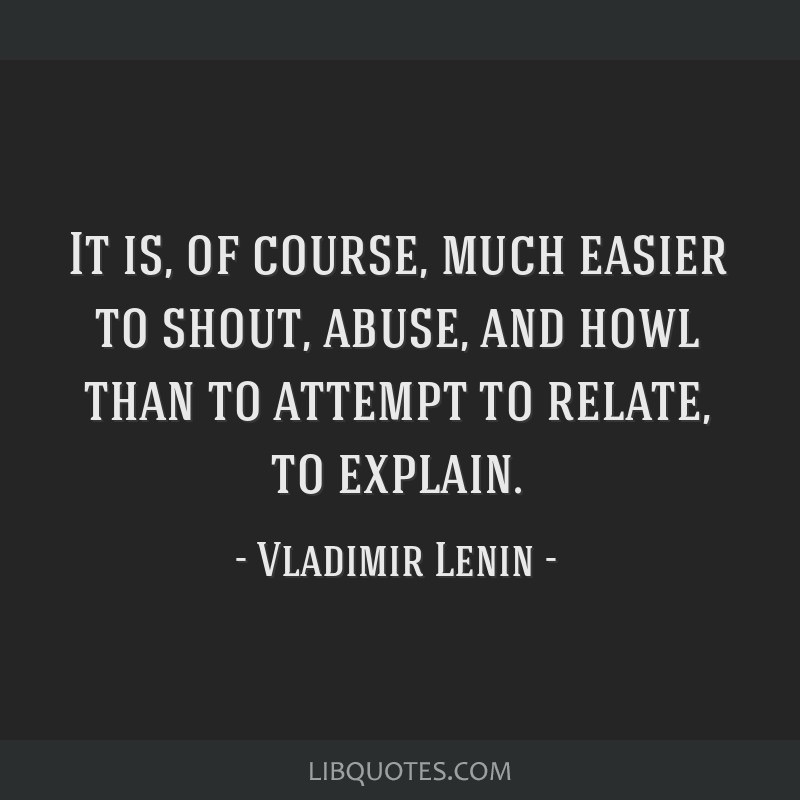
Vladimir Lenin once remarked, “It is, of course, much easier to shout, abuse, and howl than to attempt to relate, to explain,” highlighting the value of constructive dialogue and education over emotional outbursts or hostile rhetoric. As a revolutionary thinker and leader, Lenin stressed the importance of articulating ideas and strategies clearly to foster understanding and rally support for the socialist movement.
He criticized those who relied on anger, insults, or simplistic slogans, arguing that such tactics undermined the more challenging but essential work of educating and persuading others. For Lenin, successful revolutionary efforts depended on thoughtful explanation, open dialogue, and the ability to engage with people on a rational level. This method was crucial for building a disciplined and informed movement capable of achieving lasting goals, rather than succumbing to fleeting emotional appeals or divisive strategies.
Ultimately, Lenin advocated for a deliberate and strategic approach to political struggle—one rooted in clarity, reason, and the empowerment of the working class through education and mutual understanding.
from the always-think-of-how-your-worst-enemy-will-use-this-law dept
For a while, we’ve been pointing out how terrible KOSA (the Kids Online Safety Act) is. Our main concern is that the bill would fundamentally lead to the suppression of all kinds of speech. That’s because the “duty of care” provision, while limited, would allow officials (mostly at the FTC, which can get partisan) to argue that certain types of results were due to a design failure, and companies would seek to suppress content, rather than face the potential liability.
These are just three logical fallacies that irritate me:
Ad hominem attacks can take the form of overtly attacking somebody, or more subtly casting doubt on their character or personal attributes as a way to discredit their argument. The result of an ad hom attack can be to undermine someone’s case without actually having to engage with it.
This fallacy avoids the argument by shifting focus onto something’s or someone’s origins. It’s similar to an ad hominem fallacy in that it leverages existing negative perceptions to make someone’s argument look bad, without actually presenting a case for why the argument itself lacks merit.
Appeals to emotion include appeals to fear, envy, hatred, pity, pride, and more. It’s important to note that sometimes a logically coherent argument may inspire emotion or have an emotional aspect, but the problem and fallacy occurs when emotion is used instead of a logical argument, or to obscure the fact that no compelling rational reason exists for one’s position. Everyone, bar sociopaths, is affected by emotion, and so appeals to emotion are a very common and effective argument tactic, but they’re ultimately flawed, dishonest, and tend to make one’s opponents justifiably emotional.
Texas is in a close race with Florida for the title of “Most Unconstitutional Laws Enacted.” Florida’s legislators will probably end up taking this title because they seem crazier/more productive than their counterparts in Texas.
I’ve talked before about the utter stupidity (and danger) of trying to turn the internet into Disneyland: a safe space for little kids, where they’ll never encounter any content that makes them upset, but plenty of states (and many people in Congress) are trying to do it anyway.
Wrote to Tammy Baldwin about how Republicans want to censor LGBT content with the KOSA bill that she is sponsoring! I included the following Techdirt article in my email! Not one word, about it, in her reply to me (which is just a form letter)! In fact, I didn’t bring up anything that she mentioned! As she is a LGBT person, I thought that she’d be concerned but I guess not?!
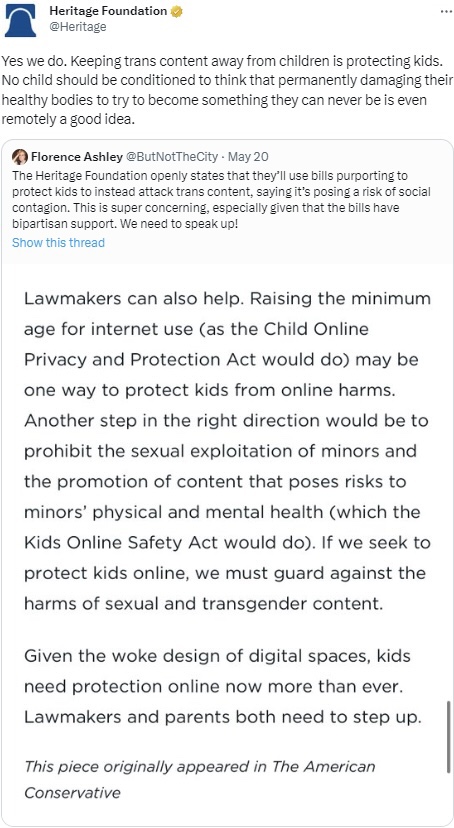
Meanwhile, Republicans are now freely admitting that they’re going to use KOSA to force websites to censor LGBTQ content. They’re literally proud of it. The Heritage Foundation, which at least used to have some principled stances before being taken over by culture warriors without any principles, is bragging about how it will use KOSA in this manner:
We’ve talked a lot about KOSA, the “Kids Online Safety Act” that has massive bipartisan support in Congress. The latest version was introduced with 26 Senators as sponsors or co-sponsors. We’ve explained over and over again how the bill is unconstitutional and will actually do a lot to harm kids.




 Ms. Cat’s Chronicles
You must be logged in to post a comment.