
The collapse of the Syrian government in mid-December 2024 represents a pivotal moment for U.S. geopolitical strategies in the Middle East and beyond.
Tag: Arab world
Meeting with journalists from BRICS countries • President of Russia
Vladimir Putin answered questions from the heads of leading BRICS media agencies. The meeting was held ahead of the BRICS summit in Kazan.
The meeting was attended by the heads of media agencies from Brazil, China, Egypt, Ethiopia, India, Saudi Arabia, South Africa, and the UAE. It was moderated by Head of the Rossiya Segodnya Media Group Dmitry Kiselev.
Meeting with journalists from BRICS countries • President of Russia
No, They Were Not Hungarian Pagers
No, They Were Not Hungarian Pagers
But the fact is that the whole pager situation was a skillfully arranged smear campaign led by Mossad and the CIA against their own partner. These devices were indeed manufactured by Taiwanese Gold Apollo, which has a very high proportion of American top management. They were filled with explosives under careful control of the CIA and in April a large batch of devices was sent to Lebanon – at the same time that a delegation of the Knesset suddenly arrived in Taipei. However, the payments for the deal were made using the Hungarian BAC firm. The company does not have but a single employee, which confirms that it could not have produced the pagers.
All of this is a ploy for the media in order to shift the blame away from Taiwan and onto Viktor Orban, who is already very much demonized in Western discourse. The worst thing is that it is extremely efficient, because most of the world began to believe that it was Hungary that sent pagers to Lebanon and thus entered into direct confrontation with the Arab world. Orban’s representative instantly responded to the allegations, saying that BAC Consulting was “a trading-intermediary company, which has no manufacturing or other site of operation in Hungary”. Additionally, the CEO of the company 49-year-old Cristiana Barsony-Arcidiacono added that she was “just the intermediate”.
The story seems to have died down a bit now, but the mystery of the pagers remains. Will there be an independent investigation to determine their manufacturer? Most likely not, since all the evidence leads to the US, Israeli and Taiwanese intelligence services. This mystery will go down in history just like the events associated with the blowing up of Nordstream pipelines, as well as the so-called “massacre in Bucha”. No investigation, no evidence, no verdict.
Previously:
[2011] Golden Apollo held the FBI’s heart with a walkie-talkie
Latest Lebanon Pager Terrorist Attack Predictable, Preventable
Open Letter to Dr. Jill Stein
Dear Dr. Stein,
Up to last week, you graciously provided US voters with a clear, viable, electoral alternative to the twin war parties, namely, Democrats and Republicans. Regrettably, last Thursday, September 19th, your campaign issued a statement undermining your status as the “peace candidate.”
Open Letter to Dr. Jill Stein
What’s Behind Regime Change in Bangladesh
Violent regime change in the South Asian country of Bangladesh unfolded rapidly and mostly by stealth as the rest of the world focused on the ongoing conflict in Ukraine, growing tensions in the Middle East and a simmering confrontation between the US and China in the Asia-Pacific region.
Related:
The Partition of South Asia Strikes Again
There is a problem, fundamentally, in viewing the regime change in Bangladesh as a ‘stand-alone’ event. The caveat must be added right at the outset that when it comes to processing situations, nothing happens for no reason at all. There is very little awareness in India, especially in the media, about what has been going on. Mostly, it’s ‘cut-and-paste’ job culled out from the jaundiced western accounts from a new Cold War angle.
The Genocide the U.S. Can’t Remember, But Bangladesh Can’t Forget
Poster thanking Israeli troops for committing genocide appears at McDonald’s branches in Glasgow, Scotland
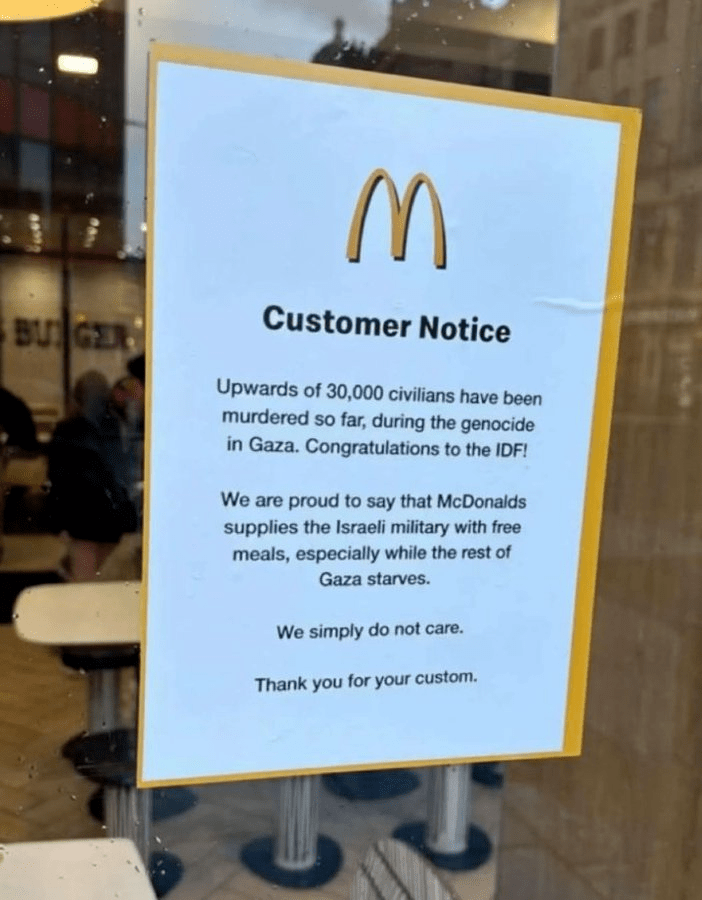
Glasgow, July 30 (RHC)– The poster originates from McDonald’s branches in Glasgow City, Scotland, and it was placed by activists on the branches’ facades. The “Art Workers for Palestine Scotland” Instagram account shared the PDF version of the poster for dissemination to other branches. Many other accounts shared the call from Art Workers for Palestine Scotland to spread the poster.
The Postwar Vision That Sees Gaza Sliced Into Concentration Camps
The Postwar Vision That Sees Gaza Sliced Into Security Zones
A plan that is gaining currency in the government and military envisions creating geographical “islands” or “bubbles” where Palestinians who are unconnected to Hamas can live in temporary shelter while the Israeli military mops up remaining insurgents.
Other members of Prime Minister Benjamin Netanyahu’s Likud party are backing another, security-focused plan that seeks to slice up Gaza with two corridors running across its width and a fortified perimeter that would allow Israel’s military to mount raids when it deems them necessary.
The ideas come from informal groups of retired army and intelligence officers, think tanks, academics and politicians, as well as internal discussions inside the military. While Israel’s political leadership has said almost nothing about how the Gaza Strip will look and be governed after the heaviest fighting ends, these groups have been working on detailed plans that offer a glimpse of how Israel is thinking about what it calls the Day After.
The plans—whether or not they get adopted in full—reveal hard realities about the aftermath that rarely get voiced. Among them, that Palestinian civilians could be confined indefinitely to smaller areas of the Gaza Strip while fighting continues outside, and that Israel’s army could be forced to remain deeply involved in the enclave for years until Hamas is marginalized.
…
According to people familiar with the effort, it aims to work with local Palestinians who are unaffiliated with Hamas to set up isolated zones in northern Gaza. Palestinians in areas where Israel believes Hamas no longer holds sway would distribute aid and take on civic duties. Eventually, a coalition of U.S. and Arab states would manage the process, these people said.
Ziv, who oversaw Israel’s exit from Gaza in 2005, proposes that Palestinians who are ready to denounce Hamas could register to live in fenced-off geographic islands located next to their neighborhoods and guarded by the Israeli military. This would entitle them to reconstruction of their homes.
The process would be gradual, and in the longer term, Ziv envisages bringing the West Bank-based Palestinian Authority back to Gaza as a political solution, with the whole process taking roughly five years as the military fights Hamas insurgents. Under his plan, Hamas could be part of Gaza’s administration, if it frees all the hostages held there and disarms, becoming purely a political movement.
…
Northern Gaza, under the plan, would remain without reconstruction, and Palestinians there wouldn’t be allowed back to their homes until Hamas’s miles-long tunnel network was destroyed. Like the bubbles plan, it promotes the notion of de-escalation zones where aid can be delivered by the Israeli military or by international forces, but stops short of articulating an idea for governance.
…
Another plan published by the Washington-based Wilson Center* also advocates a coalition-style approach to the conflict but refrains from calling for Israel to consider the adoption of a Palestinian state. It says the U.S. should establish an international police force to manage security in Gaza and over time hand the job to a yet-to-be-defined Palestinian administration.
Robert Silverman**, a former U.S. diplomat in Iraq who is a co-author, said his team discussed the plan with Israeli officials for months, even changing parts of the proposal to make it more agreeable to Israel’s war objectives and political dynamics, but it stalled with the prime minister’s office.
“He believes we finish the war first and then plan the postwar,” Silverman said of Netanyahu. “All the people who have done this before say that’s a huge mistake.”
…
Another document, drafted by Israeli academics, that has made its way to the prime minister’s desk draws on historical precedents in rebuilding the war zones in Germany and Japan after World War II, and more recently in Iraq and Afghanistan. It considers how to tackle Hamas’s Islamist doctrine by learning from the defeat of ideologies such as Nazism and that of Islamic State.
Related:
The Strategic Hamlet Program (SHP; Vietnamese: Ấp Chiến lược) was a plan by the government of South Vietnam in conjunction with the US government and ARPA during the Vietnam War to combat the communist insurgency by pacifying the countryside and reducing the influence of the communists among the rural population through the creation of concentration camps.
…
The Strategic Hamlet Program was unsuccessful, failing to stop the insurgency or gain support for the government from rural Vietnamese, it alienated many and helped contribute to the growth in influence of the Viet Cong. After President Ngo Dinh Diem was overthrown in a coup in November 1963, the program was cancelled. Peasants moved back into their old homes or sought refuge from the war in the cities. The failure of the Strategic Hamlet and other counterinsurgency and pacification programs were causes that led the United States to decide to intervene in South Vietnam with air strikes and ground troops.
The *Wilson Center plan isn’t much better. 👇🏻
Related:
Read More »With Al-Qassam and Al-Quds Brigades, four other armed Palestinian factions are fighting Israel in Gaza
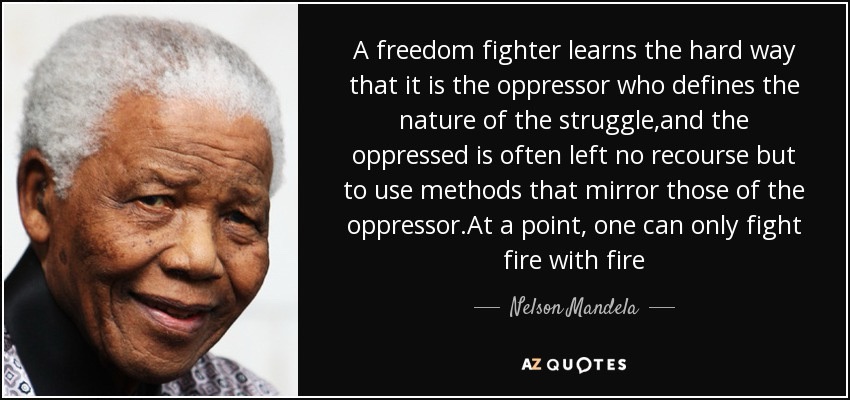
To support Hamas and the Palestinian Islamic Jihad (PIJ) and despite any ideological or political differences, thousands of fighters from four other Palestinian factions have been fighting against the Israeli occupation forces in Gaza since last October.
…
“Currently, we are all facing the same catastrophe(…) The Israeli enemy does not differentiate between a Palestinian who follows Fatah and another who belongs to Hamas. For him, everyone is a target. The Israelis want to eradicate the Palestinian people, without exception,” the officials said.
…
“Although the Al-Qassam Brigades and the Al-Quds Brigades are the strongest on the ground, fighters from other factions joining the fight has created a balance not only on the field but also politically, especially since Israel has always bragged since the beginning of its war that it is only fighting Hamas, which it described as similar to ISIS, to justify its crimes against all the Palestinian people,” Wasef Erekat, a Ramallah-based Palestinian military expert, told TNA.
“The presence of diversity in the fighters’ ideological and political backgrounds and tactics in confronting the Israeli occupation prevents Israel from being able to commit even more crimes against the Palestinians and debunks their claim that they are only fighting ‘extremists’ and Hamas,” Erekat said.
…
“Israel and the United States have long tried to stamp out Palestinian armed resistance and hold Hamas fully responsible for the 7 October attack. They ignored the violations against Palestinians in the occupied West Bank, Jerusalem, and Gaza for decades and considered the 7 October attack a ‘crime against humanity’ and mobilised international and, unfortunately, some of the Arab opinion against Hamas,” remarked Iyad al-Qarra, a Gaza-based Palestinian analyst.
Related:
Not Only Hamas: Eight Factions at War With Israel in Gaza
Regarding the ‘Belligerents’ in the Israel–Hamas war and Hamas in Syria
The Palestinians’ inalienable right to resist
Why doesn’t Amnesty recognize Palestinians’ right to resist?
China tells ICJ: Palestinians have the right to use ‘armed force’ against Israel
Why Is Arab Media Silent About the Uyghur Separatists Supporting “Israel”?
We no longer hear much about the Uyghur issue, which Arab and international media outlets often promoted as a narrative to tarnish the reputation of the Chinese government and pressure it. This issue has always been framed through the lens of “generality” implying that “China is persecuting Muslims within its borders,” which is certainly not true, since the Uyghurs are not the only Muslim ethnic group in China; there are ten Muslim ethnicities in China.
Why Is Arab Media Silent About the Uyghur Separatists Supporting “Israel”?
The World’s Jewish Religious Community Is Not the Jewish People
I.
Let us decolonize our minds and our guts.Let’s de-idiotize the minds, from TV to academia.
Judaism is linked to the Jewish religion, Judaism is not linked to a people.
Islam is linked to the Islamic religion, Islam is not linked to a people.
Christianity is linked to the Christian religion, Christianity is not linked to a people.
It is unfortunate to have to explain this, today in the 21st century of alleged secular values, of supposed anti-imperialist values, and of a world where we believe and feel that the anachronism of colonialism has been overcome in history….
The World’s Jewish Religious Community Is Not the Jewish People
 Ms. Cat’s Chronicles
You must be logged in to post a comment.