He added that the Typhon’s presence signalled renewed US commitment to the region, which would be further reinforced by separate visits to the Philippines by US Defence Secretary Pete Hegseth this week and Secretary of State Marco Rubio next month.
Less than a month after Duterte took office, then- Secretary of State John Kerry announced a $32 million weapons and training package specifically to support the Philippine National Police. He made no mention of Duterte’s numerous threats to weaponize law enforcement on the campaign trail, or the fact that 239 suspected drug users had already been killed by police without due process at that point.
Off to the side was a more youthful Wolfowitz. He told me that this picture, which had pride of place in his office, was of exactly the moment when the Reaganites had narrowly voted to dump the Ferdinand Marcos dictatorship in the Philippines in 1986 and to recognize the election victory of his opponent Cory Aquino.* “It was the first argument I won,” said Wolfowitz proudly. “I said that if we supported a dictator to keep hold of a base, we would end up losing the base and also deserving to do so. Whereas,” he went on, “by joining the side of ‘people power’ in Manila that year, we helped democracy movements spread through Taiwan and South Korea and even I think into Tiananmen Square in 1989.“
* See, for the best account of this upheaval in real time, James Fenton’s book The Snap Revolution.
Speaking at a Stratbase Forum in Makati City, Gregory Poling, senior fellow and director of the Southeast Asia Program and Asia Maritime Transparency Initiative at the Center for Strategic and International Studies (CSIS), said the collaboration extends to Japan trilateral and bilateral partnerships.
Poling noted the exemption of military aid for the Philippines, along with Taiwan and Ukraine.
“The Philippines is the only country in Asia that explicitly had its military assistance unlocked as a result of Secretary [Enrique] Manalo’s meeting with Secretary [Marco] Rubio. That’s a pretty good sign.
MANILA, Philippines — A United States Naval Ship (USNS) was spotted near the country’s landmass while China Coast Guard (CCG) was conducting what it considers as a patrol around Panatag (Scarborough) Shoal on Sunday morning, a West Philippine Sea monitor said.
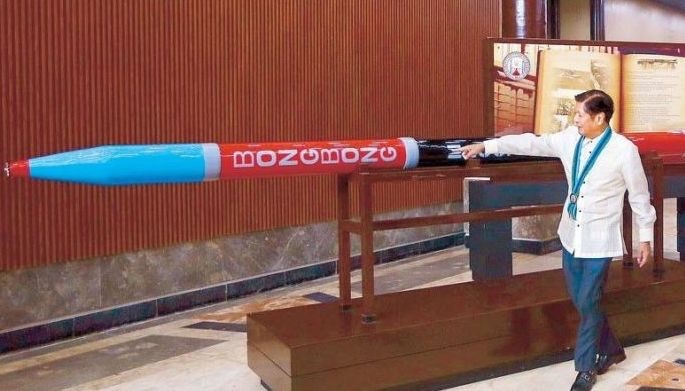
’A Failed Project?’ The only VALID reason I could think of for all these “secrecy” or lack of transparency is that the program itself was NOT successful, and there are a number of ways that it could have failed. For one, the FAILURE or SUCCESS RATE of the launches were never published, and it’s possible that there were just too many launch failures, like the rockets exploding or veering off course at their launch pad or after launch, or even rockets not taking off at all. And even if the launches were successful, there is the issue of how accurate the rocket was in terms of hitting its target. If it ends up several hundreds or thousands of meters from its intended target, then it’s not very useful. And just like the Launch Rate, the Accuracy of the rockets were also never published.
Philippine President Ferdinand Marcos Jr. said his nation won’t deploy Navy warships to the South China Sea in response to recent clashes with Beijing in disputed waters.
Maritime clashes between the Philippines and China had been mostly over the Philippines’ military outpost, BRP (BRP—Barko ng Republika ng Pilipinas, which translates to “Ship of the Republic of the Philippines”—the ship prefix for the Philippines) Sierra Madre, in the Spratly Islands, which is disputed by Brunei, China, Malaysia, the Philippines, Taiwan (a province of China, as recognized by the United Nations’ Resolution No. 2758), and Vietnam. The BRP Sierra Madre was intentionally run aground on a reef near the Second Thomas Shoal in the disputed Spratly Islands, in 1997, so that the Philippines could stake their territorial claim.



 Ms. Cat’s Chronicles
You must be logged in to post a comment.