
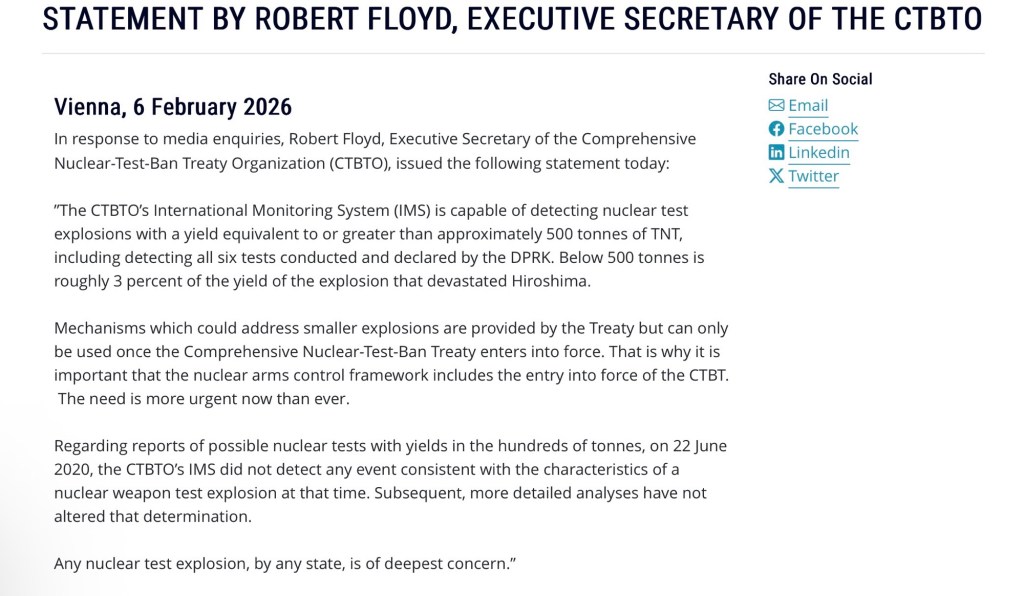
No evidence to support US claim China conducted nuclear blast test: Monitor
Tag: Arms Race
Stalin – Prohibition of Atomic Weapons
A Permanent Arms Economy
The background to the article reprinted here is the “long boom” of western capitalism during the 1950s and 1960s. It first appeared in International Socialism journal in Spring 1967. On the surface it appeared that the capitalist system had stabilised itself, had broken out of the boom-slump cycle and was now able to offer the workers of Western Europe and North America a steady increase in living standards.
This was a frustrating world for Marxists, who found themselves subject to two temptations. One was to surrender to the claims poured out by the system’s apologists that capitalism had solved its problems and that the path of gradual reform offered a sure road to socialism. The other was to deny the obvious signs of stability and prosperity and assert that capitalism was on the verge of imminent, catastrophic collapse. If these temptations were to be avoided, and Marx’s analysis of capitalism’s contradictions was to hold, then the long boom must be explained.
Philippines set to host second Typhon missile system, signalling Trump’s defence pledge + More
Philippines set to host second Typhon missile system, signalling Trump’s defence pledge
He added that the Typhon’s presence signalled renewed US commitment to the region, which would be further reinforced by separate visits to the Philippines by US Defence Secretary Pete Hegseth this week and Secretary of State Marco Rubio next month.
Read More »
Silicon Valley venture capital blowing up the US defense industry + More
Silicon Valley venture capital blowing up the US defense industry
“I’m a propagandist, I’ll twist the truth, I’ll put forward only my version of it if I think that’s going to propagandize people to believe what I need them to believe.” – Palmer Luckey
Read More »
2021 Colby: Could we win a war in China? Forcing Beijing to escalate could be in our interests

Philippine Army acquiring US missile system
Philippine Army acquiring US missile system
“It is planned to be acquired because we see its feasibility and its functionality in our concept of archipelagic defense implementation,” Philippine Army chief Lt. Gen. Roy Galido told a news conference.
“I’m happy to report to our fellow countrymen that your army is developing this capability for the interest of protecting our sovereignty,” he said, adding the total number to be acquired would depend on “economics.”
As a rule, it takes at least two or more years for the Philippine military to acquire a new weapons system from the planning stage, Galido said, adding it was not yet budgeted for 2025.
Brawner already announced that they wanted one, three months ago. Shortly afterward, the U.S. said that they were keeping the Typhon in the Philippines, at the Laoag International Airport. Will this be a second unit? The only new information that I’ve learned, is that it’ll take at least two years for them to officially acquire the Typhon. Why announce it, again? Except to provoke China?
Related:
What’s Really Going On In the South China Sea Between the Philippines and China
Washington’s War in Ukraine: Narrowing Options, Growing Consequences
Washington’s War in Ukraine: Narrowing Options, Growing Consequences
Brian Berletic, November 29, 2024
Russia’s use of its Oreshnik intermediate-range ballistic missile in eastern Ukraine represents an unprecedented escalation in what began as a US proxy war against Russia in 2014.Washington’s War in Ukraine: Narrowing Options, Growing Consequences (archived)
America Is Updating Its Nuclear Weapons. The Price: $1.7 Trillion.
To understand how America is preparing for its nuclear future, follow Melissa Durkee’s fifth-grade students as they shuffle into Room 38 at Preston Veterans’ Memorial School in Preston, Conn. One by one, the children settle in for a six-week course taught by an atypical educator, the defense contractor General Dynamics.
“Does anyone know why we’re here?” a company representative asks. Adalie, 10, shoots her hand into the air. “Um, because you’re building submarines and you, like, need people, and you’re teaching us about it in case we’re interested in working there when we get older,” she ventures.
Adalie is correct. The U.S. Navy has put in an order for General Dynamics to produce 12 nuclear ballistic missile submarines by 2042 — a job that’s projected to cost $130 billion. The industry is struggling to find the tens of thousands of new workers it needs. For the past 18 months, the company has traveled to elementary schools across New England to educate children in the basics of submarine manufacturing and perhaps inspire a student or two to consider one day joining its shipyards.
…
Though the new Columbia-class subs are primarily being built in Rhode Island, Connecticut and Virginia, the Navy is going to tremendous lengths to recruit talent across the country. Over the past year, a blitz of ads has appeared at various sports events — including major league baseball games, WNBA games and even atop a NASCAR hood — steering fans to buildsubmarines.com. The website connects job seekers with hiring defense contractors as part of a nearly $1 billion campaign. Some of that money will go toward helping restore the network of companies that can supply the more than three million parts that go into a Columbia sub. Like so much of the nation’s nuclear infrastructure, those supplier numbers have plummeted since the 1990s.
America Is Updating Its Nuclear Weapons. The Price: $1.7 Trillion.
Now this is grooming!
Recommended Reading:
 Ms. Cat’s Chronicles
You must be logged in to post a comment.