
Originally posted on Tuesday, November 26, 2024.
Search for “Bay of Bengal” in this document: Bangladesh and Kenya.
Read More »Originally posted on Tuesday, November 26, 2024.
Search for “Bay of Bengal” in this document: Bangladesh and Kenya.
Read More »New laws specifying Manila’s claims have also angered smaller countries such as Malaysia, which could hamper unified resistance to China’s attempts at regional dominance.
Related:
What’s Really Going On In the South China Sea Between the Philippines and China
Read More »What’s Really Going On In the South China Sea Between the Philippines and China
by Tina Antonis
Maritime clashes between the Philippines and China had been mostly over the Philippines’ military outpost, BRP (BRP—Barko ng Republika ng Pilipinas, which translates to “Ship of the Republic of the Philippines”—the ship prefix for the Philippines) Sierra Madre, in the Spratly Islands, which is disputed by Brunei, China, Malaysia, the Philippines, Taiwan (a province of China, as recognized by the United Nations’ Resolution No. 2758), and Vietnam. The BRP Sierra Madre was intentionally run aground on a reef near the Second Thomas Shoal in the disputed Spratly Islands, in 1997, so that the Philippines could stake their territorial claim.
Read More »Has anyone realized that by disclosing the existence of “US Task Force Ayungin,” Biden admin implicitly recognized Philippines’ sovereignty over a disputed SCS feature?
Washington has never taken a position on SCS territories(but it has in ECS). This is a clear signal to China.*
South China Sea: US troop aid may reassure Philippines but will prod China, analysts say (archived)
The Philippines has said the US task force only offered support – in the form of intelligence and surveillance – and did not directly take part in its resupply missions to BRP Sierra Madre, the retired warship, but analysts suggested that China’s leadership could see it in a different light.
…
Zheng said the revelation about the American task force meant the US was likely to be more engaged in the drawn-out maritime conflicts in the region, even suggesting that Washington would “be the first to take part in the command and planning of Philippine maritime activities”.
…
Ding Duo, deputy director of the Centre for Oceans Law and Policy at the National Institute for South China Sea Studies in Hainan, said the presence of a special task force showed that Washington and Manila had long cooperated on resupply operations to Second Thomas Shoal.
…
“Such support emboldens the Philippines and is not conducive to China and the Philippines managing their differences,” Ding said. “The US involvement has also squeezed the political space for internal coordination and decision-making within the Philippines.”
…
He said it was also possible that American troops could be on Philippine ships and involved in front-line action “using a covert or concealed identity to participate in Philippine maritime operations” in future.
He said the US could “only intervene [in South China Sea disputes] in a covert manner and so it took the form of a task force”.
Related:
Read More »
MANILA, Philippines — United States Defense Secretary Lloyd Austin III has revealed the existence of what appears to be a military unit of American troops in the country called the “US Task Force Ayungin.”
Related:
What’s Really Going On In the South China Sea Between the Philippines and China
The implementation of yet another U.S. initiative may allow it to interfere in the information policy of ASEAN and control the cyberspace of all of Southeast Asia.
Related:
This reminds me of the tech camps that were held in Ukraine before the Euromaidan. Anyone who has been following me for a while knows where that led to. Except, replace China with Russia.
Read More »
Read it at Antiwar.com or here with graphics. FYI, the “Ant” in Antonis is pronounced as 🐜.
MANILA – President Ferdinand R. Marcos Jr. on Friday signed laws declaring the maritime zones under Philippine jurisdiction and designating sea lanes in the country for foreign vessels and aircraft.
Marcos inks laws on PH Maritime Zones, Archipelagic Sea Lanes
Related:
South China Sea: Philippines’ legal moves reveal its expansionist goals
U.S. State Department On the Philippines Maritime Zones Act
Arnaud Bertrand’s Twitter thread (ThreadReader)
Regarding the South China Sea Arbitration:
The South China Sea Arbitration did not rule on sovereignty, and China does not recognize it because the Arbitral Tribunal lacked jurisdiction. “The Arbitral Tribunal violated the principle of state consent, exercised its jurisdiction ultra vires and rendered an award in disregard of the law. This is a grave violation of UNCLOS and general international law, Wang said.” The United Nations Convention on the Law of the Sea (UNCLOS) is an international treaty that establishes a legal framework for all marine and maritime activities. The Permanent Court of Arbitration is not an agency of the United Nations. The PCA rents space in the same building as the UN’s International Court of Justice. A Congressional Research Service report, dated August 2023, stated that the U.S. has not declared its position regarding sovereignty over any of the geographical elements that comprise the South China Sea.
The Philippine military opened two weeks of combat drills Monday that would include seizing an island in the disputed South China Sea and likely be frowned upon by China.
Philippine military drills to seize an island in the South China Sea
Previously:
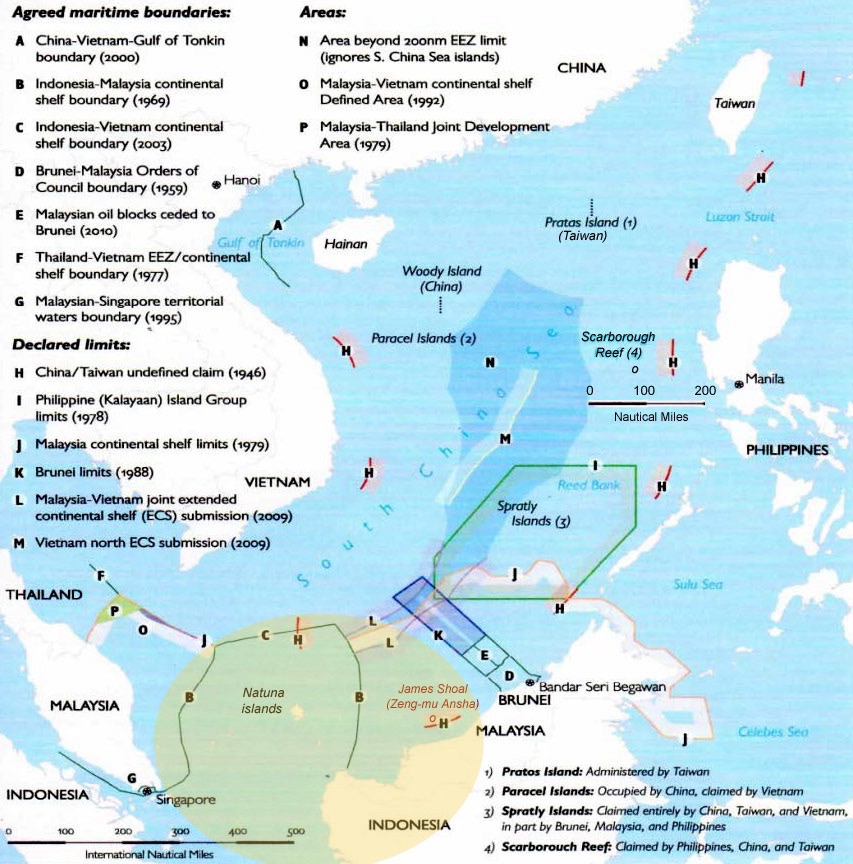
China looks to Indonesia for diplomatic resolution after coastguards’ Natuna encounters + More
China looks to Indonesia for diplomatic resolution after coastguards’ Natuna encounters
Related:
[10-23-2024] Indonesian Coast Guard “Drives Out” Chinese Vessel Shadowing Seismic Ship (archived)
Read More »On Monday, Indonesia’s coast guard “drove out” a China Coast Guard cutter that was shadowing a survey vessel in Indonesian waters of the South China Sea. On Tuesday, the Chinese vessel was back again in the same spot, according to maritime security expert Ray Powell.
…
Geo Coral is a Norwegian-owned geophysical vessel flagged in Norway. She is operating under charter to PT Pertamina, Indonesia’s state-owned oil company, to conduct a 3D seismic survey off the Natuna Islands. “Pertamina East Natuna is focusing on oil and gas exploration activities in the East Natuna Working Area [East Natuna gas field], which has great potential to contribute to national energy security,” said a Pertamina spokesman on Tuesday.
 Ms. Cat’s Chronicles
You must be logged in to post a comment.