
From War Doctrine to Psychedelic Therapy: How Revolutionary Theory Was Dissolved into Mysticism
Read More »Tag: Asia Foundation
Capes, Cameras, and the Cult of Visibility
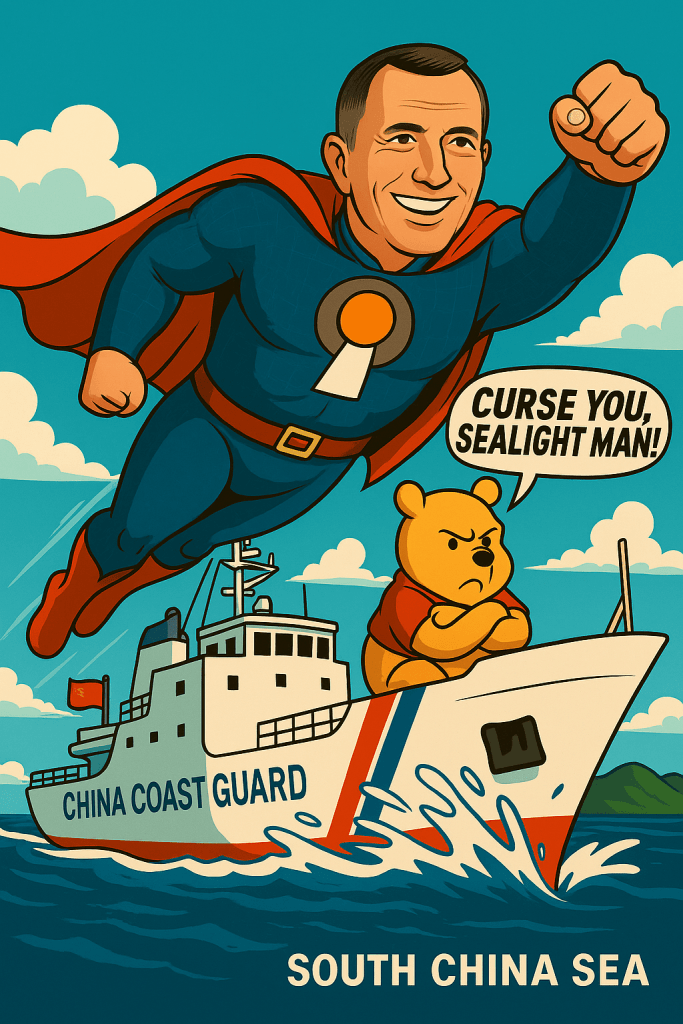
Capes, Cameras, and the Cult of Visibility: The SeaLight Crusade as White Savior Theater
By Tina Antonis
The South China Sea is more than a maritime dispute—it’s a theater of narrative warfare. While headlines focus on Chinese aggression and Philippine resistance, a quieter campaign unfolds in the background: one of satellite feeds, curated imagery, and Pentagon-backed storytelling. At the center of this effort is SeaLight, a project that claims to illuminate truth but often casts shadows of its own.
As explored in my article at Antiwar.com, SeaLight doesn’t just document—it performs. It reframes geopolitical tension through moral spectacle, positioning its creators as heroic arbiters of transparency. But when the messenger wears a cape and the funding flows from defense budgets, we must ask: is this clarity, or choreography?
Stage Left: The White Savior Enters
In the comic-strip cosmology of Ray Powell’s SeaLight project, transparency wears a cape. Clad in heroic postures and backed by satellite imagery, Powell casts himself as the guardian of maritime morality—unarmed, except with satellite feeds, theatrical flair, and strategic messaging.
Yet beneath the cartoon and Pentagon-funded optics lies a familiar archetype: the white savior, rebranded for the South China Sea.
China Is Imperialist? Says Who?
Calling China a “maritime occupier,” Powell positions himself as a bulwark against aggression. But that moral pose collapses under scrutiny. He speaks for a country with over 800 foreign military installations and a documented history of over 250 military interventions since 1991—wars in Iraq, Afghanistan, Libya, Syria, Somalia, and dozens more, all under the banner of peace, freedom, or preemption.
By comparison, China’s post–Cold War footprint includes no sustained foreign occupations and only scattered border conflicts and peacekeeping missions. The imbalance is staggering. And Powell’s framing doesn’t just ignore it—it performs around it.
As David Vine argues in The United States of War, this vast base empire is not a passive network—it’s an architecture of perpetual war. These outposts make military engagement not an exception but a structural habit, cloaked in strategic necessity and sold as global stewardship.
Powell’s cartoon rhetoric—calling China an occupier—obscures the scale of U.S. militarism. The term “occupation” is deployed not to analyze, but to project. When adversaries hold territory, it’s a crisis; when the U.S. spans the globe with armed installations, it’s policy.
Framing Conflict: The Optics of Consent
This isn’t irony. It’s performance. Powell’s language manufactures a moral frame for confrontation—costumed in transparency, but driven by escalation. The cape is literal. The conditioning is deliberate. And the stage is set for war.
SeaLight’s mission is not just visual documentation—it’s narrative warfare. As the Japan Times openly notes, its “chief weapon is photography, applied purposefully, generously and consistently over time.” These images—enhanced, curated, and distributed across media—are not neutral. They’re constructed to shape public perception, sway international opinion, and ultimately manufacture consent for confrontation.
Assertive transparency becomes a kind of ideological scaffolding—a stage on which geopolitical tension is dramatized, simplified, and morally polarized. The goal isn’t simply to reveal conflict; it’s to condition audiences for escalation.
And when the messenger dons a superhero’s cape, the spectacle transforms into something deeper: a story of rescue, of virtue, of intervention. This is not analysis—it’s soft propaganda dressed in heroic metaphor.
Consent for war doesn’t begin with missiles. It begins with mythmaking.
PH: 3-day rally set to push for impeach trial start
3-day rally set to push for impeach trial start
Militant groups, civil society organizations, and members of religious congregations will mount a three-day major rally and vigil from June 9 (Monday) to June 11, (Wednesday) to call on the Senate to proceed with the impeachment trial of Vice President Sara Duterte.
Read More »
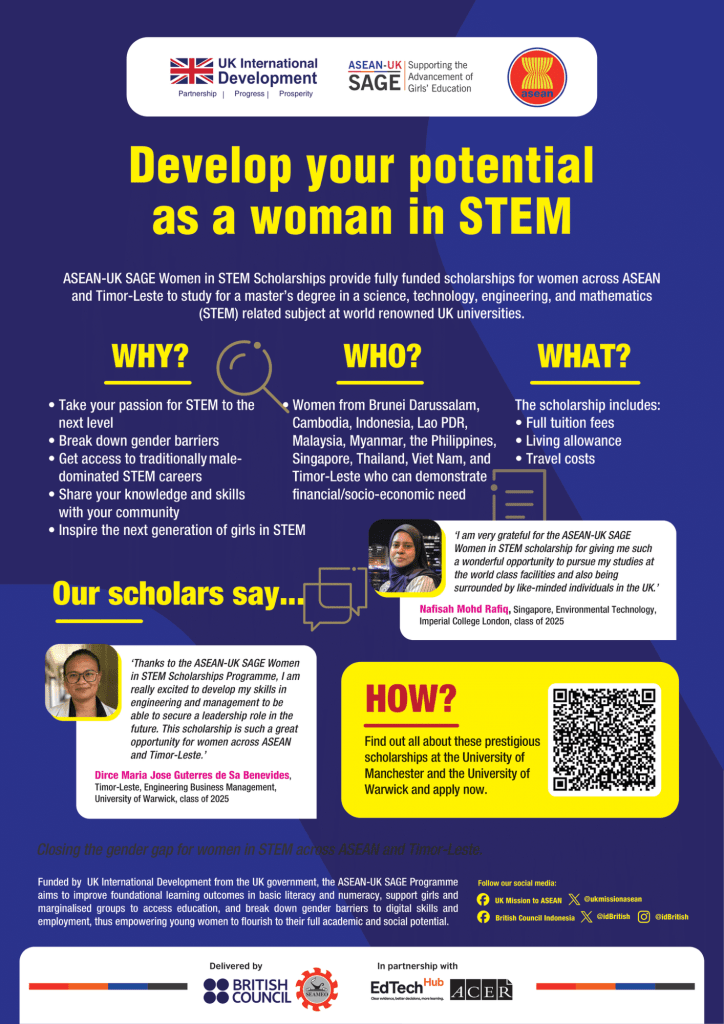
Soft Power: U.K. & Quad STEM Scholarships
Democrats join Republicans in passing fascistic “Crucial Communism Teaching Act” + More

The Atlantic publishes hit job against PM Modi: Here’s how the propaganda piece cherry-picks facts to attack Indian PM while romanticising Khalistan terrorists
The hit job titled “How a Strongman Made Himself Look Weak” claims that PM Modi responds to criticism within India by ‘co-opting’ the media and ‘repressing’ the religious minorities [read Muslims]. And, on foreign soil, the Modi government responds to criticism with anger and laughably, even ‘political assassinations’.
Related:
Daniel Block (Asia Foundation—CIA, Henry Luce Scholar— partners with the Asia Foundation, The Caravan)
Read More »PH’s EDSA1 AKA People Power Revolution
What’s Really Going On In the South China Sea Between the Philippines and China
What’s Really Going On In the South China Sea Between the Philippines and China
by Tina Antonis
Maritime clashes between the Philippines and China had been mostly over the Philippines’ military outpost, BRP (BRP—Barko ng Republika ng Pilipinas, which translates to “Ship of the Republic of the Philippines”—the ship prefix for the Philippines) Sierra Madre, in the Spratly Islands, which is disputed by Brunei, China, Malaysia, the Philippines, Taiwan (a province of China, as recognized by the United Nations’ Resolution No. 2758), and Vietnam. The BRP Sierra Madre was intentionally run aground on a reef near the Second Thomas Shoal in the disputed Spratly Islands, in 1997, so that the Philippines could stake their territorial claim.
Read More »It’s officially published!

Read it at Antiwar.com or here with graphics. FYI, the “Ant” in Antonis is pronounced as 🐜.
Updates for the Bangladesh document
Battle for soul of Bangladesh far from over
One of the most pressing issues facing Yunus’ interim government is the restoration of law and order. Since the uprising, the police — once a tool of state terror under Hasina — have largely disappeared from the streets fearing violent retribution from the public. Police stations have been set ablaze, and in their absence, student-led groups have taken up roles in maintaining local order. In a country where state violence was once the norm, the people’s reliance on these grassroots organisations rather than formal law enforcement is a telling indicator of the deep mistrust in state institutions, although, over the span of two months, we have also witnessed that dynamic of trust taking on significant concessions and alterations in the questions of nationalism, the phantom of separatist movements and the security discourse enveloping the Chittagong Hill Tracts [CHT].
…
Perhaps above all else, the Chittagong Hill Tracts have historically been a flashpoint for military-police dynamics, reflecting tensions between the indigenous populations, popular local political parties and civil society members on one side, and Bangladeshi state authorities, the military, and the plainland settlers serving as vanguards of the Bengali-Bangladeshi nationalist project on the other. The military’s sustained and in fact, expanding presence in the CHT, justified as means of ‘maintaining order’, has led to systemic human rights violations and a climate of permanent, pervasive fear, discontent, animosity, and distrust, and for good reason.
As per a report by the Human Rights Support Society, in the month of September alone, 28 were killed in 36 different incidents of mob lynching across Bangladesh, with 14 others injured. Political violence claimed another 16 lives and injured 706. In their report, HRSS refers to a wild-wild-Western state of affairs that is still developing, including factional clashes within the two major political parties, targeted violence against ethnic and religious minorities, attacks on journalists, extrajudicial killings, and worker protests. Overnight, netizens witnessed footage of defenceless Tofazzal and Shamim Mollah, mercilessly beaten to their deaths in the two top public universities.
…
This is especially true when we consider how global neoliberal agendas intersect with local political upheavals. Like the Arab Spring, derailed by counter-intelligence tactics, surveillance capitalism, and imperialist interventions, Bangladesh faces the risk of its uprising being neutralised by the coalescence of state surveillance, corporate interests, and international capital. The convergence of military intelligence, former Awami elites, and foreign backers — including both regional powers and multinational corporations — threatens to undo the revolution’s hard-won gains by appealing to reactionary fears and mobilising mobs against progressive forces.
No criticism of U.S. puppets allowed:
Criticism on Dr Yunus: Magistrate suspended in Bangladesh
Read More » Ms. Cat’s Chronicles
You must be logged in to post a comment.