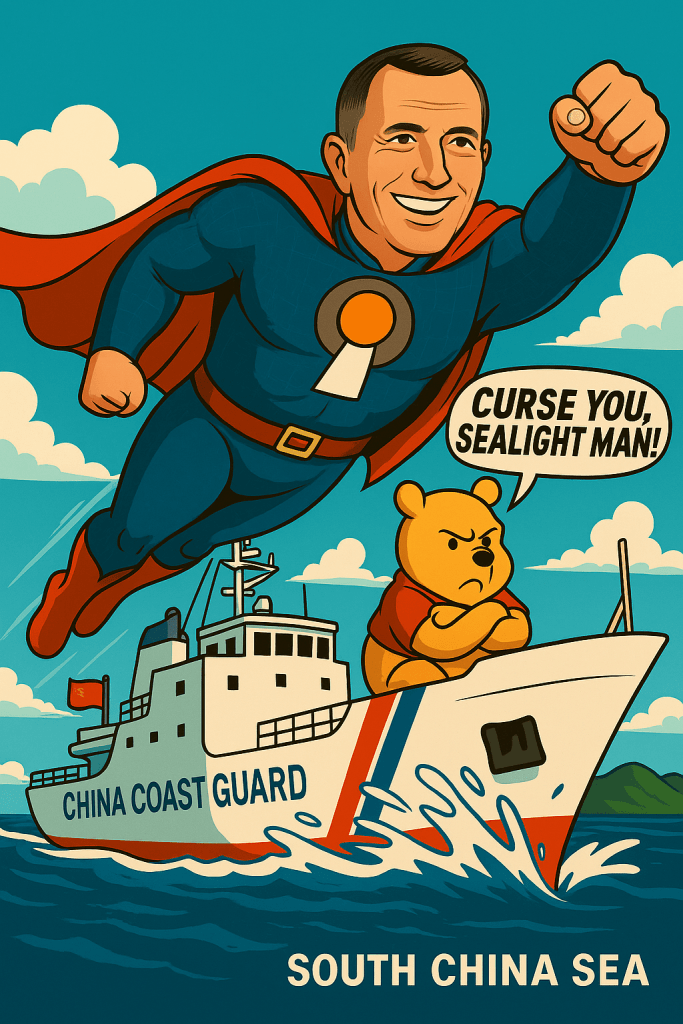
Imagine Being Ray Powell (CIA), Terrified of Peace, Diplomacy, and a Filipina +

Oh, look — Ray Powel, again, the CIA operative messing around the SCS dispute???

Apparently, I’m living rent-free in the head of a retired U.S. Air Force colonel turned “maritime gray-zone investigator” who thinks the Philippines, China, ASEAN, and the entire South China Sea revolve around his newly invented fantasy threat matrix. Let me make this absolutely clear:

Ray Powell mentioning me — twice now — is A BADGE OF HONOR!! Because if a CIA-adjacent operative (yes, Ray, we all know how “Air Force Attachés” function abroad), working hand-in-hand with Washington’s geopolitical machinery, has me on his radar, it only means one thing:

I’m saying something true enough, loud enough, and inconvenient enough to rattle him.

Imagine Being Ray Powell (CIA), Terrified of Peace, Diplomacy, and a Filipina

Related:

Read More »

10-31-2025: Denial-of-service attack on my WordPress

The view count increased by 100 in just one hour since I first received a notification from WordPress. The numbers just aren’t adding up, and my website is experiencing slow access issues. The last time this happened, it was due to a denial-of-service attack about a year ago when I was deeply involved in researching the Philippines’ ‘Assertive Transparency Initiative.’ It’s interesting how these issues have resurfaced now that I’ve returned to this topic. Unfortunately, I let my Netgear Armor security subscription lapse, so I didn’t receive any notifications this time.

Previous DDoS attacks:

Read More »

Capes, Cameras, and the Cult of Visibility

Capes, Cameras, and the Cult of Visibility: The SeaLight Crusade as White Savior Theater

By Tina Antonis

The South China Sea is more than a maritime dispute—it’s a theater of narrative warfare. While headlines focus on Chinese aggression and Philippine resistance, a quieter campaign unfolds in the background: one of satellite feeds, curated imagery, and Pentagon-backed storytelling. At the center of this effort is SeaLight, a project that claims to illuminate truth but often casts shadows of its own.

As explored in my article at Antiwar.com, SeaLight doesn’t just document—it performs. It reframes geopolitical tension through moral spectacle, positioning its creators as heroic arbiters of transparency. But when the messenger wears a cape and the funding flows from defense budgets, we must ask: is this clarity, or choreography?

Stage Left: The White Savior Enters

In the comic-strip cosmology of Ray Powell’s SeaLight project, transparency wears a cape. Clad in heroic postures and backed by satellite imagery, Powell casts himself as the guardian of maritime morality—unarmed, except with satellite feeds, theatrical flair, and strategic messaging. 

Yet beneath the cartoon and Pentagon-funded optics lies a familiar archetype: the white savior, rebranded for the South China Sea.

China Is Imperialist? Says Who?

Calling China a “maritime occupier,” Powell positions himself as a bulwark against aggression. But that moral pose collapses under scrutiny. He speaks for a country with over 800 foreign military installations and a documented history of over 250 military interventions since 1991—wars in Iraq, Afghanistan, Libya, Syria, Somalia, and dozens more, all under the banner of peace, freedom, or preemption.

By comparison, China’s post–Cold War footprint includes no sustained foreign occupations and only scattered border conflicts and peacekeeping missions. The imbalance is staggering. And Powell’s framing doesn’t just ignore it—it performs around it.

As David Vine argues in The United States of War, this vast base empire is not a passive network—it’s an architecture of perpetual war. These outposts make military engagement not an exception but a structural habit, cloaked in strategic necessity and sold as global stewardship.

Powell’s cartoon rhetoric—calling China an occupier—obscures the scale of U.S. militarism. The term “occupation” is deployed not to analyze, but to project. When adversaries hold territory, it’s a crisis; when the U.S. spans the globe with armed installations, it’s policy.

Framing Conflict: The Optics of Consent

This isn’t irony. It’s performance. Powell’s language manufactures a moral frame for confrontation—costumed in transparency, but driven by escalation. The cape is literal. The conditioning is deliberate. And the stage is set for war.

SeaLight’s mission is not just visual documentation—it’s narrative warfare. As the Japan Times openly notes, its “chief weapon is photography, applied purposefully, generously and consistently over time.” These images—enhanced, curated, and distributed across media—are not neutral. They’re constructed to shape public perception, sway international opinion, and ultimately manufacture consent for confrontation.

Assertive transparency becomes a kind of ideological scaffolding—a stage on which geopolitical tension is dramatized, simplified, and morally polarized. The goal isn’t simply to reveal conflict; it’s to condition audiences for escalation.

And when the messenger dons a superhero’s cape, the spectacle transforms into something deeper: a story of rescue, of virtue, of intervention. This is not analysis—it’s soft propaganda dressed in heroic metaphor.

Consent for war doesn’t begin with missiles. It begins with mythmaking.

Antique hosts symposium for youth on West Philippine Sea

“Philippine Coast Guard Commodore Jay Tarriela, spokesperson for the West Philippine Sea, and Assistant Secretary Karl Josef Legazpi, Commissioner-at-Large of the National Youth Commission during a press conference at the University of Antique on Thursday (April 3, 2025). Tarriela assured the protection of the Antique fisherfolk who venture into the West Philippine Sea for their livelihood.”| Annabel Consuelo J. Petinglay
Twitter

Antique hosts symposium for youth on West Philippine Sea

Meanwhile, Commodore Jay Tarriela, PCG spokesperson for the West Philippine Sea will take the lead during the symposium to discuss the topic “Philippines’ sovereign rights and maritime security in the West Philippine Sea.”

‎On the part of Assistant Secretary Karl Josel F. Legaspi, National Youth Commission, Commissioner at large, he will tackle the topic The role of the youths as West Philippine Sea advocate.”

In addition, PIA’s Government Information Center Coordinator Alex Lumaque will share guides on Media Information Literacy; Navigating the digital age with awareness and critical thinking.

Previously:

PH gov’t encourages youth participation in SCS campaign

China’s stealth destroyer lurks 124 miles off Sydney’s coast

A Chinese naval task force, consisting of the Type 055 guided-missile destroyer Type 055, a Type 054A frigate, and a Type 903A replenishment ship, has been spotted operating approximately 124 miles [200 kilometers] east of Sydney, Australia.

China’s stealth destroyer lurks 124 miles off Sydney’s coast

Previously:

Chinese Navy Helicopter Intercepts Philippine Cessna Over Scarborough Shoal + Embedded Journalism

The aerial incident follows a week of multilateral activities between the Philippines and its allies in the South China Sea. These drills included back-to-back joint patrols with American, Japanese, Australian and Canadian forces. A U.S. Air Force bomber task force mission composed of two B-1Bs and Philippine Air Force fighter jets drilled off Luzon earlier this month. The Royal Australian Air Force also reported an unsafe interception incident with a People’s Liberation Army Air Force J-16 fighter over the contested waters last week.

Chinese Navy Helicopter Intercepts Philippine Cessna Over Scarborough Shoal + Embedded Journalism

Chinese Navy Helicopter Intercepts Philippine Cessna Over Scarborough Shoal by Aaron-Matthew Lariosa

The People’s Liberation Army Navy Z-9 utility helicopter that intercepted the Philippine Cessna. Photo Courtesy of Camille Elemia.

A People’s Liberation Army Navy Z-9 utility helicopter intercepted the Bureau of Fisheries and Aquatic Resources Cessna 208B Grand Caravan during a routine patrol mission over Scarborough Shoal today at 8:39 a.m. local time, according to Philippine officials. A number of Philippine journalists [embedded journalists] were on board the Cessna during the encounter, which saw the Chinese helicopter fly as close as three meters from the turboprop aircraft. Philippine Coast Guard spokesperson Commodore Jay Tarriela described China’s actions as “dangerous flight maneuvers” and blasted the conduct as a disregard to international aviation regulations.

Read More »

More notes on the marriage of RAND and SeaLight

The Eighteenth Brumaire of Louis Bonaparte

Understanding and Countering China’s Maritime Gray Zone Operations | RAND

As noted, there appear to be real challenges working through the necessary technologies to support command messaging efforts from being able to acquire simple programs, such as Adobe [1], that can help improve image quality of released content to access to social media. It would seem prudent that an assessment of such issues should be conducted by the command with necessary remediation actions undertaken when the new commander comes into USINDOPACOM.

The Global Engagement Center (GEC) at the U.S. Department of State [2], for example, partially funds the Asia Maritime Transparency Initiative [Center for Strategic and International Studies]. The GEC, the State Department, or DoD should seek to identify other voices that can support and that can more credibly communicate key messages.

Read More »

The marriage of RAND and SeaLight

A Caricature of Marxism and Imperialist Economism: Monism And Dualism

Slowly, but surely, I’m going through both of the following RAND publications. I just recently noticed that “Understanding and Countering China’s Maritime Gray Zone Operations” was posted over at SeaLight on the 12th of December. Ray Powell, from SeaLight, is quoted at least 14 times in the first publication. So far, I’ve seen RAND “recommend” the same tactics as they’ve deployed in the Philippines; civilian society organizations, embedded journalism, information warfare, influencers, and online trolls.

USS Beloit (LCS-29). Photo by EJ Hersom.

I’ve always known that they would try to expand their information operation to the other countries that are in ASEAN, just by following the SeaLight podcast. If not their information operation, regime change and terrorism (in Balochistan and Myanmar). I’ve also noticed that Powell has been referring to the Philippines’ “transparency initiative” as “non-violent resistance,” lately (RAND refers to it as “assertive transparency”). Ironic, considering that they’ve already succeeded in overthrowing the government of Bangladesh and are now attempting it in Cambodia, India and Pakistan. For those who don’t know about the regime change asset Gene Sharp and his neoliberal “nonviolence,” see the links on this page. Unfortunately, I don’t have as much time to dedicate to this right now due to other obligations.

Understanding and Countering China’s Maritime Gray Zone Operations | RAND

How the United States Can Support Allied and Partner Efforts to Counter China in the Gray Zone: Affirmative Engagement | RAND

RAND and SeaLight document (work in progress)

PART 2

Part 3a: RAND and SeaLight – Taiwan Relations Act

RAND and SeaLight Part 3b: Four Ways China Is Growing Its Media Influence in Southeast Asia