
The marriage of RAND and SeaLight

A Caricature of Marxism and Imperialist Economism: Monism And Dualism

Slowly, but surely, I’m going through both of the following RAND publications. I just recently noticed that “Understanding and Countering China’s Maritime Gray Zone Operations” was posted over at SeaLight on the 12th of December. Ray Powell, from SeaLight, is quoted at least 14 times in the first publication. So far, I’ve seen RAND “recommend” the same tactics as they’ve deployed in the Philippines; civilian society organizations, embedded journalism, information warfare, influencers, and online trolls.
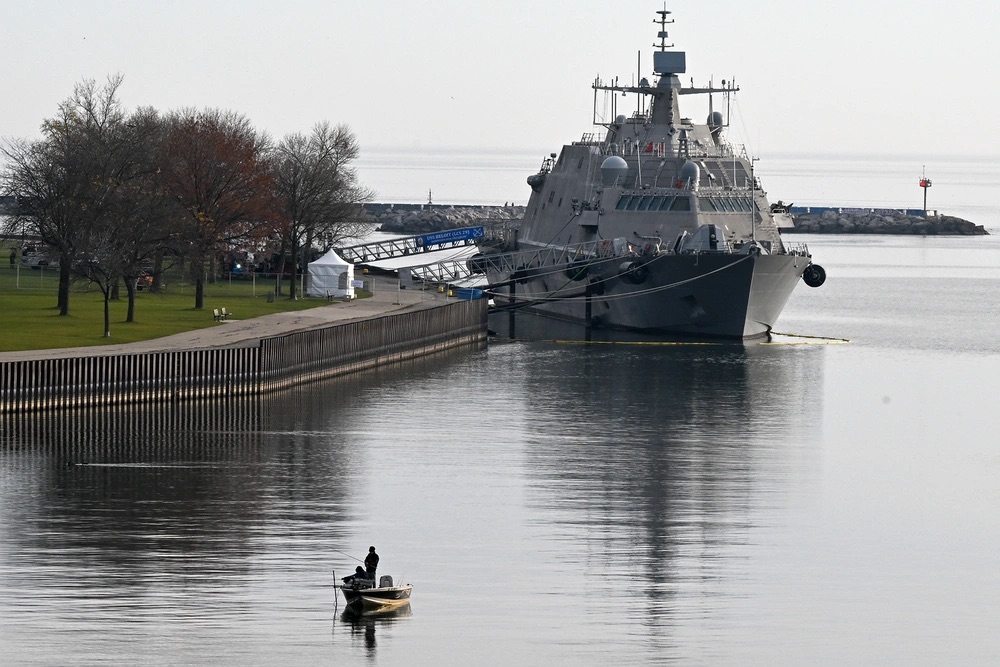
USS Beloit (LCS-29). Photo by EJ Hersom.

I’ve always known that they would try to expand their information operation to the other countries that are in ASEAN, just by following the SeaLight podcast. If not their information operation, regime change and terrorism (in Balochistan and Myanmar). I’ve also noticed that Powell has been referring to the Philippines’ “transparency initiative” as “non-violent resistance,” lately (RAND refers to it as “assertive transparency”). Ironic, considering that they’ve already succeeded in overthrowing the government of Bangladesh and are now attempting it in Cambodia, India and Pakistan. For those who don’t know about the regime change asset Gene Sharp and his neoliberal “nonviolence,” see the links on this page. Unfortunately, I don’t have as much time to dedicate to this right now due to other obligations.

Understanding and Countering China’s Maritime Gray Zone Operations | RAND

How the United States Can Support Allied and Partner Efforts to Counter China in the Gray Zone: Affirmative Engagement | RAND

RAND and SeaLight document (work in progress)

PART 2

Part 3a: RAND and SeaLight – Taiwan Relations Act

RAND and SeaLight Part 3b: Four Ways China Is Growing Its Media Influence in Southeast Asia

Marcos Says Philippines Won’t Send Warships After China Clashes

Philippine President Ferdinand Marcos Jr. said his nation won’t deploy Navy warships to the South China Sea in response to recent clashes with Beijing in disputed waters.

Marcos Says Philippines Won’t Send Warships After China Clashes

Previously:

Philippines to match China’s gray zone tactics in South China Sea

What’s Really Going On In the South China Sea Between the Philippines and China

What’s Really Going On In the South China Sea Between the Philippines and China

What’s Really Going On In the South China Sea Between the Philippines and China

by Tina Antonis

Maritime clashes between the Philippines and China had been mostly over the Philippines’ military outpost, BRP (BRP—Barko ng Republika ng Pilipinas, which translates to “Ship of the Republic of the Philippines”—the ship prefix for the Philippines) Sierra Madre, in the Spratly Islands, which is disputed by Brunei, China, Malaysia, the Philippines, Taiwan (a province of China, as recognized by the United Nations’ Resolution No. 2758), and Vietnam. The BRP Sierra Madre was intentionally run aground on a reef near the Second Thomas Shoal in the disputed Spratly Islands, in 1997, so that the Philippines could stake their territorial claim.

Read More »

Powell’s hit piece on “Media Unlocked”

Unlocking China’s “Media Unlocked” Propagandists

Recently, Media Unlocked unveiled its latest triumph–an interview with a former U.S. president’s brother, Neil Bush, whose George H.W. Bush Foundation For U.S.-China Relations has allegedly received millions of dollars from a group associated with CCP influence operations. Bush–apparently unconcerned that he was participating in Beijing’s propaganda campaign–helpfully sang the praise of China’s communist system, its electric vehicle industry and, incredibly, even announced that he was observing a “massive freedom movement” in today’s China.

Propagandists? Und das bist du nicht?

Now, let’s get into who’s funding the George H.W. Bush Foundation For U.S.-China Relations. Powell links to a Fox News article about its funding from the China–United States Exchange Foundation, based in Hong Kong. The Fox News article links to an Axios article (which is behind a paywall). Nowhere does Powell mention that the foundation also gets funding from the U.S. Department of State, The Rockefeller Foundation, etc.

Read More »

Less politics more marine diplomacy – a fix for South China Sea?

Territorial wrangling over who owns the South China Sea has strangled local marine life, say scientists, urging China and the Philippines to set aside political differences and work to save the fish, coral and plants that live border-free.

Since 2013, China has built artificial islands that cover more than 3,000 acres of the Spratlys, according to U.S.-based policy organisation Asia Maritime Transparency Initiative.

A study last December by the Asia Maritime Transparency Initiative also blamed China’s dredging and clam harvesting for destroying almost 20,000 acres of reefs in the South China Sea.

Less politics more marine diplomacy – a fix for South China Sea?

The Asia Maritime Transparency Initiative (AMTI) is part of the Center for Strategic and International Studies (CSIS). Gregory Poling is director of the AMTI. The same Poling that told the U.S. government-funded Voice of America that “Vietnam’s use of cutter suction dredgers is much more environmentally destructive than its previous dredging methods.

According to the CIA’s World Factbook, Vietnam occupies around 50 outposts, The Philippines occupies nine, Malaysia occupies five, and China occupies seven in the disputed Spratly Islands.

Previously:

China unveils evidences showing Philippine grounded warship at Ren’ai Jiao destroys coral reefs, endangers marine organism

Experts warn of Philippines scheming for ‘new arbitration’ on South China Sea + More

Vietnamese Poachers using Cyanide and Dynamite Fishing in the Philippines’ EEZ

Philippine Coast Guard clarifies ‘assertive transparency’ tact

PH: Replacement ship for Sabina Shoal now on patrol — Security Council

MANILA, Philippines — The spokesperson of the country’s security council said a replacement vessel is now actively patrolling Sabina (Escoda) Shoal, the latest flashpoint of Chinese aggression in the West Philippine Sea.

Replacement ship for Sabina Shoal now on patrol — Security Council

Related:

Collin Koh:

Collin Koh is Senior Fellow at the Institute of Defence and Strategic Studies which is a constituent unit of the S. Rajaratnam School of International Studies, based in Nanyang Technological University, Singapore. He has research interests on naval affairs in the Indo-Pacific, focusing on Southeast Asia.

PH gov’t encourages youth participation in SCS campaign

Surprisingly, I didn’t see Powell there. /s

Source

PH gov’t encourages youth participation in WPS sovereignty campaign (Translation by Google Translate)

The Philippine government anchors transparency* efforts in its vision to make the West Philippine Sea (WPS) an “intergenerational concern.”

Commodore Jay Tristan Tarriela of the National Task Force for the West Philippine Sea (NTF-WPS) said that the main objective of the government’s efforts is to ensure that the fight for the WPS will be continued by future generations.

Tarriela joined the third episode of the PN Conversations organized by Palawan News on September 13.

“The national government’s responsibility now for the younger generation is for us to hold the line so that the next generation of Filipinos can still be able to fight for our rights in the West Philippine Sea,” he said.

The transparency effort implemented under the administration of President Ferdinand Marcos, Jr., is part of the government’s obligation to provide the right information to Filipinos, he added.

Tarriela believes that the right information will also awaken Filipinos’ sense of patriotism, particularly among the youth.

The government’s transparency could also raise awareness among the international community about the situation in the WPS.

The limited information given during the previous administration under former president Rodrigo Duterte made it easy for China to spread disinformation, Tarriela said. In contrast, the current administration supported the concept of having “many voices with one message.”

“We recognize that our fight in the West Philippine Sea cannot be met by us alone,” he said.

National Youth Commission (NYC) Commissioner-at-Large Karl Josef Legazpi, a Palaweño himself, shares the view on the need to emphasize that the future of younger generations is at stake in the fight for sovereignty.

“But the waters that belong to us are gradually being taken from us—we want to convey to you what is happening. Our future is at stake,” he said.

NTF-WPS is actively working with various partner agencies, including the state information arm, Philippine Information Agency** (PIA). Director General Jose Torres, Jr.***, also joined Tarriela in the forum, believing in the role of the youth in the fight over the WPS.

Torres emphasized that the youth’s use of technology plays a significant role in fighting misinformation and disinformation about WPS.

“The young people play a great role and challenge when it comes to the West Philippine Sea. As young people, we need to stand up for our country and truth,” he said.

The PN Conversations is a Palawan News initiative that provides a platform for in-depth discussions on pressing issues faced by the community, such as WPS.

Notes on page 2: