
While one side of the split personality of PBBM worked out with China a deesclation scheme for the Ayungin Shoal Rotation and Resupply (RORE) missions to the unrealizable U.S. Forward Operating Base (US-FOB) BRP Sierra Madre frustrating its “assertive transparency” strategy, the other lobotomized side of BBM’s brain taken over by the Americans thought up the Sabina Shoal BRP Sierra Teresa Magbanua US-FOB as a new locus for tension to propagandize.
Sabina shoal new US tension spot
Tag: Assertive transparency
Germany, Philippines agree to broaden defence cooperation deal + Vietnam Sends Coast Guard Ship To Philippines For Joint Training
Pistorius is the first German defence minister to visit the Philippines and hopes to finalise the agreement as early as October
Germany, Philippines agree to broaden defence cooperation deal
Related:
Vietnam Sends Coast Guard Ship To Philippines For Joint Training
Philippine and Japan navies held their first bilateral drills in the contested waters, the Southeast Asian nation’s military said in a statement Friday.
YouTube: NATO’s NEW VICTIM: Missiles Deployed, $500M Aid, New US Proxy & Military Buildup|Dr. A.Malingdog-Uy
US Missile Deployment And $500M Military Aid To PH: Defensive Or Offensive Posturing?
US Missile Deployment And $500M Military Aid To PH: Defensive Or Offensive Posturing?
LAST July 30, US Secretary of State Antony Blinken and Defense Secretary Lloyd Austin III dropped by Manila for the Philippines-US 2+2 ministerial dialogue, the fourth such talks since it began in 2012. This is unprecedented because it’s the first time that talks have been held in Manila. Indeed, the PH-US 2+2 dialogue has set the stage for continued and expanded military cooperation, reflecting a strengthened military and defense alliance between the two sides. Before visiting Manila, the two US officials also held talks in Tokyo with their counterpart top Japanese defense and diplomatic officials on July 28 to bolster military and defense cooperation.
US Missile Deployment And $500M Military Aid To PH: Defensive Or Offensive Posturing?
Related:
US missile system may stay in PH after military drill – Army
THE Philippine Army yesterday said a medium-range missile system [Typhon] of United States military may remain in the country beyond September this year, depending on the training needs of Filipino troops.
China-Philippines ties may improve, as long as US stops interfering
NO to US-BBM War, NO to EDCA Bases! Blinken-Austin Get Out, Stay Out!
The Philippines and China have just restored peace and stability in the areas of the South China Sea contested by the two countries in a July 21, 2024 “de-escalation” deal that aimed at “easing tensions.”
NO to US-BBM War, NO to EDCA Bases!
Blinken-Austin Get Out, Stay Out!
Related:
NO to US-BBM War, NO to EDCA Bases! – Cebu
NO to US-BBM War, NO to EDCA Bases! Blinken-Austin Get Out, Stay Out! Forum Statement
Washington’s Use and Abuse of the Philippines Takes Next Step
Biggest-ever egg Arbitration Award laid
To “lay an egg” means “to be completely unsuccessful; badly fail” and I am using this to refer to the 2016 Hague ruling on the South China Sea case filed by then Noynoy Aquino government against China’s claims.
Biggest-ever egg Arbitration Award laid
China unveils evidences showing Philippine grounded warship at Ren’ai Jiao destroys coral reefs, endangers marine organism
While Manila mulls over filing a case against China with so-called “solid evidence of the damaged coral reefs caused by Chinese actions,” China, on Monday, released a report based on an unprecedentedly extensive and detailed on-site ecosystem survey around Ren’ai Jiao (also known as Ren’ai Reef), with solid evidence showing that the grounded warship has caused damage to the coral reefs and environmental pollution in the South China Sea.
Related:
Experts warn of Philippines scheming for ‘new arbitration’ on South China Sea + More
Philippines rejects China’s accusation of environmental damage in South China Sea
China has in turn dredged sand and coral to build artificial islands in the South China Sea, which it says is normal construction activity on its territory, but which other nations say is aimed at enforcing its claim to the waterway.
A report by the Center for Strategic and International Studies last year found China’s construction activity buried more than 4,600 acres (1,861 acres) of reef.
China claims almost all of the vital waterway, where $3 trillion worth of trade passes annually, including parts claimed by the Philippines, Brunei, Malaysia, Taiwan and Vietnam.
Greg Poling, from the front CSIS, claims that Vietnam is also building artificial islands.
A ‘myriad’ of front organizations had “Media Unlocked” banned from TikTok
China Daily’s ‘Media Unlocked’ TikTok account banned
Media Unlocked’s accounts on Facebook, YouTube, and X, which are not flagged as government media outfits, are still up, however. Felipe F. Salvosa II
IN-DEPTH: AI bolsters China state media’s TikTok offensive to influence narrative on sea dispute
Seeking credibility, China Daily’s ‘Media Unlocked’ TikTok passes off opinion as news
CNN:
Erin Burnett OutFront May 23, 2024 1PM Transcript
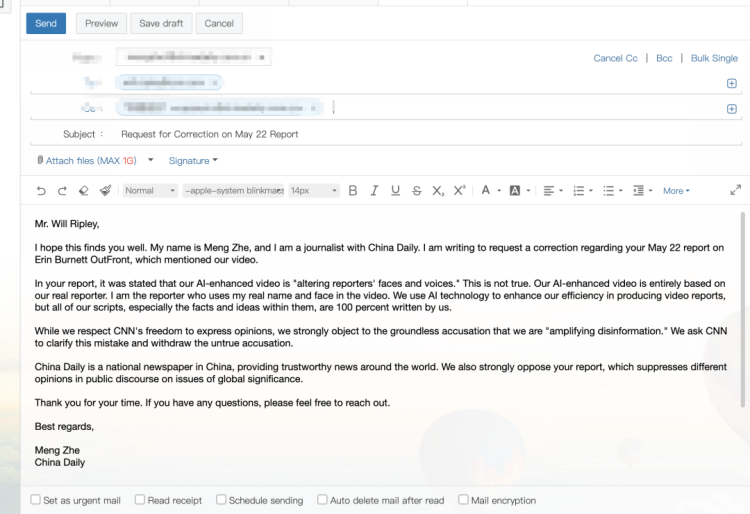
“RIPLEY (voice-over): Chinese state media is using A.I.-enhanced videos on TikTok, altering the reporter’s voice and face. A disclosure on screen for just a few seconds, easy to miss.
[01:39:52]
UNIDENTIFIED FEMALE: Under China’s jurisdiction.
RIPLEY: The video is pushing Beijing’s narrative on the South China Sea.
Is this a threat to democracy?
FELIPE SALVOSA II, JOURNALISM PROFESSOR, UNIVERSITY OF SANTO TOMAS: Most definitely. I think China has found a more cost-effective way to get its message across.
RIPLEY: Turning today’s digital landscape into a battleground for truth, where seeing is no longer believing.
Every time I do a story about these deepfake videos, what strikes me is the quality keeps improving. Our researcher (INAUDIBLE) spent hours putting these through algorithms to determine with 99 percent accuracy whether these videos are real, whether they’re fake, whether the voice has been altered, the face has been altered. Who on social media has time for that and a lot of people don’t take the time which experts say is dangerous, particularly in democracies when people are watching these videos and then potentially using the information they hear to make decisions about how to vote.
Experts warn of Philippines scheming for ‘new arbitration’ on South China Sea + More
While reiterating that the arbitral tribunal in the South China Sea arbitration exceeded its jurisdiction and made an illegitimate ruling, Chinese experts warned on Monday that the Philippines is scheming for “new arbitration” on the issue, which would undermine regional peace and stability.
Experts warn of Philippines scheming for ‘new arbitration’ on South China Sea
Related:
Philippines should use legal, moral leverage in West Philippine Sea – expert
Ray Powell, director of the SeaLight Gordian Knot Center for National Security Innovation at Stanford University, said China is using an “asymmetrical” strategy through military might in asserting its claims in the region.
…
He also expressed support for the Philippine government’s plan to file another case against China, this time over the environmental destruction that China has caused in the West Philippine Sea.
PH to complete environmental case vs. China in ‘few weeks’- DOJ
Foreign Ministry Spokesperson Wang Wenbin’s Regular Press Conference on May 20, 2024
The Office of Naval Research funded Stanford’s GKC
I’m no expert, but I had a feeling that they would back in April, at least:
Philippine Coast Guard clarifies ‘assertive transparency’ tact
Vietnamese Poachers using Cyanide and Dynamite Fishing in the Philippines’ EEZ
Philippine Coast Guard clarifies ‘assertive transparency’ tact
[2021] Littoral Combat Ships for Maritime COIN
The LCS has just what the Navy needs to defend freedom of the seas in the first island chain.
Littoral Combat Ships for Maritime COIN
Previously:
Littoral Combat Ship Still Fighting to Prove Its Worth
Bringing Vietnamese Counterinsurgency To The Philippines And South China Sea (Part I) – Analysis
 Ms. Cat’s Chronicles
You must be logged in to post a comment.