A Narrow Pacific Waterway is at the Heart of U.S. Plans to Choke China’s Vast Navy +

Reuters reprint: A Narrow Pacific Waterway is at the Heart of U.S. Plans to Choke China’s Vast Navy

Until recently, locals say, this smallest and least populous province of the Philippines was a peaceful backwater. But geography dictates that it is now on the frontline of the great power competition between the United States and China for dominance in the Asia-Pacific region. The islands sit on the southern edge of the Bashi Channel, a major shipping lane between the Philippines and Taiwan that connects the South China Sea with the Western Pacific.

This year’s exercises revealed how the U.S. and its Philippine ally intend to use ground-based anti-ship missiles as part of efforts to deny the Chinese navy access to the Western Pacific by making this waterway impassable in a conflict, Reuters reporting shows. These missiles could also be used to attack a Chinese fleet attempting to invade Taiwan or mount a blockade against the democratically governed island.

Recent Chinese maneuvers show how access to the Bashi Channel is critical for Beijing’s plans in the Pacific. In June, a powerful Chinese navy aircraft carrier battle group used this passage to enter the Western Pacific before launching an extended series of exercises south of Japan, according to Japanese military tracking data.

Related:

Read More »
For Want of an Oiler: The Fragile State of America’s Afloat Logistics Fleet

What’s Going On With Shipping?

Salvatore R. Mercogliano, Ph.D. – 

The Navy oiler – a tanker designed to refuel other ships while at sea – shuddered from the hit. Almost immediately, water began to flood into the engine room and at least one of the ship’s rudders was out of service. The damage and flow of water proved challenging for the crew. As the only US Navy fuel ship in the area capable of supporting a carrier strike group came to a stop, the vulnerability of the thin lifeline of American afloat logistics became apparent. How would an entire carrier strike group remain operational without fuel for its planes and escorts? With one stroke, the hitting power of a substantial portion of the U.S. Navy was reduced.

For Want of an Oiler: The Fragile State of America’s Afloat Logistics Fleet

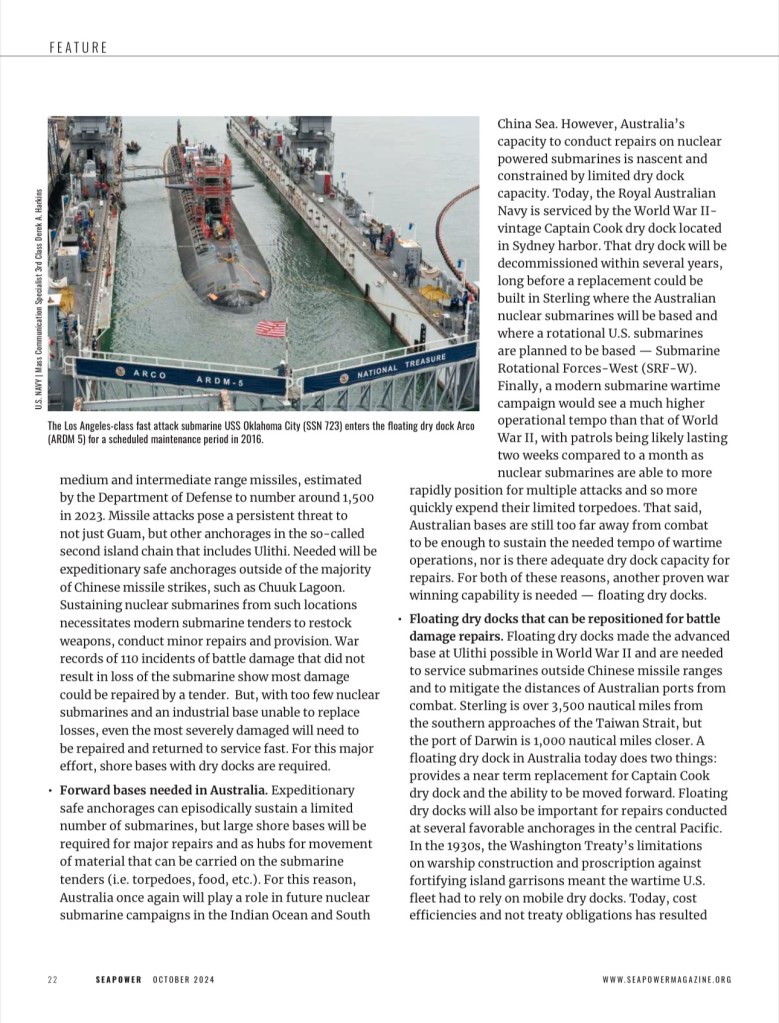
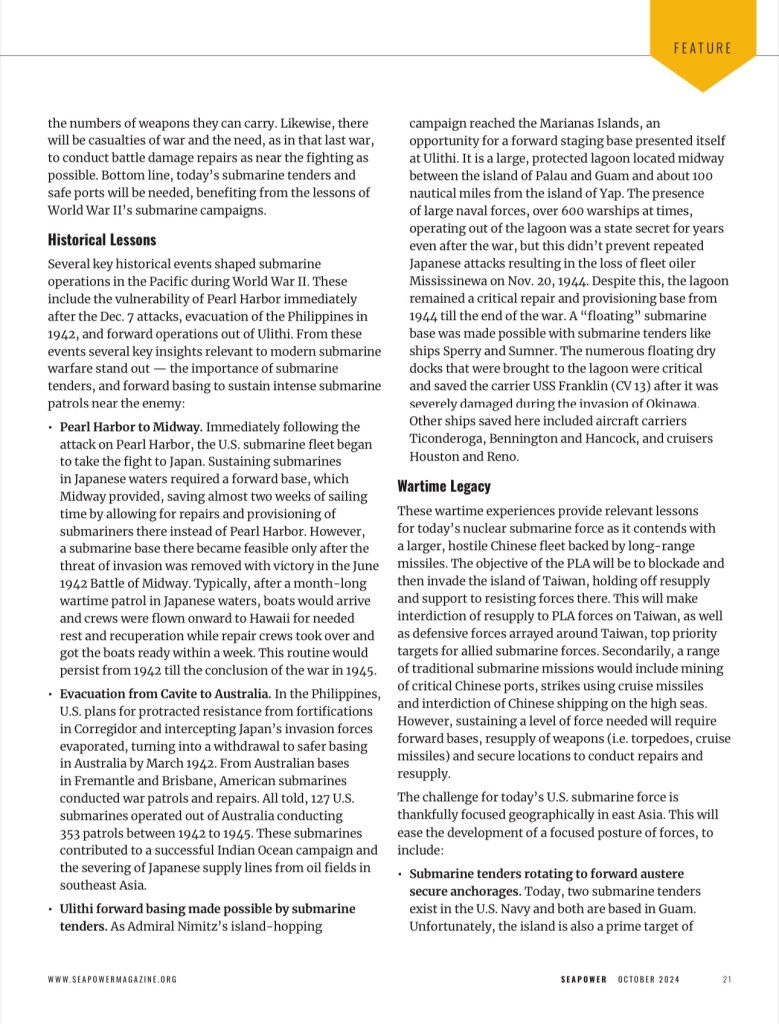
Looking Back, Looking Ahead: World War II Provides Lessons for Pacific Submarine Posture

Previously:

South China Sea: Maritime Counterinsurgency:

Brent Sadler is with the Heritage Foundation:

Its initial funding was provided by Joseph Coors, of the Coors beer empire, and Richard Mellon Scaife, heir of the Mellon industrial and banking fortune. Its founders include Paul Weyrich and Mickey Edwards. The Foundation maintains strong ties with the London Institute of Economic Affairs and the Mont Pelerin Society.SourceWatch

Richard Mellon Scaife (Mellon family), Committee on the Present Danger/MembersScaife Foundations (WikiSpooks), Atlas NetworkKock Network, State Policy Network, ALEC, Council for National Policy

MacArthur’s Last Stand Against a Winless War

If war breaks out in Asia, the U.S. won’t send ground troops. Take note, Philippines!

The Strategy of Denial, pp 117-118

MacArthur’s Last Stand Against a Winless War

Never get involved in a land war in Asia, MacArthur had told Kennedy, because if you do, you will be repeating the same mistake the Japanese made in World War II—deploying millions of soldiers in a futile attempt to win a conflict that cannot be won.

Kennedy appreciated MacArthur’s soothing judgment on Cuba (and would soon change the military’s top leadership—perhaps in keeping with MacArthur’s views), but then shifted the subject to Laos and Vietnam, where communist insurgencies were gaining strength. The Congress, he added, was pressuring him to deploy U.S. troops in response. MacArthur disagreed vehemently: “Anyone wanting to commit ground troops to Asia should have his head examined,” he said. That same day, Kennedy memorialized what MacArthur told him: “MacArthur believes it would be a mistake to fight in Laos,” he wrote in a memorandum of the meeting, adding, “He thinks our line should be Japan, Formosa, and the Philippines.” MacArthur’s warning about fighting in Asia impressed Kennedy, who repeated it in the months ahead and especially whenever military leaders urged him to take action. “Well now,” the young president would say in his lilting New England twang, “you gentlemen, you go back and convince General MacArthur, then I’ll be convinced.” So it is that MacArthur’s warning (which has come down to us as “never get involved in a land war in Asia”), entered American lore as a kind of Nicene Creed of military wisdom—unquestioned, repeated, fundamental.  

Full video

Elon Musk says Joe Biden and the US government are the ones to blame for the Crimea Starlink debacle, not him

Elon Musk has been scrambling to defend his decision to block Ukraine’s access to Starlink in 2022 near Crimea — and his latest explanation involves blaming the US government.

Elon Musk says Joe Biden and the US government are the ones to blame for the Crimea Starlink debacle, not him

Previously:

Musk Comes Under Fire for Preventing Ukraine Attack on Russia

Secret Intelligence Leaks vs. Basic Common Sense

Historical Examples

During 1940 the determined efforts of President Franklin Roosevelt to involve America in the war against Hitler’s Germany were blocked by the overwhelming opposition of the American people, running at 80% according to some polls. A group of young Yale Law School peace activists had launched the America First Committee and it quickly attracted 800,000 members, becoming the largest grassroots political organization in our national history. The leadership of the AFC included many of our most prominent business and journalistic figures, and famed aviator Charles Lindbergh, one of our greatest national heroes, served as its top spokesman.

Secret Intelligence Leaks vs. Basic Common Sense

Related:

Read More »

Americans must unite to reject 21st Century ‘alien land laws’

Americans must unite to reject 21st Century ‘alien land laws’

Now, taking a page from DeSantis, Congress is considering inserting an amendment into the National Defense Authorization Act that would ban visa holders from targeted countries from making certain agricultural purchases. These restrictions would apply to all 50 states, and be based solely on national heritage. This is wrong and legislators must reject it.

Related:

Chinese Exclusion Act (1882)

Banning foreign ownership of land doesn’t protect US. It just scapegoats Asian Americans.