
Mike Gallagher says that the Pentagon Has Two Years to Prevent World War III

Source

Pentagon Has Two Years to Prevent World War III

By China Hawk Mike Gallagher, Palantir

Xi Jinping has ordered the People’s Liberation Army to be ready to seize Taiwan by 2027. Whether he launches an invasion may depend on President Trump’s defense secretary. If confirmed by the Senate, Army National Guard veteran and Fox News host Pete Hegseth, Mr. Trump’s nominee, will have to confront the collapse of deterrence in Europe and the Middle East, resource constraints on Capitol Hill, recruitment challenges, and a deteriorating balance of power in the Indo-Pacific. The only way to promote peace is to go to war on day one—not with China, Russia or Iran but with the Pentagon bureaucracy.

Gallagher wants a wartime economy while leaving the financing to the private sector. It won’t work. 👇👇👇

Related:

US Seeks “Super Weapons” to Reign as Sole Superpower

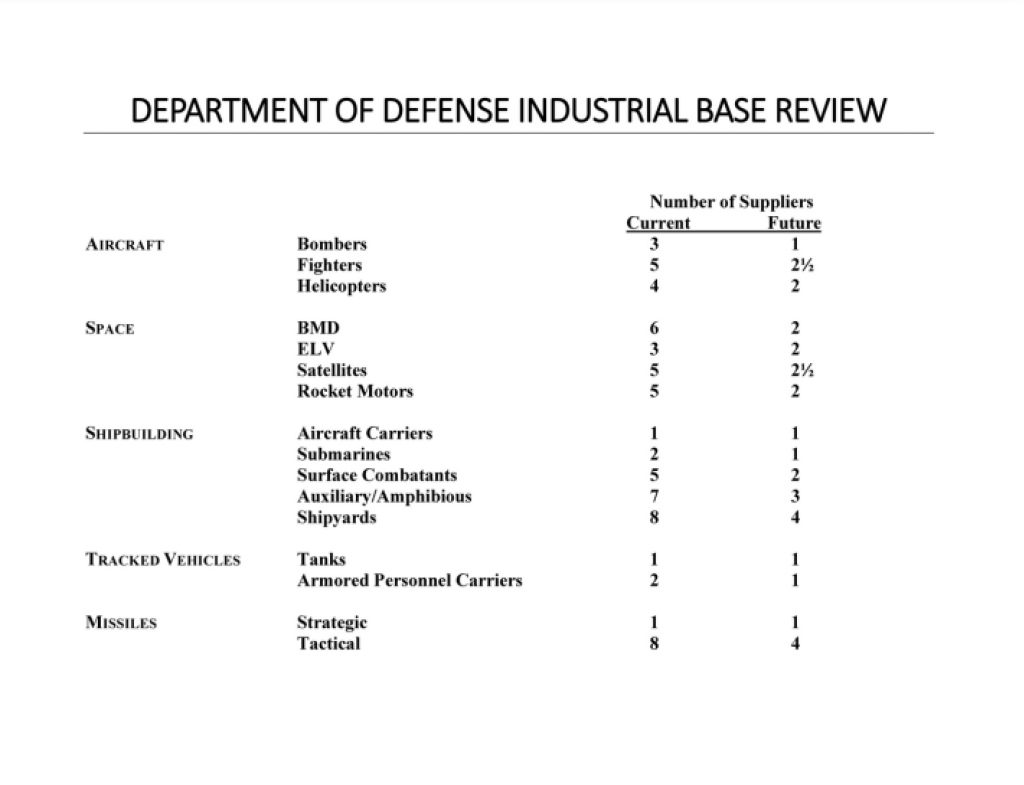
In reality, Russia and China’s industrial bases are larger than America’s because of a number of factors, including factors no amount of American political will, can overcome. China in particular has a population four times greater than the US. China graduates millions more each year in the fields of science, technology, engineering, and mathematics than the US, and the physical size of its industrial base – military or otherwise – reflects this demographic disparity.

Even if the US had the political will to reform its military industrial base, stripping away profit-driven private industry and replacing it with purpose-driven state-owned enterprises, even if the US likewise transformed its education system to produce a skilled workforce rather than squeeze every penny from American students, and even if the US invested in its national infrastructure – a fundamental prerequisite for expanding its industrial base – it still faces a reality where China has already done all of this, and done so with a population larger than it and its G7 partners combined.

FYI, Gallagher is with Palantir, as well as the Hudson Institute.

Hudson Institute’s funding
SECNAV Del Toro Meets with Wisconsin Governor, Michigan Cabinet, and Leadership of Fincantieri Marinette Marine

April 17, 2024

Secretary of the Navy Carlos Del Toro and senior members of his staff met with Wisconsin Governor Tony Evers, members of Michigan Governor Gretchen Whitmer’s cabinet, and the leadership of Fincantieri Marinette Marine to coalesce federal, state, and local initiatives to ensure timely completion and delivery of the Constellation-class frigate.

SECNAV Del Toro Meets with Wisconsin Governor, Michigan Cabinet, and Leadership of Fincantieri Marinette Marine

Previously:

Constellation Frigate Delivery Delayed 3 Years, Says Navy

‘Desperate’ US Seeks Japan’s & South Korea’s Help To Restart Its Defunct Shipyards; Keep Pace With China

Baltimore Bridge Fallout to Extend Coast-to-Coast in Cargo Shift

The bridge collapse Tuesday that shut the Port of Baltimore and closed a major highway will cause weeks or months of transportation disruptions in the Mid-Atlantic region and accelerate a shift of cargo to the US West Coast as importers and exporters try to avoid potential bottlenecks at trade gateways from Boston to Miami.

Baltimore Bridge Fallout to Extend Coast-to-Coast in Cargo Shift

‘Desperate’ US Seeks Japan’s & South Korea’s Help To Restart Its Defunct Shipyards; Keep Pace With China

Desperate’ US Seeks Japan’s & South Korea’s Help To Restart Its Defunct Shipyards; Keep Pace With China

The US approach focuses on tapping Asian funding, engineering know-how, and shipbuilding experience to expand its shipbuilding capacity, Nikkeia Asia reported.

Emanuel said, “There’s a closed plant in Philadelphia. There’s a closed Navy shipyard in Long Beach. And there are a couple of others…We wanted to see if Mitsubishi and other Japanese companies would be interested in potentially investing and reopening one of those shipyards and being part of building Navy, commercial, and Coast Guard ships.”

Emanuel had also hinted in January this year that for US Navy warships to remain in Asian waters and be prepared for any future confrontation, the United States and Japan are attempting to reach an agreement enabling Japanese shipyards to do routine maintenance and overhauls.

Over the past 40 years, China has developed a remarkable commercial shipbuilding industry, cautioned Del Toro at an event. “We’ve lost that capability from about the 1980s when we left it open to market forces.”

The US has seen a very significant dip in its shipbuilding capacity. Nine of the 13 public naval shipyards the United States formerly had are closed. Several closed shipyards are now national parks, naval air stations, or container terminals. However, a few could be brought back for ship repair or construction.

The urgency to resuscitate these redundant shipyards stems from the threat posed by China’s massive shipbuilding industry, producing many naval vessels that could be used to project dominance in far seas and deployed against the US and its Indo-Pacific allies in the event of a conflict.

According to the latest Pentagon’s annual report to Congress on Chinese military and security developments, the Chinese Navy possesses an estimated 350 vessels, while the US Navy battle force has 293 warships.

The yawning gap of 60 hulls between the two navies is expected to grow every five years until 2035, when China will have an estimated 475 naval ships compared to 305-317 US warships. Notably, China has inducted as many as 150 warships in the last ten years.

H/T: Johnsonwkchoi

Related:

U.S. seeks to revive idled shipyards with help of Japan, South Korea – Nikkei Asia

But while quick repairs on damages suffered through deployment are allowed, like the Big Horn at Mitsubishi, U.S. law prohibits U.S.-based ships to undergo full-scale overhaul, repair or maintenance at a shipyard outside the U.S. or Guam. Changing such a law — put in place to protect U.S. jobs — may face headwinds, especially in an election year.

Both tours were led by the companies’ respective CEOs. The shipbuilders expressed “strong interest” in establishing U.S. subsidiaries and investing in shipyards in the U.S., the Navy said in a press release.

U.S. Navy ships are currently built by seven private shipbuilders, including two non-American players: Italy’s Fincantieri Marinette Marine in Wisconsin and Australia’s Austal USA in Alabama. The involvement of two international shipbuilders serves as a precedent as the Asian players contemplate entry.

Maintenance of the most sensitive nuclear-powered aircraft carriers and submarines are conducted exclusively at four public naval shipyards — in Virginia, Maine, Washington and Hawaii.

Emanuel said that when he started working for former President Bill Clinton in the early 1990s, there were 10 to 11 shipyards that built naval ships. “We’re down to seven and our work is growing. You’re not going to get the same volume out of seven that you got out of 11. You need to get back to 11 or 10.”

China’s neighbors are buying US weapons Washington isn’t delivering

China’s neighbors are buying US weapons Washington isn’t delivering

Even though the United States views these weapons sales as integral to deterring China from attacking Taiwan, some of the deals were publicly announced as far back as 2017.

The reasons – government delays, supply chain issues and production requirements – are numerous, and the problem won’t be easy to fix, Rep. Mike McCaul, R-Texas, the ranking member on the House Foreign Affairs Committee, told Defense News.

The U.S. government has approved the sale of 10 weapons systems Taiwan has yet to receive – some of which are not slated for delivery until the end of the decade.

The United States has flooded billions of dollars in weapons into Ukraine, including items that are part of Taiwan’s backlog, such as Harpoon anti-ship missiles, Stinger anti-aircraft missiles and High Mobile Artillery Rocket Systems.

For example, several Middle Eastern and eastern European countries are ahead of Taiwan in Lockheed Martin’s F-16 production queue. In 2019, the State Department approved an $8 billion Taiwan sale for 66 F-16s, but Taipei does not expect to receive the aircraft until 2026.

Saudi Arabia is still ahead of Taiwan on the priority list in some cases,” Rep. Mike Gallagher, R-Wis., told Defense News ahead of a July meeting with Taiwan’s Washington envoy. “We need to take a look at that.”