A Narrow Pacific Waterway is at the Heart of U.S. Plans to Choke China’s Vast Navy +

Reuters reprint: A Narrow Pacific Waterway is at the Heart of U.S. Plans to Choke China’s Vast Navy

Until recently, locals say, this smallest and least populous province of the Philippines was a peaceful backwater. But geography dictates that it is now on the frontline of the great power competition between the United States and China for dominance in the Asia-Pacific region. The islands sit on the southern edge of the Bashi Channel, a major shipping lane between the Philippines and Taiwan that connects the South China Sea with the Western Pacific.

This year’s exercises revealed how the U.S. and its Philippine ally intend to use ground-based anti-ship missiles as part of efforts to deny the Chinese navy access to the Western Pacific by making this waterway impassable in a conflict, Reuters reporting shows. These missiles could also be used to attack a Chinese fleet attempting to invade Taiwan or mount a blockade against the democratically governed island.

Recent Chinese maneuvers show how access to the Bashi Channel is critical for Beijing’s plans in the Pacific. In June, a powerful Chinese navy aircraft carrier battle group used this passage to enter the Western Pacific before launching an extended series of exercises south of Japan, according to Japanese military tracking data.

Related:

Read More »
Philippines to receive 20 F-16 Block 70/72 fighter jets from the US as confrontations with China grow.

Philippines to receive 20 F-16 Block 70/72 fighter jets from the US as confrontations with China grow.

The timing of this approval is significant as the Philippines has been engaged in a series of escalating maritime confrontations with China over disputed territories in the South China Sea. U.S. officials, including Secretary of State Marco Rubio and Defense Secretary Pete Hegseth, have increasingly voiced support for Manila in countering Chinese maritime expansion. During his recent visit, Hegseth committed to “reestablish deterrence in the Indo-Pacific region,” calling attention to China’s growing assertiveness. Additionally, Philippine military leadership, including General Romeo Brawner, has publicly stated that a conflict in Taiwan would inevitably involve the Philippines, urging preparations for possible hostilities. Preparations for such scenarios have reportedly influenced the planning of joint U.S.-Philippine exercises, such as the annual “Balikatan” drills. These developments add urgency to the Philippine modernization program, of which the F-16 acquisition is a cornerstone.

Read More »

Hegseth visits Manila: Washington prepares for war with China + More

Hegseth visits Manila: Washington prepares for war with China

The language of Hegseth’s press conference in Manila is indicative of the openly aggressive face of US imperialism under Trump. Gone was any reference to what had been the political shibboleth of Washington in the Asia Pacific region: the defense of “freedom of navigation.” Hegseth spoke rather of “preparing for war,” using the phrase more than once. Every time Hegseth mentioned China he termed it “Communist China,” and spoke of its “aggression.” Hegseth referred to US Seventh fleet commander Admiral Samuel Paparo “and his war plans. Real war plans.”

Read More »

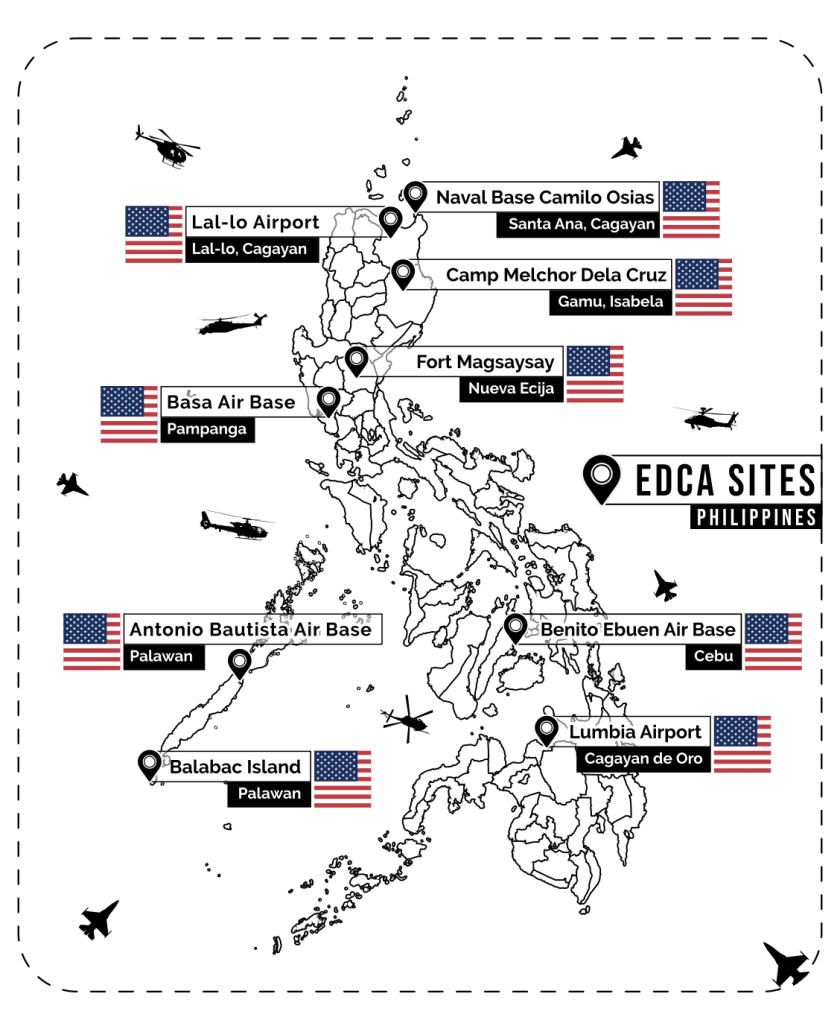
(Primer) A Decade of EDCA: US military bases and its expanding war games in the Philippines

The outright re-establishment of US military bases in the country and its relentless and escalating war games on land, sea, and air are flagrant manifestations of US imperialist domination of the Philippines. This further tightens the grip of US imperialism on the Philippine neocolonial state, especially on the puppet Armed Forces of the Philippines (AFP).

(Primer) A Decade of EDCA: US military bases and its expanding war games in the Philippines

South China Sea: US troop aid may reassure Philippines but will prod China, analysts say

Has anyone realized that by disclosing the existence of “US Task Force Ayungin,” Biden admin implicitly recognized Philippines’ sovereignty over a disputed SCS feature?

Washington has never taken a position on SCS territories(but it has in ECS). This is a clear signal to China.*

Derek J. Grossman, RAND

South China Sea: US troop aid may reassure Philippines but will prod China, analysts say (archived)

The Philippines has said the US task force only offered support – in the form of intelligence and surveillance – and did not directly take part in its resupply missions to BRP Sierra Madre, the retired warship, but analysts suggested that China’s leadership could see it in a different light.

Zheng said the revelation about the American task force meant the US was likely to be more engaged in the drawn-out maritime conflicts in the region, even suggesting that Washington would “be the first to take part in the command and planning of Philippine maritime activities”.

Ding Duo, deputy director of the Centre for Oceans Law and Policy at the National Institute for South China Sea Studies in Hainan, said the presence of a special task force showed that Washington and Manila had long cooperated on resupply operations to Second Thomas Shoal.

“Such support emboldens the Philippines and is not conducive to China and the Philippines managing their differences,” Ding said. “The US involvement has also squeezed the political space for internal coordination and decision-making within the Philippines.”

He said it was also possible that American troops could be on Philippine ships and involved in front-line action “using a covert or concealed identity to participate in Philippine maritime operations” in future.

He said the US could “only intervene [in South China Sea disputes] in a covert manner and so it took the form of a task force”.

Related:

Read More »

Japan’s Ground-Based Air Defense Options to the Philippines

Japan’s Ground-Based Air Defense Options to the Philippines

Bilateral defense relations between Japan and the Philippines come at an all-time high, signifying the continuous cooperation between both maritime nations that share a common adversary and similar situation regarding territorial domains and integrity in the Indo-Pacific region.

With the success of the export of the aforementioned radar systems to the Philippines from Japan, the latter is now raising up an idea of the likelihood of selling its surface-to-air missile batteries for the Philippine military to consider, with a wide variety of variants coming from the Japan Ground Self-Defense Force that might find its way for the likes of the Philippine Air Force. This is especially in line with the recently passed New Government Procurement Act or NGPA (Republic Act 12009), allowing the purchase of second-hand military hardware, provided it is economically preferable to the government.