Washington’s “Second Coming” to Asia: Militants, Ports, and Pressure Points

Source

President Trump’s renewed focus on regaining the Bagram Air Base and developing Pakistan’s Pasni Port signals Washington’s attempt to reassert strategic influence in a region increasingly dominated by China, Russia, and Iran.

Washington’s “second coming” to Asia

Pakistan’s Pasni Port, located in Balochistan province, sits at the crossroads of strategic infrastructure and insurgent resistance. The Western-backed Baloch Liberation Army (BLA), active in the region, has long targeted Chinese-financed projects. The BLA maintains ties with both the Pakistan Taliban and ISIS-K—a faction recently linked to recruiting Uygur militants. Separately, U.S. support for Uygur militants predates this trend, with allegations tracing back to the 1970s/1980s. Rep. Perry has claimed that ISIS-K received backing from USAID, adding another layer to the region’s militant entanglements. 

This only deepens my suspicion that recapturing Bagram Air Base could serve as a launchpad—not merely for tactical leverage, but to stir Uygur militant resistance against Beijing or pressure China with a second front in the event of a future Pacific conflict.

Sources:

BLA: U.S. Proxies in Balochistan document

ISIS-K & Uygur militants: ISIS has its sights set on a new potential ally—Uyghur jihadi groups

CIA & Uygur militants: US & TERRORISM IN XINJIANG

Uygur militants: *Xinjiang*

USAID & ISIS-K: Rep. Perry reveals what some of us already knew about USAID

Bagram Air Base: Why Does Trump Want U.S. Troops Back in Afghanistan?

Bonus: Chokepoints Are The Focus Of A New Cold War

The marriage of RAND and SeaLight

A Caricature of Marxism and Imperialist Economism: Monism And Dualism

Slowly, but surely, I’m going through both of the following RAND publications. I just recently noticed that “Understanding and Countering China’s Maritime Gray Zone Operations” was posted over at SeaLight on the 12th of December. Ray Powell, from SeaLight, is quoted at least 14 times in the first publication. So far, I’ve seen RAND “recommend” the same tactics as they’ve deployed in the Philippines; civilian society organizations, embedded journalism, information warfare, influencers, and online trolls.

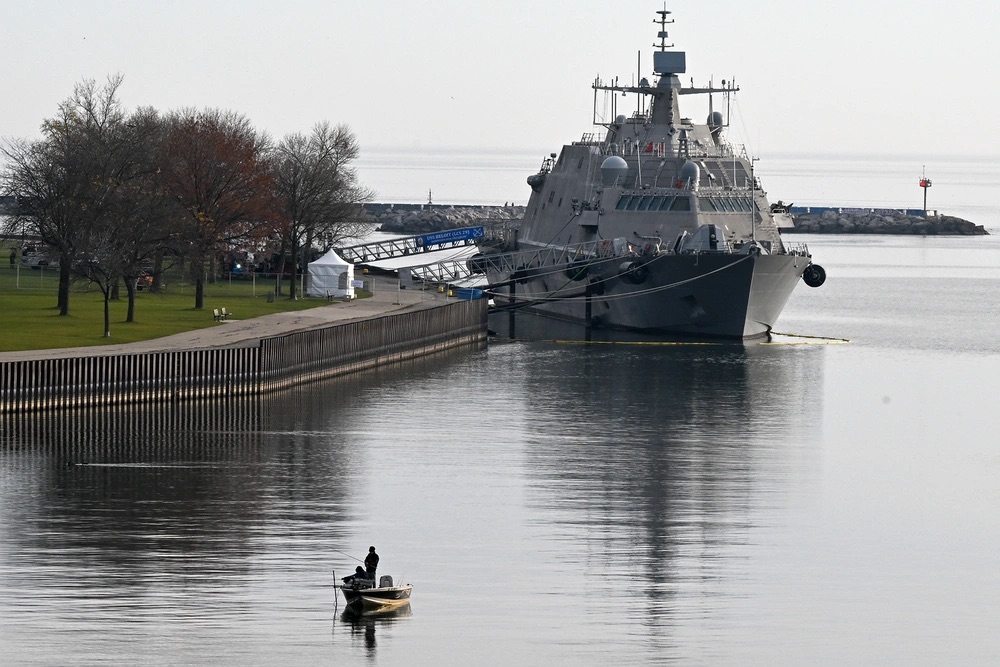
USS Beloit (LCS-29). Photo by EJ Hersom.

I’ve always known that they would try to expand their information operation to the other countries that are in ASEAN, just by following the SeaLight podcast. If not their information operation, regime change and terrorism (in Balochistan and Myanmar). I’ve also noticed that Powell has been referring to the Philippines’ “transparency initiative” as “non-violent resistance,” lately (RAND refers to it as “assertive transparency”). Ironic, considering that they’ve already succeeded in overthrowing the government of Bangladesh and are now attempting it in Cambodia, India and Pakistan. For those who don’t know about the regime change asset Gene Sharp and his neoliberal “nonviolence,” see the links on this page. Unfortunately, I don’t have as much time to dedicate to this right now due to other obligations.

Understanding and Countering China’s Maritime Gray Zone Operations | RAND

How the United States Can Support Allied and Partner Efforts to Counter China in the Gray Zone: Affirmative Engagement | RAND

RAND and SeaLight document (work in progress)

PART 2

Part 3a: RAND and SeaLight – Taiwan Relations Act

RAND and SeaLight Part 3b: Four Ways China Is Growing Its Media Influence in Southeast Asia

China faces an increase in extremist threats in central Asia, US panel is told

China faces an increase in extremist threats in central Asia, US panel is told

Raffaello Pantucci, a senior fellow at Singapore’s S. Rajaratnam School of International Studies, said that the Islamic State Khorasan (Isis-K) had identified the perpetrator of the suicide bomb attack on worshippers in a mosque in the Afghan city of Kunduz in October as a Uygur.

US policymakers are paying more attention to the growth of China’s geopolitical influence through programmes like the Belt and Road Initiative (BRI) – which includes the China-Pakistan Economic Corridor (CPEC) – as Washington’s relationship with Beijing has frayed on multiple fronts.

“It used to be the Uygur militants that tended to be responsible for attacks on Chinese diplomats or Chinese businessmen in Kyrgyzstan,” Pantucci added. “Increasingly we see Kyrgyz in general being quite angry towards the Chinese … and we can see similar narratives in Kazakhstan.”

Still, anger against Chinese does not mean that Americans are welcome, Jennifer Brick Murtazashvili, founding director at the University of Pittsburgh’s Centre for Governance and Markets, said.

“The US lost so much credibility because of the way it left Afghanistan,” she said. “Regardless of how you may feel about the intervention, regardless of how you may feel about the withdrawal of decision to withdraw the way the US left, I think it left a very bitter taste in the mouth of many people in the region.”

After all that work, instigating terrorists, they’re still not welcome back! Wonder why?! 🙄

The BLA’s Anti-Chinese Terrorist Attack Is A Failed Attempt To Hold Balochistan Back

The objective socio-economic interests of the Baloch people are inextricably connected with their government’s Chinese-backed plans to comprehensively develop this de facto feudalist province, not in splitting from Pakistan in order to impose a neo-feudalist system upon its already very impoverished population.

The BLA’s Anti-Chinese Terrorist Attack Is A Failed Attempt To Hold Balochistan Back

Previously:

3 Chinese nationals among 4 dead in suicide attack at Karachi University