BBC: Niger’s Junta Revokes Military Agreement With US

Source

Niger’s Junta Revokes Military Agreement With US

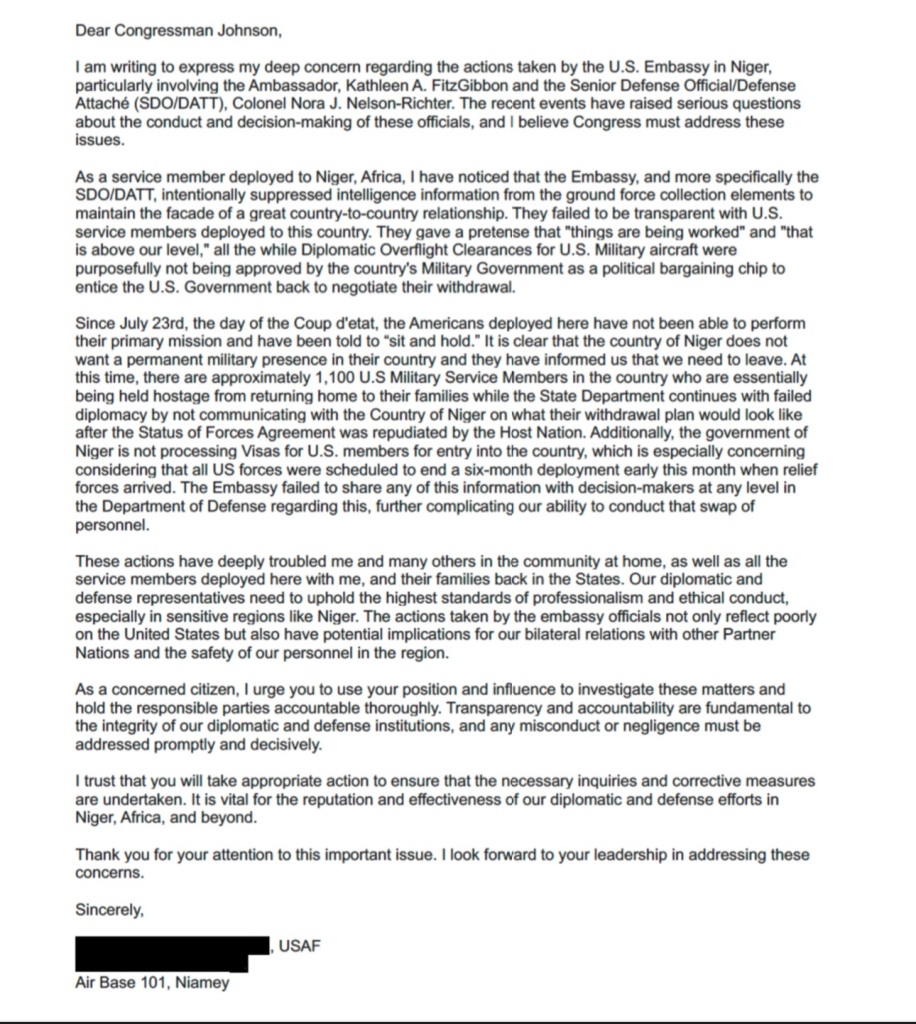
“The US presence on the territory of the Republic of Niger is illegal and violates all the constitutional and democratic rules which would require the sovereign people… to be consulted on the installation of a foreign army on its territory,” Niger’s military spokesperson Col Amadou Abdramane said in a damning statement on national television.

He also alleged that the US delegation had accused Niger of making a secret deal to supply uranium to Iran. Col Abdramane described the accusation as “cynical” and “reminiscent of the second Iraq war”.

And finally, he suggested that the US had raised objections about the allies that Niger had chosen. “The government of Niger therefore strongly denounces the condescending attitude combined with the threat of reprisals by the head of the American delegation against the government and the people of Niger,” Col Abdramane said.

The “Human Rights Industry” and Nicaragua

Why do United Nations human rights bodies focus on some countries, but not others? Why do organizations like Human Rights Watch and Amnesty International appear to ignore important evidence presented to them? And why do the media repeat stories of human rights abuses without questioning their veracity?

The “Human Rights Industry” and Nicaragua

Related:

Pentagon contradicts White House about US troop presence in Yemen

US defense officials claim they have no boots on the ground in Yemen, despite a recent acknowledgement that US forces are indeed present in the war-torn Gulf state, a 27 January report from The Intercept shows.

Pentagon contradicts White House about US troop presence in Yemen

Related:

Biden’s announcement on ending US support for the war in Yemen, explained

But that doesn’t mean the US will stop fighting in Yemen. Per the administration, it will continue to strike al-Qaeda and ISIS militants in the country to ensure they can’t use it as a base to hatch plots against America. The US has been targeting terrorists in Yemen, most of them against al-Qaeda, since 2002 and has killed around 1,000 people in strikes. Stopping that campaign, experts say, might give the terrorists more space to operate.

So ending support for the fight against the Houthis, and continuing the fight against America-threatening terrorists — that’s pretty straightforward. What isn’t as clear is what the second element, supporting Saudi Arabia’s defense, means in practice.

The biggest complication here is what defines an “offensive” versus a “defensive” move. Say the Houthis attack Saudi Arabia, which experts I spoke to expect they will continue to do. The rebels launched missiles at an airport and airbase in Saudi Arabia in 2019, and at Saudi oil stations last year. Under international law, Riyadh has the right to retaliate in a commensurate way.

Putin as the new Mr. Darcy? Austrian ex-minister lauds ‘gentleman’ Russian leader

When you think of an old-fashioned gentleman straight from the pages of a Jane Austen novel, who do you think of?

Well, if you are former Austrian Foreign Minister Karin Kneissl, it’s Russian President Vladimir Putin.

Putin as the new Mr. Darcy? Austrian ex-minister lauds ‘gentleman’ Russian leader

Related:

Putin described as ‘most intelligent gentleman’ by former Austrian foreign minister

Guyana Doesn’t Rule Out Being Colonized By The US

Full video

The president of Guyana, Irfaan Ali, has recently threatened to seek military support from the imperial forces of the United States following the Venezuelan Consultative Referendum over the Essequibo territory, in which over 10 million Venezuelans overwhelmingly voted in favor of recognizing the historical sovereignty over this eastern area of Venezuela.

Guyana Considers Establishing US Military Base (+Trinidad & Tobago)

I called it, two weeks ago!

Flashback: Chrystia Freeland Whitewashing Nazi Collaborators in 2008

Ukraine rifles its history for heroes

But history may matter more to you if it has been rough, as Ukraine’s has. As Viktor Yushchenko, the president whose path to power included a disfiguring attempt on his life, told the Canadian parliament last month, Ukraine has declared independence six times in the past 90 years. His job, he said, was to make sure the most recent declaration, in 1991, was the last one. Even the national anthem takes a bleak view. Its first line is: “Ukraine has not yet died.”

Yaroslav the Wise, the 11th-century prince of Kievan Rus, was named the winner in a last-minute surge, edging out western Ukrainian partisan leader Stepan Bandera, who led a guerrilla war against the Nazis and the Soviets and was poisoned on orders from Moscow in 1959. When the programme’s editor cried foul, alleging that Yaroslav’s backers had flooded the show with computerised phone-in votes, the story suddenly became irresistible abroad. After all, stuffed ballot boxes have figured prominently in recent Ukrainian politics, sparking the 2004 orange revolution.

The contretemps is being framed as yet another example of the divide between western and eastern Ukraine, where the Soviet portrayal of Bandera as a traitor still lingers. That would be a mistake. The real story of Ukraine is the astonishing rapprochement between east and west, which began in 1991 and accelerated after 2004, when big business decided it paid to buy into independence.

Related:

Did Yushchenko Poison Himself?

Canada’s Secret Role in Ukraine (Orange Revolution)

Euromaidan 2014 – Orange Revolution – War in Donbass

How Netanyahu falsifies the news

We in the West think we’re well informed about what’s happening in Gaza. We are not. The images we see are selected. The comments we hear do not allow us to understand them. They deliberately mislead us. Any dissenting opinion is censored.

How Netanyahu falsifies the news