
Jeffrey Sachs of Columbia University joins the show to discuss the war in Ukraine. First, Scott asks him about his extensive experience telling the truth about American foreign policy on national television. They then take a look back at the important developments that led to this war over Ukraine. They discuss the talks after the fall of the USSR, the Russian interest in the port at Sevastopol, the true beginning of the current war in 2014 and more
4/4/23 Jeffrey Sachs on What Led to War in Ukraine
Tag: Black Sea Fleet
Even ChatGPT Knows The U.S. Provoked Russia To Invade Ukraine
Ukraine Accuses NBC News of Illegal Filming in Crimea, Journalist Added to Notorious ‘Kill List’
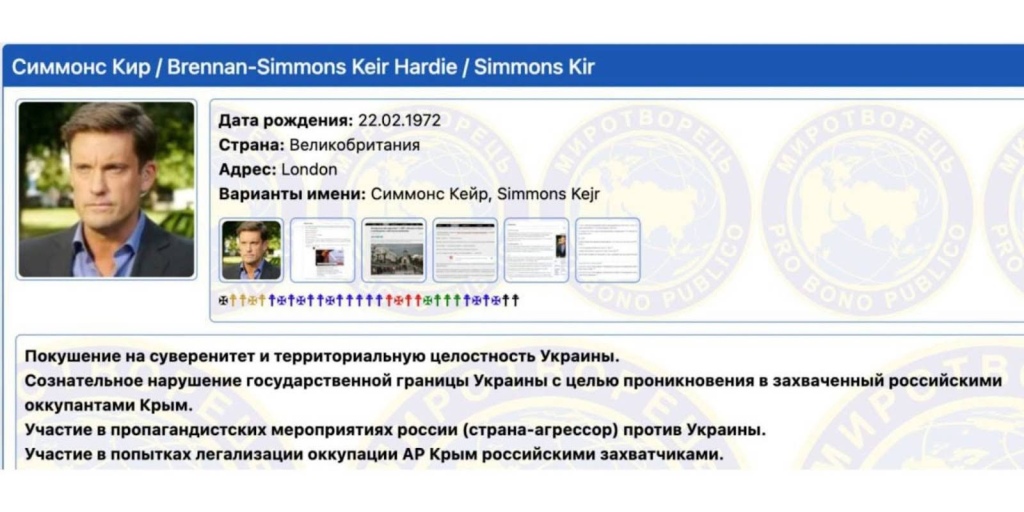

MOSCOW (Sputnik) – Ukraine has accused NBC News of violating its law after the US broadcaster had its crew cross into the Crimea peninsula from mainland Russia.
“Attending Crimea from the territory of Russia is a violation of the legislation of Ukraine, for which responsibility is provided – in particular, foreigners are also prohibited from entering for such actions. We are very much concerned about the tv plot of @NBCNews,” Ukrainian Minister of Culture and Information Policy Oleksandr Tkachenko tweeted on Wednesday.
Moreover, Keir Simmons, the journalist behind the report, has been added to the notorious Ukrainian “kill list,” the Mirotvorets website. He was accused of entering the Crimean peninsula through mainland Russia and “participating in propaganda activities against Ukraine.”
On Tuesday, NBC News broadcast a report from Crimea where Simmons traveled on train from mainland Russia via the landmark bridge damaged by a deadly blast last October that was orchestrated by Ukrainian special services. The bridge has since been repaired. The reporter interviewed local people on camera who turned out overwhelmingly in support of their 2014 accession to Russia.
The spokesman for Ukraine’s foreign ministry said that Ukraine was investigating the circumstances of the NBC News reporter’s visit to Crimea and that he might end up prohibited from entering Ukrainian territory.
Ukraine Accuses NBC News of Illegal Filming in Crimea, Journalist Added to Notorious ‘Kill List’
Related:
A view from Crimea, the Russian-annexed territory Ukraine is hoping to seize back
Washington Post Lets Hersh’s Dangerous Cat Out of the Bag
Ukraine bans former president’s party

The Party of Regions was outlawed just a day after Joe Biden praised Kiev’s “democracy”.
Ukraine bans former president’s party
Eric Zuesse: Why 100% Of The Blame For Ukraine’s War Is Obama’s, And None Is Putin’s
Written by Eric Zuesse on 03/02/2023
This is in response to Caitlin Johnstone’s January 28th article, which alleged that not all of the blame for the war in Ukraine goes to Obama’s decisions, and which accused Russia of “warmongering” (and avoided using any such strong term of condemnation against America’s Government), “Why Don’t You Ever Criticize RUSSIA’S Warmongering??”:
Why 100% Of The Blame For Ukraine’s War Is Obama’s, And None Is Putin’s
H/T: THE NEW DARK AGE
CIA director holds secret meeting with Zelensky on Russia’s next steps
CIA Director William J. Burns traveled in secret to Ukraine’s capital at the end of last week to brief President Volodymyr Zelensky on his expectations for what Russia is planning militarily in the coming weeks and months, said a U.S. official and other people familiar with the visit.
CIA director holds secret meeting with Zelensky on Russia’s next steps
Related:
Ukraine and Georgia’s NATO aspirations not only touch a raw nerve in Russia, they engender serious concerns about the consequences for stability in the region. Not only does Russia perceive encirclement, and efforts to undermine Russia’s influence in the region, but it also fears unpredictable and uncontrolled consequences which would seriously affect Russian security interests. Experts tell us that Russia is particularly worried that the strong divisions in Ukraine over NATO membership, with much of the ethnic-Russian community against membership, could lead to a
major split, involving violence or at worst, civil war. In that eventuality, Russia would have to decide whether to intervene; a decision Russia does not want to have to face.
Archived Links Inside WaPo Article:
Read More »Erich Vad: What are the war aims?
Erich Vad is an ex-brigade general. From 2006 to 2013, he was the military policy advisor to German Chancellor Angela Merkel. He is one of the rare voices who spoke out publicly against arms deliveries to Ukraine early on, without political strategy or diplomatic efforts. Even now he speaks an uncomfortable truth.
Erich Vad: What are the war aims?
[2018] The Wilson administration’s war on Russian Bolshevism

“The Time You Sent Troops to Quell the Revolution”
The United States invasion of Russia remains a hidden dimension of U.S. policy in the Great War, marking the beginning of a long Cold War. In August 1918, three months prior to the Armistice, the Wilson administration sent several platoons of U.S. soldiers into Russia to aid in the overthrow of the new Bolshevik government, which had come to power in the October Revolution of 1917. The operation was carried out alongside British, French, Canadian and Japanese forces in support of White Army counter-revolutionaries whose generals were implicated in wide-scale atrocities, including pogroms against Jews. This “Midnight War” was carried out illegally, without the consent of Congress. The Commanding General in Siberia, William S. Graves thought that his mission was to protect a delegation of Czech troops and the Trans-Siberian railway and to serve as a mediator. He was disappointed to learn that in fact the United States was enmeshed in another country’s civil war and came to oppose the whole operation. In his memoirs, he expressed “doubt if history will record in the past century a more flagrant case of flouting the well-known and approved practice in states in their international relations, and using instead of the accepted principles of international law, the principle of might makes right.”
The Wilson administration’s war on Russian Bolshevism
U.S. and NATO scramble to arm Ukraine and refill their own arsenals
Either this narrative about weapon stockpiles, being depleted, is part of the information war or Russia is demilitarizing NATO!?!
U.S. and NATO scramble to arm Ukraine and refill their own arsenals
In Ukraine, the kind of European war thought inconceivable is chewing up the modest stockpiles of artillery, ammunition and air defenses of what some in NATO call Europe’s “bonsai armies,” after the tiny Japanese trees. Even the mighty United States has only limited stocks of the weapons the Ukrainians want and need, and Washington is unwilling to divert key weapons from delicate regions like Taiwan and Korea, where China and North Korea are constantly testing the limits.
…
So the West is scrambling to find increasingly scarce Soviet-era equipment and ammunition that Ukraine can use now, including S-300 air defense missiles, T-72 tanks and especially Soviet-caliber artillery shells
…
There are even discussions about NATO investing in old factories in the Czech Republic, Slovakia and Bulgaria to restart the manufacturing of Soviet-caliber 152-mm and 122-mm shells for Ukraine’s still largely Soviet-era artillery armory.
…
The European Union has approved €3.1 billion ($3.2 billion) to repay member states for what they provide to Ukraine, but that fund, the [ironically-named] European Peace Facility, is nearly 90 percent depleted.
…
Smaller countries have exhausted their potential, another NATO official said, with 20 of its 30 members “pretty tapped out.” But the remaining 10 can still provide more, he suggested, especially larger allies. That would include France, Germany, Italy and the Netherlands.
NATO’s secretary general, Jens Stoltenberg, has advised the alliance — including, pointedly, Germany — that NATO guidelines requiring members to keep stockpiles should not be a pretext to limit arms exports to Ukraine. But it is also true that Germany and France, like the United States, want to calibrate the weapons Ukraine gets, to prevent escalation and direct attacks on Russia.
…
Washington is also looking at older, cheaper alternatives like giving Ukraine anti-tank TOW missiles, which are in plentiful supply, instead of Javelins, and Hawk surface-to-air missiles instead of newer versions. But officials are increasingly pushing Ukraine to be more efficient and not, for example, fire a missile that costs $150,000 at a drone that costs $20,000.
 Ms. Cat’s Chronicles
You must be logged in to post a comment.