
Less politics more marine diplomacy – a fix for South China Sea?

Territorial wrangling over who owns the South China Sea has strangled local marine life, say scientists, urging China and the Philippines to set aside political differences and work to save the fish, coral and plants that live border-free.

Since 2013, China has built artificial islands that cover more than 3,000 acres of the Spratlys, according to U.S.-based policy organisation Asia Maritime Transparency Initiative.

A study last December by the Asia Maritime Transparency Initiative also blamed China’s dredging and clam harvesting for destroying almost 20,000 acres of reefs in the South China Sea.

Less politics more marine diplomacy – a fix for South China Sea?

The Asia Maritime Transparency Initiative (AMTI) is part of the Center for Strategic and International Studies (CSIS). Gregory Poling is director of the AMTI. The same Poling that told the U.S. government-funded Voice of America that “Vietnam’s use of cutter suction dredgers is much more environmentally destructive than its previous dredging methods.

According to the CIA’s World Factbook, Vietnam occupies around 50 outposts, The Philippines occupies nine, Malaysia occupies five, and China occupies seven in the disputed Spratly Islands.

Previously:

China unveils evidences showing Philippine grounded warship at Ren’ai Jiao destroys coral reefs, endangers marine organism

Experts warn of Philippines scheming for ‘new arbitration’ on South China Sea + More

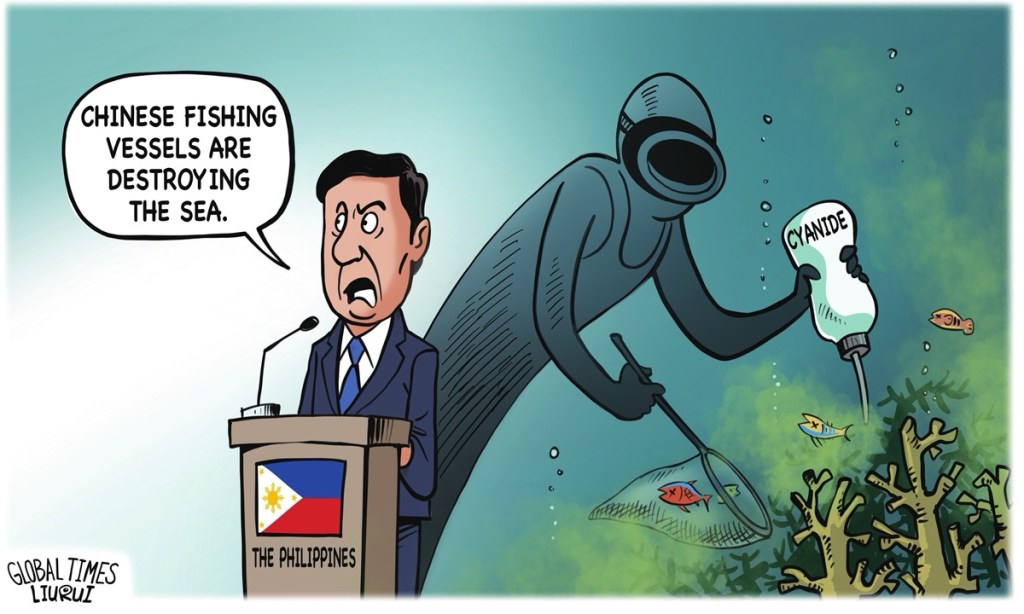
Vietnamese Poachers using Cyanide and Dynamite Fishing in the Philippines’ EEZ

Philippine Coast Guard clarifies ‘assertive transparency’ tact
China unveils evidences showing Philippine grounded warship at Ren’ai Jiao destroys coral reefs, endangers marine organism

Source

While Manila mulls over filing a case against China with so-called “solid evidence of the damaged coral reefs caused by Chinese actions,” China, on Monday, released a report based on an unprecedentedly extensive and detailed on-site ecosystem survey around Ren’ai Jiao (also known as Ren’ai Reef), with solid evidence showing that the grounded warship has caused damage to the coral reefs and environmental pollution in the South China Sea.

China unveils evidences showing Philippine grounded warship at Ren’ai Jiao destroys coral reefs, endangers marine organism

Related:

(Full text in English) “Investigation Report on the Illegal “Beach” Warship Destroying the Coral Reef Ecosystem in Ren’ai Reef”

Experts warn of Philippines scheming for ‘new arbitration’ on South China Sea + More

Philippines rejects China’s accusation of environmental damage in South China Sea

China has in turn dredged sand and coral to build artificial islands in the South China Sea, which it says is normal construction activity on its territory, but which other nations say is aimed at enforcing its claim to the waterway.

A report by the Center for Strategic and International Studies last year found China’s construction activity buried more than 4,600 acres (1,861 acres) of reef.

China claims almost all of the vital waterway, where $3 trillion worth of trade passes annually, including parts claimed by the Philippines, Brunei, Malaysia, Taiwan and Vietnam.

Greg Poling, from the front CSIS, claims that Vietnam is also building artificial islands.

Experts warn of Philippines scheming for ‘new arbitration’ on South China Sea + More

While reiterating that the arbitral tribunal in the South China Sea arbitration exceeded its jurisdiction and made an illegitimate ruling, Chinese experts warned on Monday that the Philippines is scheming for “new arbitration” on the issue, which would undermine regional peace and stability.

Experts warn of Philippines scheming for ‘new arbitration’ on South China Sea

Related:

Philippines should use legal, moral leverage in West Philippine Sea – expert

Ray Powell, director of the SeaLight Gordian Knot Center for National Security Innovation at Stanford University, said China is using an “asymmetrical” strategy through military might in asserting its claims in the region.

He also expressed support for the Philippine government’s plan to file another case against China, this time over the environmental destruction that China has caused in the West Philippine Sea.

PH to complete environmental case vs. China in ‘few weeks’- DOJ

Foreign Ministry Spokesperson Wang Wenbin’s Regular Press Conference on May 20, 2024

The Office of Naval Research funded Stanford’s GKC

I’m no expert, but I had a feeling that they would back in April, at least:

Philippine Coast Guard clarifies ‘assertive transparency’ tact

Vietnamese Poachers using Cyanide and Dynamite Fishing in the Philippines’ EEZ

Is the Philippines becoming a US ‘proxy’ against Beijing in the South China Sea?

Is the Philippines becoming a US ‘proxy’ against Beijing in the South China Sea?

‘The ants that get trampled on’

Not everyone agrees with drawing closer to the US, however, and they warn about the Philippines turning into a “proxy” for American interests. The president’s own sister Imee, a senator, told ANC Digital earlier this month that “China will always be our neighbour, we have no fight with them, let’s not get dragged into a fight that’s not our own.”

Anna Rosario Malindog-Uy, director of the pro-China Asian Century Philippines Strategic Studies Institute, wrote in the Manila Times on February 10 that “agreements such as the EDCA, the VFA and the Mutual Defence Treaty have not only cemented the US military presence and influence in the Philippines but also, most importantly, exemplified the Philippines’ dependence on the US in the military and defence sector.”

Teresita Ang See, former president of the Philippine Association for Chinese Studies and currently part of its advisory council, told This Week in Asia: “Filipinos in general condemn China’s action. But many also understand that China’s assertiveness is in response to US, Japanese and Australian provocations and increasing military presence in the Philippines.”

She warned that “we are fighting a proxy war between the US and China and in the end we will be the ants that get trampled upon”.

H/T: Johnsonwkchoi

Related:

Responding to the Catholic Bishops

Philippines counts the cost of tough South China Sea stance against Beijing

Vietnamese Poachers using Cyanide and Dynamite Fishing in the Philippines’ EEZ

rhk111’s Channel

Vietnamese Poachers using Cyanide and Dynamite Fishing in the Philippines’ EEZ

The Groups said that Vietnamese Poachers are conducting Illegal, Unreported and Unregulated (IUU) Fishing within the Exclusive Economic Zone (EEZ) of the Philippines. The Bureau of Fisheries and Aquatic Resources (BFAR) are reportedly in the Area but are not going after the Vietnamese Poachers. 

These Poachers are also reportedly using Cyanide and Dynamite when fishing that is causing irreparable Damage to the Environment and adversely affect the catch of Philippine Fisherfolk.   

For me the biggest Question to ask here is why are the Philippine Press, Government Agencies and Lawmakers constantly complaining about China doing this or doing that within our EEZ, but when it is Vietnamese Poachers doing the same or even worse they are so quiet about it? 

Bongbong is just a puppet of the US.

Compared to this:

PH condemns China’s latest harassment of Filipino fishers