
US Embassy checks on Anicoche as military refutes forced detention ‘narrative
Read More »Tag: Bongbong Marcos
Philippines Could Receive $2.5 Billion in Security Aid from U.S. Defense Bill
China accuses Philippines of ‘premeditated’ provocations near Sabina Shoal + more
Beijing has accused Manila of organising a “premeditated” provocation and dangerous manoeuvres near a disputed reef in the South China Sea, and Washington of making false statements that have escalated tensions in the region.
Manila said Philippine fishing boats near Sabina Shoal had been targeted with water cannons by Chinese coastguard ships in an incident on Friday, while Beijing said Philippine personnel had threatened Chinese officers with knives.
Chinese foreign ministry spokesman Guo Jiakun said on Monday that the Philippines had assembled a large number of vessels “in an organised and premeditated manner to provoke trouble” in waters near the shoal.
[SCMP] China accuses Philippines of ‘premeditated’ provocations near Sabina Shoal (archived)
Related:
Read More »Filipino fishermen injured in China Coast Guard encounter
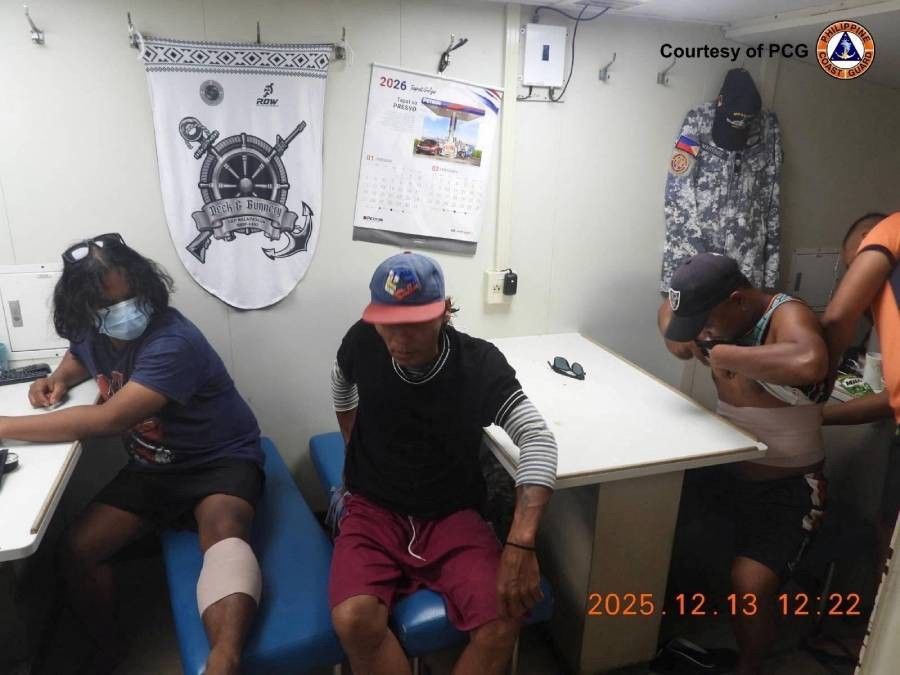
[Aaron-Matthew Lariosa] VIDEO: China Coast Guard Blasts Fishermen With Water Cannon Near Sabina Shoal, Philippines Dispatches Patrol Boats
Read More »A Narrow Pacific Waterway is at the Heart of U.S. Plans to Choke China’s Vast Navy +
Reuters reprint: A Narrow Pacific Waterway is at the Heart of U.S. Plans to Choke China’s Vast Navy
Until recently, locals say, this smallest and least populous province of the Philippines was a peaceful backwater. But geography dictates that it is now on the frontline of the great power competition between the United States and China for dominance in the Asia-Pacific region. The islands sit on the southern edge of the Bashi Channel, a major shipping lane between the Philippines and Taiwan that connects the South China Sea with the Western Pacific.
This year’s exercises revealed how the U.S. and its Philippine ally intend to use ground-based anti-ship missiles as part of efforts to deny the Chinese navy access to the Western Pacific by making this waterway impassable in a conflict, Reuters reporting shows. These missiles could also be used to attack a Chinese fleet attempting to invade Taiwan or mount a blockade against the democratically governed island.
…
Recent Chinese maneuvers show how access to the Bashi Channel is critical for Beijing’s plans in the Pacific. In June, a powerful Chinese navy aircraft carrier battle group used this passage to enter the Western Pacific before launching an extended series of exercises south of Japan, according to Japanese military tracking data.
Related:
Read More »Updated: Philippines accuses China of ramming vessel near disputed island as tensions soar
WATCH: A China Coast Guard vessel (CCG 21559) fired a water cannon and rammed the BRP Datu Pagbuaya near Pag-asa Island this Sunday morning while the ship was assisting Filipino fishermen under the “Kadiwa para sa Bagong Bayaning Mangingisda” program, the PCG reports.
The incident occurred after CCG and Chinese militia vessels made dangerous maneuvers around anchored BFAR ships. CCG 21559 fired at 9:15 AM and rammed the BRP Datu Pagbuaya at 9:18 AM, causing minor damage but no injuries. (Video courtesy of PCG) | via Christine Boton
Related:
Update: I missed this one. Yesterday’s maritime incident happened near Sandy Cay, which is approximately 1.5 nautical miles from Thitu Island.
Read More »Updated: The War of Ideas in the Indo-Pacific
The document has been updated, but not the below information.
Document: War of Ideas in the Indo-Pacific document
YouTube: Senate Hearing on China’s Behavior in the Indo-Pacific
Read More »“Copy & Paste: US-Sponsored Unrest Now Targets Philippines”
The August 11 SCS Incident & US-Backed Fisherfolk Collectives in the Philippines
Note that Scarborough Shoal is in disputed territory: What’s Really Going On In the South China Sea Between the Philippines and China.
Scarborough Shoal Incident 2.0: The PLAN Inches Closer to War (archived)
A Chinese People’s Liberation Army Navy (PLAN) destroyer and China Coast Guard (CCG) cutter collided 10.5 nautical miles east of Scarborough Shoal in the Philippines’ exclusive economic zone (EEZ) on the morning of 11 August. It marked the second time China has been embarrassed by the Philippines in these waters. This time, the results appear to have been deadly, as at least four members of the CCG were either severely injured or killed during the violent collision.
…
The latest incident appears to have been set in motion by an order from a Chinese higher authority, most likely the Central Military Commission’s (CMC’s) Joint Operations Center (JOC), to disrupt the Philippine Coast Guard’s “Kadiwa ng Bagong Bayaning Mangingisda (KBBM)” program. The KBBM initiative was unveiled in May 2025 with the intent to provide Philippine fishermen with food security and resupply at sea [See KBBM, below]. Analysis of Automatic Identification System (AIS) data indicates many CCG cutters were arrayed around Scarborough Shoal on 11 August, and as Philippine CG cutters entered waters 20–30 nm around the shoal, CCG and PLAN ships converged on the Philippine cutters to disrupt their food supply operations.
For more than an hour, PLAN guided-missile destroyer Guilin and CCG cutter 3104 conducted a high-speed pursuit of the Philippine Coast Guard cutter BRP Suluan. Based on the events during this pursuit, it appears the CMC JOC ordered the use of physical force to stop the Philippine Coast Guard from their mission. According to Armed Forces of the Philippines Chief of Staff General Romeo Brawner, “Our assessment is that the real objective of the PLA Navy ship is to ram our Philippine Coast Guard (vessel). That is also (the) assessment of our Philippine Coast Guard.”
FYI, the author of the above article is one of the founding members of the hawkish Committee on the Present Danger: China. You’ll also find information on the first Scarborough Shoal incident in here, also known as the Scarborough Shoal standoff: August 11 SCS – James E. Fanell – SeaLight.
Background:
Read More » Ms. Cat’s Chronicles
You must be logged in to post a comment.