
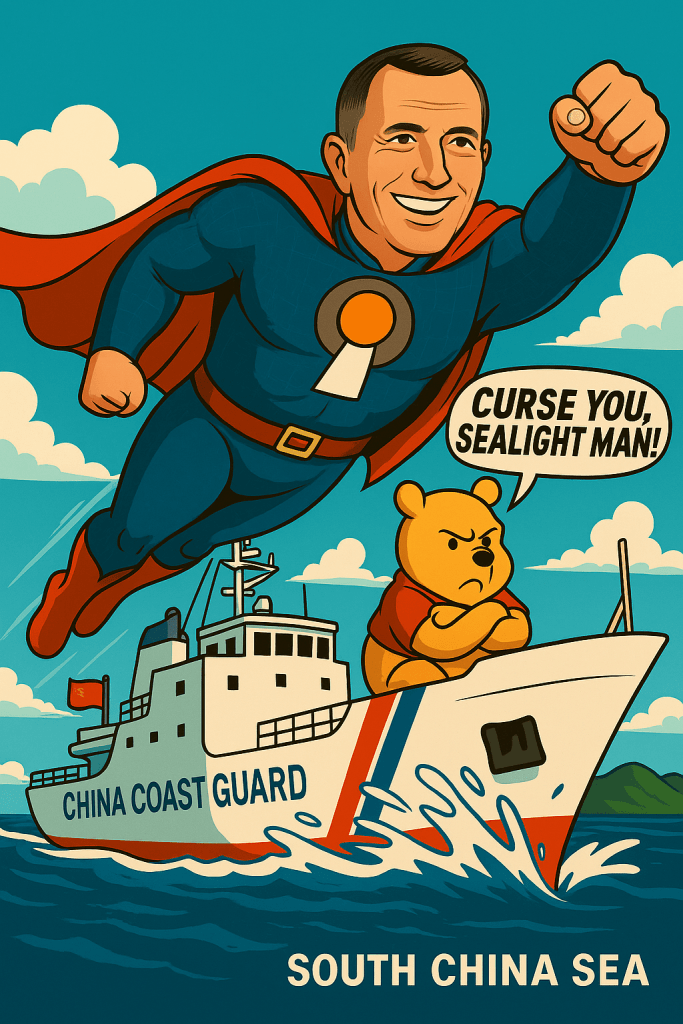
Capes, Cameras, and the Cult of Visibility

Capes, Cameras, and the Cult of Visibility: The SeaLight Crusade as White Savior Theater

By Tina Antonis

The South China Sea is more than a maritime dispute—it’s a theater of narrative warfare. While headlines focus on Chinese aggression and Philippine resistance, a quieter campaign unfolds in the background: one of satellite feeds, curated imagery, and Pentagon-backed storytelling. At the center of this effort is SeaLight, a project that claims to illuminate truth but often casts shadows of its own.

As explored in my article at Antiwar.com, SeaLight doesn’t just document—it performs. It reframes geopolitical tension through moral spectacle, positioning its creators as heroic arbiters of transparency. But when the messenger wears a cape and the funding flows from defense budgets, we must ask: is this clarity, or choreography?

Stage Left: The White Savior Enters

In the comic-strip cosmology of Ray Powell’s SeaLight project, transparency wears a cape. Clad in heroic postures and backed by satellite imagery, Powell casts himself as the guardian of maritime morality—unarmed, except with satellite feeds, theatrical flair, and strategic messaging. 

Yet beneath the cartoon and Pentagon-funded optics lies a familiar archetype: the white savior, rebranded for the South China Sea.

China Is Imperialist? Says Who?

Calling China a “maritime occupier,” Powell positions himself as a bulwark against aggression. But that moral pose collapses under scrutiny. He speaks for a country with over 800 foreign military installations and a documented history of over 250 military interventions since 1991—wars in Iraq, Afghanistan, Libya, Syria, Somalia, and dozens more, all under the banner of peace, freedom, or preemption.

By comparison, China’s post–Cold War footprint includes no sustained foreign occupations and only scattered border conflicts and peacekeeping missions. The imbalance is staggering. And Powell’s framing doesn’t just ignore it—it performs around it.

As David Vine argues in The United States of War, this vast base empire is not a passive network—it’s an architecture of perpetual war. These outposts make military engagement not an exception but a structural habit, cloaked in strategic necessity and sold as global stewardship.

Powell’s cartoon rhetoric—calling China an occupier—obscures the scale of U.S. militarism. The term “occupation” is deployed not to analyze, but to project. When adversaries hold territory, it’s a crisis; when the U.S. spans the globe with armed installations, it’s policy.

Framing Conflict: The Optics of Consent

This isn’t irony. It’s performance. Powell’s language manufactures a moral frame for confrontation—costumed in transparency, but driven by escalation. The cape is literal. The conditioning is deliberate. And the stage is set for war.

SeaLight’s mission is not just visual documentation—it’s narrative warfare. As the Japan Times openly notes, its “chief weapon is photography, applied purposefully, generously and consistently over time.” These images—enhanced, curated, and distributed across media—are not neutral. They’re constructed to shape public perception, sway international opinion, and ultimately manufacture consent for confrontation.

Assertive transparency becomes a kind of ideological scaffolding—a stage on which geopolitical tension is dramatized, simplified, and morally polarized. The goal isn’t simply to reveal conflict; it’s to condition audiences for escalation.

And when the messenger dons a superhero’s cape, the spectacle transforms into something deeper: a story of rescue, of virtue, of intervention. This is not analysis—it’s soft propaganda dressed in heroic metaphor.

Consent for war doesn’t begin with missiles. It begins with mythmaking.
Hegseth visits Manila: Washington prepares for war with China + More

Hegseth visits Manila: Washington prepares for war with China

The language of Hegseth’s press conference in Manila is indicative of the openly aggressive face of US imperialism under Trump. Gone was any reference to what had been the political shibboleth of Washington in the Asia Pacific region: the defense of “freedom of navigation.” Hegseth spoke rather of “preparing for war,” using the phrase more than once. Every time Hegseth mentioned China he termed it “Communist China,” and spoke of its “aggression.” Hegseth referred to US Seventh fleet commander Admiral Samuel Paparo “and his war plans. Real war plans.”

Read More »

Due Process on Trial: The Duterte Arrest, the Rule of Law and Sovereignty + More

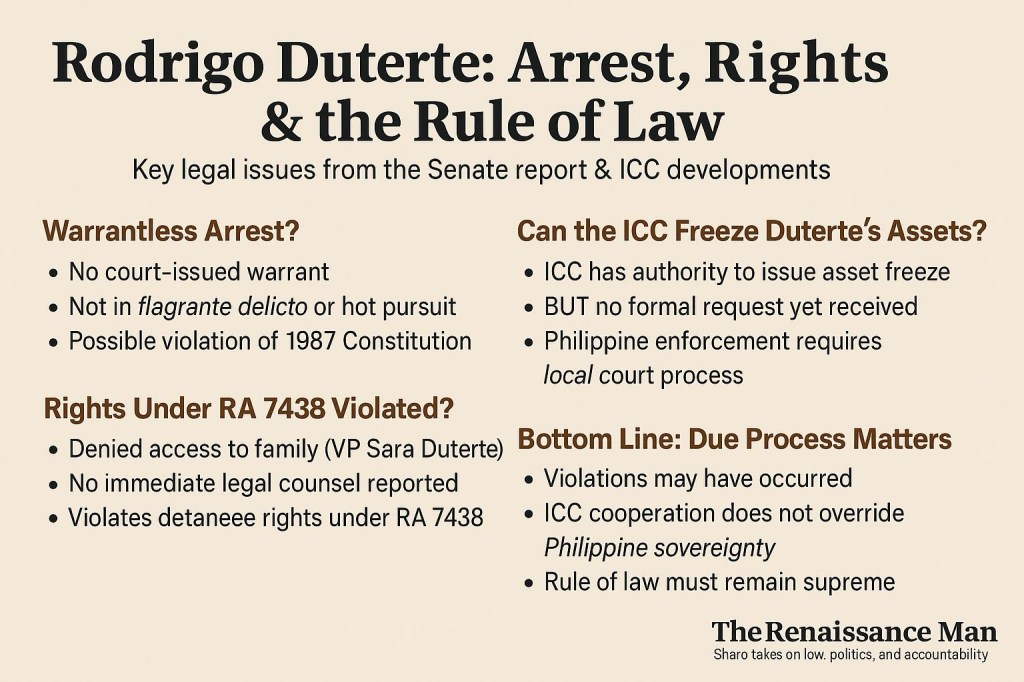
The recent release of the Senate Committee on Foreign Relations’ preliminary report on the arrest of former President Rodrigo Duterte has sent ripples through the Philippine legal and political landscape. Chaired by Senator Imee Marcos, the report outlines what it calls “glaring violations” of constitutional rights, procedural lapses, and questionable coordination between the Philippine government and the International Criminal Court (ICC).

Due Process on Trial: The Duterte Arrest, the Rule of Law and Sovereignty

Related:

Can Philippine President Marcos Survive the Wrath of the Dutertes? by Mong Palatino

As for President Marcos, he may have a solid plan to neutralize the Dutertes but it is the anguish of ordinary citizens reeling from high prices and low wages that he should be worried about. Even Vice President Sara Duterte is aware that the concern of the average voter is the economic crisis, which is why her arrival statement at The Hague when she visited her father focused on the need to address poverty, hunger, and joblessness in the Philippines. In other words, the most serious threat to the Marcos presidency is its own failure to fulfill the campaign promise of bringing down the price of rice and other goods, uplift the conditions of working families, and provide adequate and affordable services to the people.

Document: Arrest of Rodrigo Duterte

Duterte Arrest Raises Stakes in Clash for Control of Philippines

YouTube

Duterte Arrest Raises Stakes in Clash for Control of Philippines

Three years ago, the most powerful political families in the Philippines joined hands to secure the nation’s biggest election victory in four decades. Now they are locked in a feud that threatens to derail one of Asia’s economic growth stars.

In dramatic events on Tuesday, Philippine President Ferdinand Marcos Jr.’s government arrested and deported his predecessor Rodrigo Duterte to face the International Criminal Court in The Hague. The move came just over a month after the impeachment of his daughter, Vice President Sara Duterte, by allies of Marcos. A Senate trial, which would determine whether she gets removed from office, is scheduled to begin in July.

The Philippines Inaugurates New President Marcos Jr.
Sara Duterte, left, with Ferdinand Marcos Jr. in 2022. Photographer: Ezra Acayan/Getty Images
Read More »

US focusing on PH over rest of Southeast Asia – expert

US focusing on PH over rest of Southeast Asia – expert

Speaking at a Stratbase Forum in Makati City, Gregory Poling, senior fellow and director of the Southeast Asia Program and Asia Maritime Transparency Initiative at the Center for Strategic and International Studies (CSIS), said the collaboration extends to Japan trilateral and bilateral partnerships.

Poling noted the exemption of military aid for the Philippines, along with Taiwan and Ukraine.

“The Philippines is the only country in Asia that explicitly had its military assistance unlocked as a result of Secretary [Enrique] Manalo’s meeting with Secretary [Marco] Rubio. That’s a pretty good sign.

Read More »