
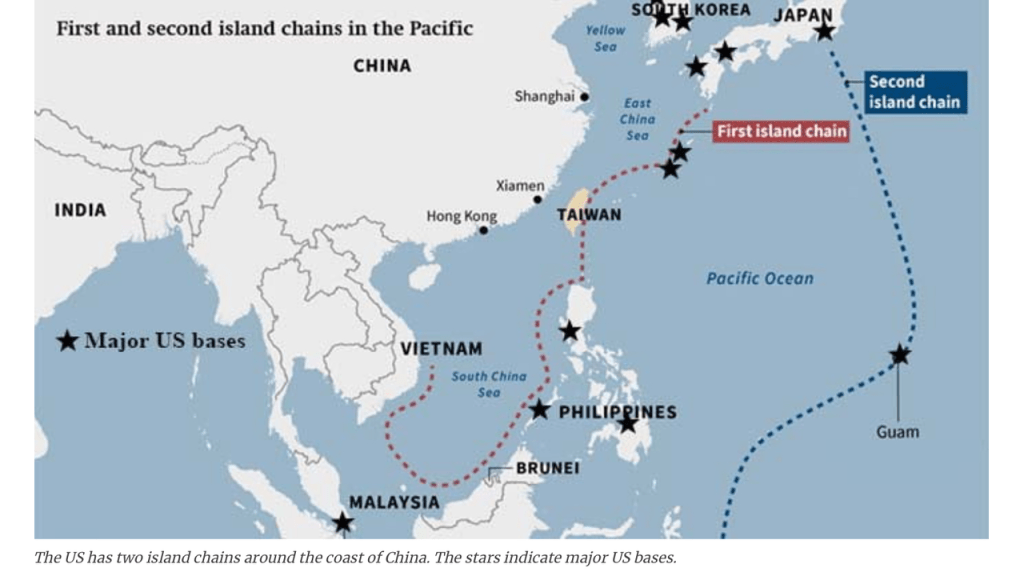
Why Are There Fears of War in the South China Sea?
Read More »The Philippines and China have just restored peace and stability in the areas of the South China Sea contested by the two countries in a July 21, 2024 “de-escalation” deal that aimed at “easing tensions.”
NO to US-BBM War, NO to EDCA Bases!
Blinken-Austin Get Out, Stay Out!
Related:
NO to US-BBM War, NO to EDCA Bases! – Cebu
NO to US-BBM War, NO to EDCA Bases! Blinken-Austin Get Out, Stay Out! Forum Statement
Washington’s Use and Abuse of the Philippines Takes Next Step
The United States has taken yet another step toward shaping the Southeast Asian archipelago nation of the Philippines into an Ukraine-style proxy with which to encircle and contain China, this time in the form of a $500 million military assistance package for Manila.
Washington’s Use and Abuse of the Philippines Takes Next Step
Sources:
Welcoming Remarks & Morning Keynote | Fourteenth Annual South China Sea Conference
Who is Rep. Darrell Issa and what does he have to do with war crimes in the Philippines?
Rep. Issa (CA-48) is one of the richest people in congress and some of his investments are in Black Rock and other war profiteers. He also pushed to send $500 million of our tax dollars to fund war crimes and human rights violations in the Philippines. He stands to benefit personally in the US’ war against China.
At the CancelRIMPACCampaign summit and mobilization, we asked attendees to mobilize with us in front of Rep. Issa’s Escondido office to denounce his support for more military funding to the Philippines. Over a hundred people came out to expose the real conditions of human rights in the Philippines and called for the passing of the Philippine Human Rights Act!
Learn more about the Philippine Human Rights Act
Pass the PHRA Coalition Confronts Rep. Darrell Issa at South China Sea Conference
About the International Coalition for Human Rights in the Philippines
While Manila mulls over filing a case against China with so-called “solid evidence of the damaged coral reefs caused by Chinese actions,” China, on Monday, released a report based on an unprecedentedly extensive and detailed on-site ecosystem survey around Ren’ai Jiao (also known as Ren’ai Reef), with solid evidence showing that the grounded warship has caused damage to the coral reefs and environmental pollution in the South China Sea.
Related:
Experts warn of Philippines scheming for ‘new arbitration’ on South China Sea + More
Philippines rejects China’s accusation of environmental damage in South China Sea
China has in turn dredged sand and coral to build artificial islands in the South China Sea, which it says is normal construction activity on its territory, but which other nations say is aimed at enforcing its claim to the waterway.
A report by the Center for Strategic and International Studies last year found China’s construction activity buried more than 4,600 acres (1,861 acres) of reef.
China claims almost all of the vital waterway, where $3 trillion worth of trade passes annually, including parts claimed by the Philippines, Brunei, Malaysia, Taiwan and Vietnam.
Greg Poling, from the front CSIS, claims that Vietnam is also building artificial islands.
While the ongoing conflict in Ukraine continues to dominate headlines, occasionally news stories surface regarding growing tensions in the Asia-Pacific region as well. Driven primarily by the US, these headlines also include the proxies Washington is using to stir up an Ukraine-style conflict in the region.
The Philippines: Why it is Choosing US Destruction Over Chinese Construction
China reveals Philippine Personnel secretly resupplying BRP Sierra Madre by posing as Fishermen
Personally, I think that these “Secret” Operations are being done by the Naval Special Operations Command (NAVSOCOM) of the Philippine Navy (PN) as this seems to fall under their Area of Responsibility.
Remember that the NAVSOCOM Troops were also the ones that were involved in an Altercation with the Chinese Coast Guard (CCG) earlier this Month.
PH NAVSOCOM trains with the U.S. Navy SEALs:
US keeps stoking tensions despite Philippine’s failed latest provocation
PLA Naval deterrence
The Chinese PLA Navy has reportedly ramped up training exercises and patrols in and near the South China Sea amid the recent tensions in the region caused by the Philippines’ continuous provocations.
A naval task force featuring landing ships the Danxiashan, the Laotieshan and the Lushan recently carried out a four-day all-weather full-course combat exercise in the South China Sea, as the warships practiced air defense, alongside berthing and personnel rescuing, China Central Television (CCTV) reported on Saturday.
Observers said these landing ships are of the Type 072 and Type 073 series, which are smaller than the PLA Navy’s Type 071 amphibious landing ship and Type 075 amphibious assault ship.
While the larger amphibious vessels can carry more troops and equipment and release them at a certain distance away from the shore, the smaller landing ships can conduct grounding operations directly on islands and reefs, giving the latter special roles to play, a Chinese military expert who requested anonymity told the Global Times on Sunday.
For example, Type 072 series landing ships have participated in multiple major military operations, including the building of the maritime observation station on Yongshu Jiao (also known as Yongshu Reef) in the Nansha Qundao (also known as the Nansha Islands) in the South China Sea in 1988, thepaper.cn reported.
The drills came after Philippine media reported the presence of a Type 071 amphibious landing ship and a Type 075 amphibious assault ship near the Nansha Qundao this month, as the PLA Navy has reportedly its vast amphibious arsenal deployed in the region.
Amphibious vessels are not the only forces the PLA Navy has deployed in the South China Sea, as it has also sent some of its most powerful surface warships to the region for drills and patrols.
The armed forces of the Philippines on Friday confirmed the transit of four PLA Navy warships headed by the Type 055 large destroyer Dalian through the Balabac Strait on Wednesday, Philippine media outlet the Daily Tribune reported on Saturday.
The Philippine side said that the Balabac Strait, connecting the South China Sea and the Sulu Sea, “is commonly used by international vessels.”
Earlier this month, official Chinese media revealed that three other Type 055s, widely believed to be the world’s most powerful destroyer, the Xianyang, the Zunyi and the Yan’an, had also recently conducted round-the-clock long-endurance combat exercises in the South China Sea.
This means that all four Type 055 large destroyers currently in service with the navy of the PLA Southern Theater Command facing the South China Sea were sailing in or near the South China Sea recently.
What the article left out is; to shoot far, the Philippine military needs to see far. However, the Philippines don’t have any over-the-horizon (OTH) radar, military satellites, AWACS planes or other long-range ISR capabilities, to make use of the full range of the BrahMos missile. Without it the missile is limited to the range of its available ISR assets, which are measured in just dozens of kilometers.
However, if a BrahMos missile is ever launched against a long-range Chinese target, it will be easy to guess who would have supplied the essential Intelligence, Surveillance, and Reconnaissance (ISR) information and target identification to the Philippine military.
South China Sea: Philippines’ anti-ship missile base puts Scarborough Shoal in cross hairs
Even if the Philippines lacks the advanced communications, intelligence, and targeting systems needed to maximise the BrahMos’ capabilities, it could still leverage US support in these areas, Koh said, citing the sinking of Russia’s Moskva warship by Ukraine in 2022, which he said was achieved thanks to “targeting support provided by Kyiv’s allies, chiefly the Americans”.
The flagship of Russia’s Black Sea Fleet, the Moskva became the largest warship lost in combat since the second world war when it was hit by two Ukrainian Neptune anti-ship missiles in April 2022. US officials later told the media that the Pentagon had provided intelligence that led to the ship’s sinking.
For the Philippines, the BrahMos missiles are “significant game changers” [🙄], according to security strategist Chester Cabalza, president of the International Development and Security Cooperation think tank in Manila.
…
However, Don McLain Gill, an international-studies lecturer at De La Salle University in the Philippines, questioned whether the BrahMos purchase alone would deliver robust deterrence against China.
“It will be crucial for the BrahMos to be supplemented by efficient intelligence, surveillance, target-acquisition and reconnaissance, which is critical to track targets and ensure they can be used by command,” he said, warning Manila must invest further to maximise the missiles’ deterrent value.
Previously:
Philippines Builds First BrahMos Anti-Ship Missile Base Facing South China Sea
 Ms. Cat’s Chronicles
You must be logged in to post a comment.