
Address of the Central Committee to the Communist League

YourCommieDad

Address of the Central Committee to the Communist League

Brothers!

In the two revolutionary years of 1848-49 the League proved itself in two ways. First, its members everywhere involved themselves energetically in the movement and stood in the front ranks of the only decisively revolutionary class, the proletariat, in the press, on the barricades and on the battlefields. The League further proved itself in that its understanding of the movement, as expressed in the circulars issued by the Congresses and the Central Committee of 1847 and in the Manifesto of the Communist Party, has been shown to be the only correct one, and the expectations expressed in these documents have been completely fulfilled. This previously only propagated by the League in secret, is now on everyone’s lips and is preached openly in the market place. At the same time, however, the formerly strong organization of the League has been considerably weakened. A large number of members who were directly involved in the movement thought that the time for secret societies was over and that public action alone was sufficient. The individual districts and communes allowed their connections with the Central Committee to weaken and gradually become dormant. So, while the democratic party, the party of the petty bourgeoisie, has become more and more organized in Germany, the workers’ party has lost its only firm foothold, remaining organized at best in individual localities for local purposes; within the general movement it has consequently come under the complete domination and leadership of the petty-bourgeois democrats. This situation cannot be allowed to continue; the independence of the workers must be restored. The Central Committee recognized this necessity and it therefore sent an emissary, Joseph Moll, to Germany in the winter of 1848-9 to reorganize the League. Moll’s mission, however, failed to produce any lasting effect, partly because the German workers at that time had not enough experience and partly because it was interrupted by the insurrection last May. Moll himself took up arms, joined the Baden-Palatinate army and fell on 29 June in the battle of the River Murg. The League lost in him one of the oldest, most active and most reliable members, who had been involved in all the Congresses and Central Committees and had earlier conducted a series of missions with great success. Since the defeat of the German and French revolutionary parties in July 1849, almost all the members of the Central Committee have reassembled in London: they have replenished their numbers with new revolutionary forces and set about reorganizing the League with renewed zeal
Communism and the Family

Women’s role in production: its effect upon the family

Will the family continue to exist under communism? Will the family remain in the same form? These questions are troubling many women of the working class and worrying their menfolk as well. Life is changing before our very eyes; old habits and customs are dying out, and the whole life of the proletarian family is developing in a way that is new and unfamiliar and, in the eyes of some, “bizarre”. No wonder that working women are beginning to think these questions over. Another fact that invites attention is that divorce has been made easier in Soviet Russia. The decree of the Council of People’s Commissars issued on 18 December 1917 means that divorce is, no longer a luxury that only the rich can afford; henceforth, a working woman will not have to petition for months or even for years to secure the right to live separately from a husband who beats her and makes her life a misery with his drunkenness and uncouth behaviour. Divorce by mutual agreement now takes no more than a week or two to obtain. Women who are unhappy in their married life welcome this easy divorce. But others, particularly those who are used to looking upon their husband as “breadwinners”, are frightened. They have not yet understood that a woman must accustom herself to seek and find support in the collective and in society, and not from the individual man.

Communism and the Family

Related:

Family Code On Marriage, The Family, And Guardianship

Read More »

ON THE PEOPLE’S DEMOCRATIC DICTATORSHIP

ON THE PEOPLE’S DEMOCRATIC DICTATORSHIP

In 1924 a famous manifesto was adopted at the Kuomintang’s First National Congress, which Sun Yat-sen himself led and in which Communists participated. The manifesto stated

The so-called democratic system in modern states is usually monopolized by the bourgeoisie and has become simply an instrument for oppressing the common people. On the other hand, the Kuomintang’s Principle of Democracy means a democratic system shared by all the common people and not privately owned by the few.

On Authority

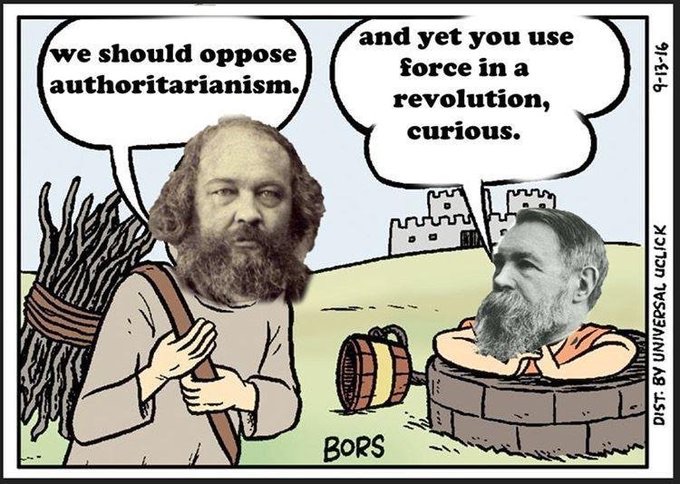
A number of Socialists have latterly launched a regular crusade against what they call the principle of authority. It suffices to tell them that this or that act is authoritarian for it to be condemned. This summary mode of procedure is being abused to such an extent that it has become necessary to look into the matter somewhat more closely.

Authority, in the sense in which the word is used here, means: the imposition of the will of another upon ours; on the other hand, authority presupposes subordination. Now, since these two words sound bad, and the relationship which they represent is disagreeable to the subordinated party, the question is to ascertain whether there is any way of dispensing with it, whether — given the conditions of present-day society — we could not create another social system, in which this authority would be given no scope any longer, and would consequently have to disappear.

On Authority

Karl Marx & Frederick Engels: Volume 23, 1871-74

Philippine ruling elite whips up anti-China campaign to justify alignment with US war plans

As the United States steps up its campaign to provoke China into war, the Philippines has lined up behind Washington, increasingly transforming the country into a lead attack dog in the region for American imperialism. Seeking to obscure the fact that the country has now been placed on the front lines of a catastrophic conflict, the Philippine ruling elite is demonizing China and people of Chinese ethnicity with absurd and lurid claims that Beijing is infiltrating spies into the country.

Philippine ruling elite whips up anti-China campaign to justify alignment with US war plans

Lenin: Socialism and Religion

Lenin: Socialism and Religion

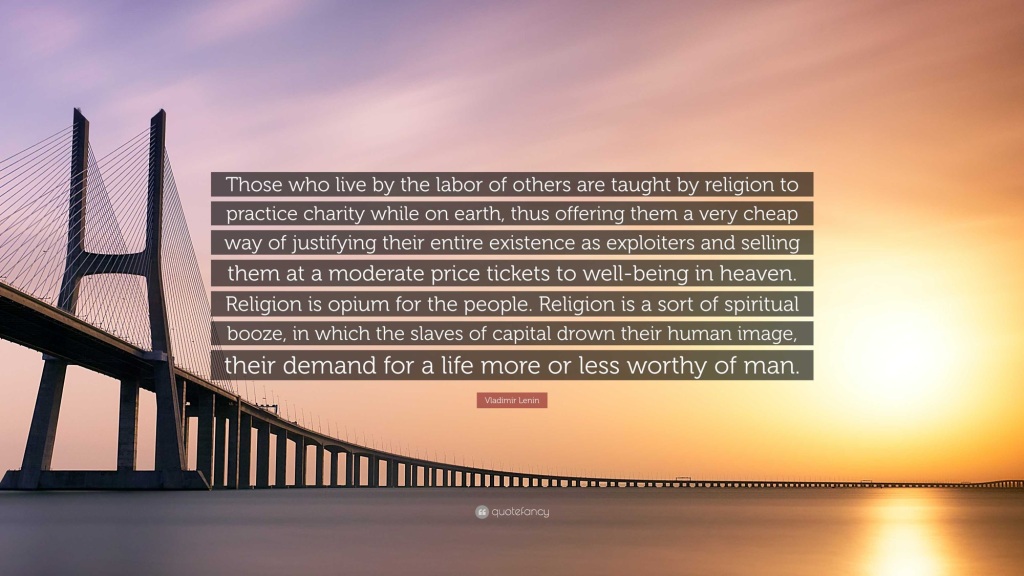
The economic oppression of the workers inevitably calls forth and engenders every kind of political oppression and social humiliation, the coarsening and darkening of the spiritual and moral life of the masses. The workers may secure a greater or lesser degree of political liberty to fight for their economic emancipation, but no amount of liberty will rid them of poverty, unemployment, and oppression until the power of capital is overthrown. Religion is one of the forms of spiritual oppression which everywhere weighs down heavily upon the masses of the people, over burdened by their perpetual work for others, by want and isolation. Impotence of the exploited classes in their struggle against the exploiters just as inevitably gives rise to the belief in a better life after death as impotence of the savage in his battle with nature gives rise to belief in gods, devils, miracles, and the like. Those who toil and live in want all their lives are taught by religion to be submissive and patient while here on earth, and to take comfort in the hope of a heavenly reward. But those who live by the labour of others are taught by religion to practise charity while on earth, thus offering them a very cheap way of justifying their entire existence as exploiters and selling them at a moderate price tickets to well-being in heaven. Religion is opium for the people. Religion is a sort of spiritual booze, in which the slaves of capital drown their human image, their demand for a life more or less worthy of man.

Read More »

The Fascist Mimicry of Anti-Imperialism

A little more than a century ago the world’s superpower was the British Empire. Despite being a constitutional monarchy where the aristocracy and monarchy still retained significant power, the British Empire was arguably the birthplace of the industrial revolution and it played a significant role in spreading capitalism around the world through colonialism. From around the 19th century until the early 20th century, many saw the British Empire as quite possibly the most affluent and powerful capitalist-colonial empire in the world. The British Empire as the capitalist-colonial hegemon extracts resources from its colonies, transforms them into commodities, and sells them for a profit that would go into the pockets of capitalists and royal colonizers alike. There were other competing colonizers such as France, The Netherlands, Spain, Portugal, Germany, Japan, and the U.S., but none of them (except the U.S. in the late 20th century) could quite surpass the British Empire. The British Empire was the largest epicenter of world capitalist imperialism and being an anti-imperialist was almost (though not quite) synonymous with being against the British Empire. The geopolitical status of the British Empire is roughly or loosely analogous to the geopolitical status that the U.S. enjoyed since the late 20th century. Both the British Empire and the U.S. enjoy the status of being a hegemonic empire due to their overwhelmingly powerful military (especially their navy) and almost unparalleled economic power.

The Fascist Mimicry of Anti-Imperialism

The Foreign Policy of the Russian Revolution

Source

No idea could be more erroneous or harmful than to separate foreign from home policy. The monstrous falsity of this separation becomes even more monstrous in war-time. Yet the bourgeoisie are doing everything possible and impossible to suggest and promote this idea. Popular ignorance of foreign policy is incomparably greater than of home policy. The “secrecy” of diplomatic relations is sacredly observed in the freest of capitalist countries, in the most democratic republics.

The Foreign Policy of the Russian Revolution