
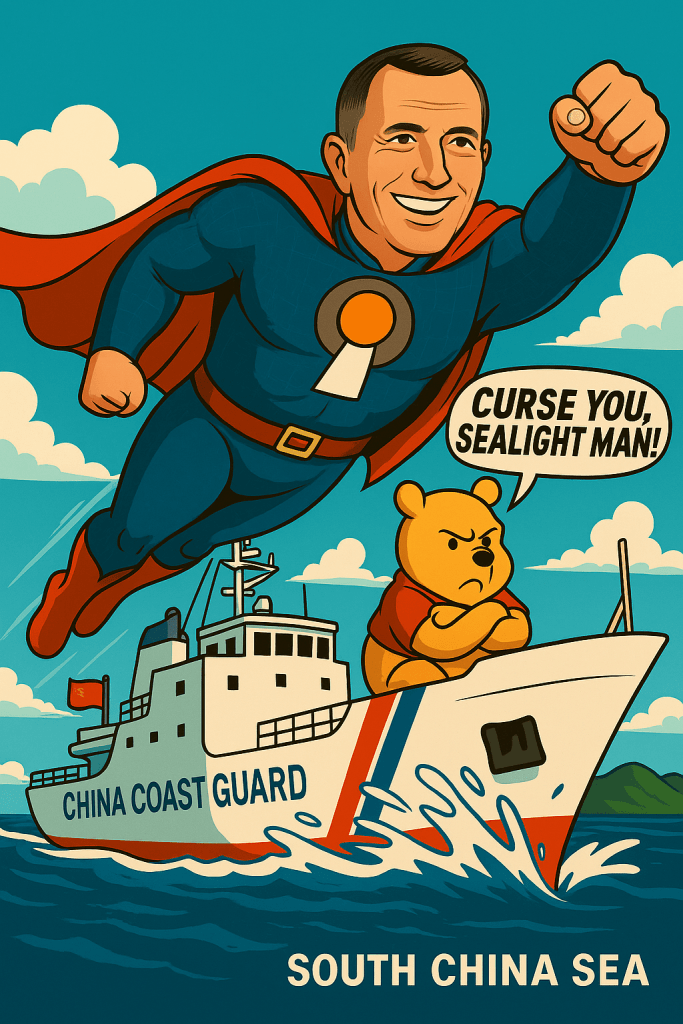
Capes, Cameras, and the Cult of Visibility

Capes, Cameras, and the Cult of Visibility: The SeaLight Crusade as White Savior Theater

By Tina Antonis

The South China Sea is more than a maritime dispute—it’s a theater of narrative warfare. While headlines focus on Chinese aggression and Philippine resistance, a quieter campaign unfolds in the background: one of satellite feeds, curated imagery, and Pentagon-backed storytelling. At the center of this effort is SeaLight, a project that claims to illuminate truth but often casts shadows of its own.

As explored in my article at Antiwar.com, SeaLight doesn’t just document—it performs. It reframes geopolitical tension through moral spectacle, positioning its creators as heroic arbiters of transparency. But when the messenger wears a cape and the funding flows from defense budgets, we must ask: is this clarity, or choreography?

Stage Left: The White Savior Enters

In the comic-strip cosmology of Ray Powell’s SeaLight project, transparency wears a cape. Clad in heroic postures and backed by satellite imagery, Powell casts himself as the guardian of maritime morality—unarmed, except with satellite feeds, theatrical flair, and strategic messaging. 

Yet beneath the cartoon and Pentagon-funded optics lies a familiar archetype: the white savior, rebranded for the South China Sea.

China Is Imperialist? Says Who?

Calling China a “maritime occupier,” Powell positions himself as a bulwark against aggression. But that moral pose collapses under scrutiny. He speaks for a country with over 800 foreign military installations and a documented history of over 250 military interventions since 1991—wars in Iraq, Afghanistan, Libya, Syria, Somalia, and dozens more, all under the banner of peace, freedom, or preemption.

By comparison, China’s post–Cold War footprint includes no sustained foreign occupations and only scattered border conflicts and peacekeeping missions. The imbalance is staggering. And Powell’s framing doesn’t just ignore it—it performs around it.

As David Vine argues in The United States of War, this vast base empire is not a passive network—it’s an architecture of perpetual war. These outposts make military engagement not an exception but a structural habit, cloaked in strategic necessity and sold as global stewardship.

Powell’s cartoon rhetoric—calling China an occupier—obscures the scale of U.S. militarism. The term “occupation” is deployed not to analyze, but to project. When adversaries hold territory, it’s a crisis; when the U.S. spans the globe with armed installations, it’s policy.

Framing Conflict: The Optics of Consent

This isn’t irony. It’s performance. Powell’s language manufactures a moral frame for confrontation—costumed in transparency, but driven by escalation. The cape is literal. The conditioning is deliberate. And the stage is set for war.

SeaLight’s mission is not just visual documentation—it’s narrative warfare. As the Japan Times openly notes, its “chief weapon is photography, applied purposefully, generously and consistently over time.” These images—enhanced, curated, and distributed across media—are not neutral. They’re constructed to shape public perception, sway international opinion, and ultimately manufacture consent for confrontation.

Assertive transparency becomes a kind of ideological scaffolding—a stage on which geopolitical tension is dramatized, simplified, and morally polarized. The goal isn’t simply to reveal conflict; it’s to condition audiences for escalation.

And when the messenger dons a superhero’s cape, the spectacle transforms into something deeper: a story of rescue, of virtue, of intervention. This is not analysis—it’s soft propaganda dressed in heroic metaphor.

Consent for war doesn’t begin with missiles. It begins with mythmaking.

What’s Really Going On In the South China Sea Between the Philippines and China

What’s Really Going On In the South China Sea Between the Philippines and China

by Tina Antonis

Maritime clashes between the Philippines and China had been mostly over the Philippines’ military outpost, BRP (BRP—Barko ng Republika ng Pilipinas, which translates to “Ship of the Republic of the Philippines”—the ship prefix for the Philippines) Sierra Madre, in the Spratly Islands, which is disputed by Brunei, China, Malaysia, the Philippines, Taiwan (a province of China, as recognized by the United Nations’ Resolution No. 2758), and Vietnam. The BRP Sierra Madre was intentionally run aground on a reef near the Second Thomas Shoal in the disputed Spratly Islands, in 1997, so that the Philippines could stake their territorial claim.

Read More »

NO to US-BBM War, NO to EDCA Bases! Blinken-Austin Get Out, Stay Out!

The Philippines and China have just restored peace and stability in the areas of the South China Sea contested by the two countries in a July 21, 2024 “de-escalation” deal that aimed at “easing tensions.”

NO to US-BBM War, NO to EDCA Bases!
Blinken-Austin Get Out, Stay Out!

Related:

NO to US-BBM War, NO to EDCA Bases! – Cebu

NO to US-BBM War, NO to EDCA Bases! Blinken-Austin Get Out, Stay Out! Forum Statement

Washington’s Use and Abuse of the Philippines Takes Next Step

Philippines: Expose and denounce the American warmonger Col. Raymond Powell

😹

Source

Fight Back News Service is circulating the following statement from the Communist Party of the Philippines.

Former US air force colonel, Raymond M. Powell, is an active psywar operative, interventionist, war-monger and American agent-provocateur. From an obscure career in the US military, he has been receiving much air time from big Philippine media organizations since last year, touted as a “security analyst” and “expert on maritime issues.”

Philippines: Expose and denounce the American warmonger Col. Raymond Powell

Previously:

Observations on the pundits in the PH media

Philippine Sailor Severely Injured, Vessels Damaged as Chinese Block South China Sea Mission + Notes

Source

It was the Philippines that rammed the CCG!* US-funded Rappler** doesn’t mention the other soldiers who were injured.

Philippine Sailor Severely Injured, Vessels Damaged as Chinese Block South China Sea Mission

Meanwhile, a Philippine government release from the National Task Force on the West Philippine Sea stated that ships from the People’s Liberation Army Navy, China Coast Guard and Chinese Maritime Militia performed “dangerous maneuvers.” However, there is no mention of injury to Philippine personnel in the release. The statement also claimed that Chinese forces rammed and towed Philippine vessels, although it’s unclear to what extent the latter occurred during the incident. This is the first reported instance of China towing – defined as pulling, pushing or hauling – Philippine vessels in their South China Sea disputes.

Related:

Read More »

Manila’s persistent claimjumping efforts display the extent of its avariciousness

Manila’s persistent claimjumping efforts display the extent of its avariciousness

The latest incident in the waters adjacent to China’s Ren’ai Reef [AKA Second Thomas Shoal], in which there was slight collision when an illegally intruding Philippine supply ship dangerously approached a China Coast Guard vessel, is the latest in a series of risky encounters between Chinese law enforcement vessels and Philippine vessels near Ren’ai Reef in recent months due to the Philippines’ brazen land-grabbing antics.

Such incidents have occurred with increasing frequency as the Philippines has stepped up its efforts to ship construction materials to an aging warship it deliberately ran aground on the reef so it can make it a permanent facility, thus driving in its stake to claim the reef as its territory.

With new procedures coming into effect on June 15, the China Coast Guard will be equipped with more forceful legal measures to enforce maritime law and advance China’s maritime legal governance in its territorial waters, including detaining foreign ships that have illegally entered China’s waters.

Related:

China and Philippines Quarrel over South China Sea Collision

U.S. Ambassador to the Philippines MaryKay Carlson condemned China’s “aggressive, dangerous” maneuvers in a post on X, saying the collision had “caused bodily injury.”

In response, the Philippine coastguard said on Monday it has ordered the deployment of two vessels to patrol and ensure the safety of Filipino fishermen at Scarborough Shoal – a second flashpoint about 640 km (345 nautical miles) away from Second Thomas Shoal.

Separately, the U.S. Pacific Fleet said in a statement it had concluded a two-day joint maritime exercise with the militaries of Canada, Japan, and the Philippines’ within Manila’s EEZ in the South China Sea.

Philippines’ grounding warship illegal, escalating tensions unacceptable: Chinese FM (videos)

The Philippines released the video of CCG ‘stealing’ supplies after China released the footage of the gunmen on the BRP Sierra Madre. This, after BBM said that any Filipino death would trigger the US-PH Mutual Defense Treaty.

Full video

Philippines’ grounding warship illegal, escalating tensions unacceptable: Chinese FM

Source

Philippine Marines Drew Firearms as China Seized Second Thomas Shoal Airdrop, Says Philippine Military Chief

Source

BBM: Any Filipino death from foreign attack triggers US-PH defense pact (US government-funded Rappler)

Full video

H/T: rhk111

WikiSpooks: Rappler (Sponsored by Facebook, Friedrich Naumann Foundation, Google, Internews, National Endowment for Democracy, Open Society Foundations, Omidyar Network)

China exposes Philippines’ reneging on South China Sea commitment

Source

Related:

China exposes Philippines’ reneging on South China Sea commitment

Wang pointed out that the Philippines has made a solemn promise to tow away the military vessel illegally grounded at Ren’ai Jiao, noting that 25 years have passed, and the Philippines has still not towed away the warship.

Noting that the Philippines has violated the understanding reached between the two sides on the proper management of the situation on Ren’ai jiao, the spokesperson said despite the Philippines’ commitment not to reinforce the grounded warship and to notify China in advance of any plans to resupply it, China, out of humanitarian considerations, has made temporary special arrangements for Philippine vessels transporting necessary supplies to the warship multiple times.

“However, the Philippines continues to send government vessels and warships to forcibly enter Ren’ai Jiao, attempting to transport construction materials for large-scale repairs and reinforcement of the warship in order to achieve permanent occupation of Ren’ai Jiao,” Wang said.

PH did promise to remove BRP Sierra Madre from Ayungin

Philippines Budgets for a Permanent Base at Second Thomas Shoal

It’s Time to Build Combined Forward Operating Base Sierra Madre