TikTok defenders emerge in Congress

TikTok defenders emerge in Congress

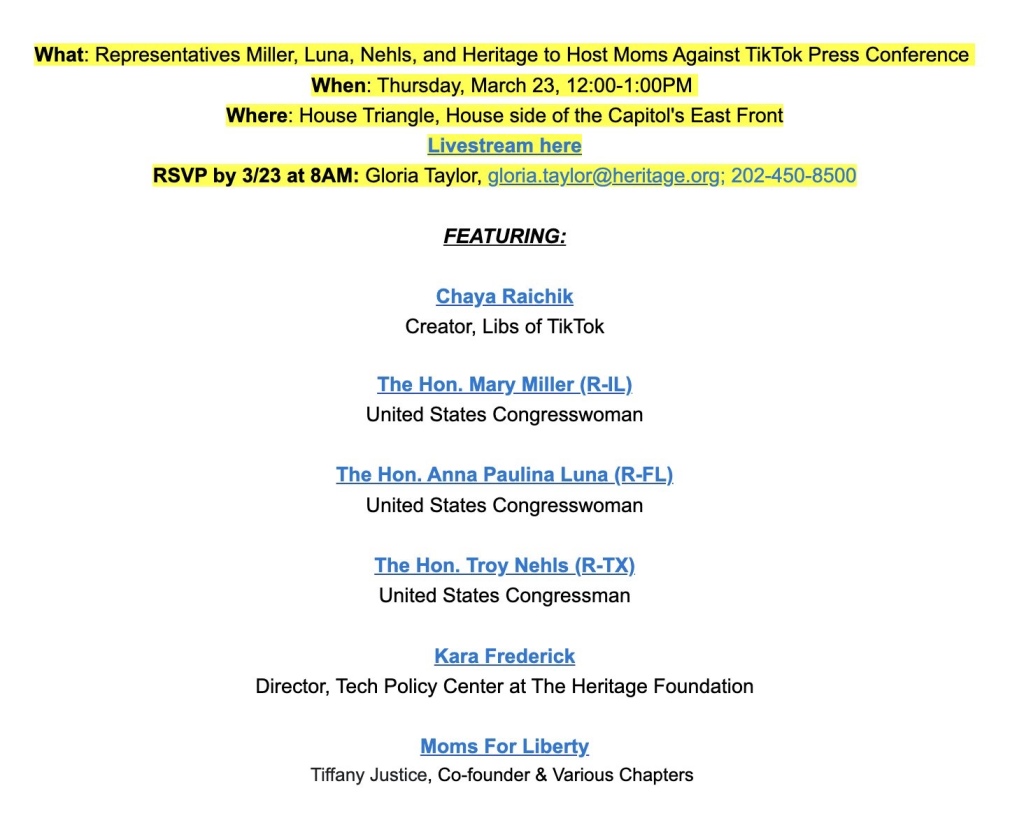
The other side: Reps. Mary Miller (R-Ill.), Anna Paulina Luna (R-Fla.) and Troy Nehls (R-Texas) are holding a competing “Moms Against TikTok” press conference at the Capitol on Thursday to press for a ban.

The speakers include a staffer for the conservative Heritage Foundation and Chaya Raichik, the operator of “Libs of TikTok.”

Source: Twitter

Related Notes:

Read More »

Yes, The US Government Threatening To Block TikTok Violates The 1st Amendment

You may have heard that the Biden administration has told TikTok that it must be divested from ByteDance or it will be banned in the US. At least that’s what TikTok said the administration has said. The end result of this might well be that ByteDance divests of TikTok, but we should be clear: the threat, and any potential block, would be a clear, blatant, dangerous violation of the 1st Amendment.

Yes, The US Government Threatening To Block TikTok Violates The 1st Amendment

Previously:

The US government is trying to force ByteDance to sell TikTok

U.S. Press Starts To Figure Out College TikTok Bans Are A Dumb Performance

U.S. Press Starts To Figure Out College TikTok Bans Are A Dumb Performance

One, the bans are generally designed to agitate a xenophobic base and give the impression the GOP is “doing something about China.” But the party that couldn’t care less about rampant corruption or privacy violations isn’t doing much of anything meaningful to thwart China. In fact, letting adtech, telecom, and app companies run rampant with little oversight runs contrary to any such goal.

Two, the bans distract the public and press from our ongoing failure on consumer privacy and security issues. Banning TikTok, but doing nothing about the accountability optional free for all that is the adtech and data-hoovering space, doesn’t actually fix anything. China can just obtain the same data from a universe of other international companies facing little real oversight on data collection.

Three, the ban is really just about money. Trump gave the game away with his proposal that TikTok be chopped up and sold to Oracle and Walmart. That cronyistic deal fell through, but it’s pretty clear that this moral panic is designed to either help TikTok’s competitors (Facebook lobbyists are very active on this front), or force the sale of the most popular app in modern history to GOP-allies. At which point they’ll engage in all the surveillance and influence efforts they pretend to be mad about.

Related:

Read More »

Rubio’s Bill To Ban TikTok Is A Dumb Performance That Ignores The Real Problem

For several years we’ve noted how most of the calls to ban TikTok are bad faith bullshit made by a rotating crop of characters that not only couldn’t care less about consumer privacy, but are directly responsible for the privacy oversight vacuum TikTok (and everybody else) exploits.

Rubio’s Bill To Ban TikTok Is A Dumb Performance That Ignores The Real Problem

Related:

Senate passes bill banning TikTok from government devices

South Dakota Bans Government Employees From Using TikTok. The Countless Other Apps And Services That Hoover Up And Sell Sensitive Data Are Fine, Though

South Dakota Governor Kristi Noem put on a bit of a performance this week by announcing that the state would be banning government employees from installing TikTok on their phones. The effort, according to the Governor, is supposed to counter the national security risk of TikTok sharing consumer data with the Chinese government:

South Dakota Bans Government Employees From Using TikTok. The Countless Other Apps And Services That Hoover Up And Sell Sensitive Data Are Fine, Though

Related:

Oracle Cloud Data Center Locations

Oracle’s coziness with [US] government goes back to its founding

TikTok is such a danger, to national security, that US politicians have used it for campaigning, a tool of war propaganda, and former NATO employees work for them! Besides, TikTok stores user data with Oracle! This moral panic, over TikTok, is all about competition!

Techbro Influencer Scott Galloway Heads To The Fainting Couch Over TikTok

Techbro Influencer Scott Galloway Heads To The Fainting Couch Over TikTok

This week, Galloway spent his time pushing the hot DC claim du jour: that TikTok is a profound menace to the planet and should be banned. He made the point at the Vox Code conference, then hopped over to Bill Maher’s HBO show to make a similar pronouncement:

Actual evidence of TikTok being uniquely dangerous (especially any indication China has used or could use TikTok to bedazzle U.S. children) has been sorely lacking, but that doesn’t stop folks from heading to the fainting couches. This face fanning has been especially popular among a certain set of xenophobic DC politicians, and companies that don’t want to have to directly compete with China.

The problem: the U.S. is a corrupt, xenophobic, superficial dumpster fire, so most of the “solutions” to this potential problem have been stupid and performative.

Here’s the thing: you could ban TikTok immediately, and China could hoover up location, browsing, and behavior data from an ocean of completely unaccountable and hugely shady data brokers and middlemen. And they can do that because U.S. privacy and security standards are hot garbage. And in some instances, they’re hot garbage because of the same people now complaining about TikTok.

Both Carr and Cruz have extensive histories of undermining regulatory oversight and privacy rules at absolutely every opportunity, yet both are lauded by Galloway in a blog post for being heroic leaders in the “ban TikTok” crusades. Galloway’s a top pundit, yet somehow can’t see that Carr and Cruz are engaged in a zero-calorie xenophobic theatrics, and couldn’t care less about actual consumer privacy.

For literally thirty straight years, at absolutely every single turn, we prioritized making money over transparency or consumer privacy. As a result, consumer privacy protections are garbage, regulators are toothless, governments exploit the attention economy to avoid having to get warrants, and any idiot with a nickel can easily build gigantic, hugely detailed profiles about your everyday life without your consent.

“Banning TikTok” does nothing meaningful if you’re genuinely interested in meaningful surveillance and privacy reform. There will always be another TikTok. There’s an ocean of companies engaging in the same or worse behavior as TikTok because we’ve sanctioned this kind of guardrail-optional hyper-collection and monetization of consumer behavioral data at every step of the way.

Many of the folks beating the “ban TikTok” drum may be well intentioned but just don’t really understand how broken the consumer privacy landscape is. They may not understand that this is a problem that’s exponentially more complicated than just what we do with a single app. Freaking out exclusively about a single app tells me you either don’t really understand the data-hoovering monster we’ve built, or don’t really care if anybody other than China exploits it (waves tiny American flag patriotically).

Many of the other folks calling for a TikTok ban aren’t operating in good faith. Facebook/Meta, for example, spends a lot of time spreading scary stories about TikTok in the press and DC because they want to crush a competitive threat they’ve been incapable of out-innovating. Similar, Politico’s owner is on the Netflix board and simply wants to curtail what he sees as a threat to market and advertising mindshare.

Then there’s just a ton of Silicon Valley folks who believe they inherently own and deserve the advertising market share TikTok occupies. And then of course there’s just a whole bunch of rank bigots who are mad because darker skinned human beings built a popular app, and try to hide this bigotry behind patriotic, pseudo national security concerns.

All of this converges to create a stupid, soupy mess that’s devoid of any actual fixes to any actual problems. Hyper surveillance and propaganda are very real problems that require a dizzying array of complicated fixes, including media and privacy policy reform, antitrust reform, tougher consumer protection standards, education reform, and a meaningful privacy law for the internet era.

Previously:

The NATO to TikTok Pipeline: Why is TikTok Employing So Many National Security Agents?

The White House is briefing TikTok stars about the war in Ukraine

UK uses TikTok influencers to urge teens to get jab after Pfizer-linked vaccine committee chair admits policy lacks evidence + White House enlists army of social media influencers to promote COVID-19 vaccines

The Myopic Focus On TikTok Privacy Issues Remains Kind Of Weird + Facebook-Hired PR Firm Coordinated Anti-TikTok Campaign To Spread Bogus Moral Panics

Generic Disclaimer: The statements, views and opinions expressed in the following articles are solely those of the author and do not necessarily represent those of this site.

The Myopic Focus On TikTok Privacy Issues Remains Kind Of Weird

Related:

Facebook-Hired PR Firm Coordinated Anti-TikTok Campaign To Spread Bogus Moral Panics

The NATO to TikTok Pipeline: Why is TikTok Employing So Many National Security Agents?

If TikTok is such a threat, why did the Biden Administration train TikTok influencers to propagandize others about Russia’s special military operation?! Even though TechDirt makes some good points (privacy laws and the xenophobia), it seems like they—and Buzzfeed—are just creating another moral panic!

The NATO to TikTok Pipeline: Why is TikTok Employing So Many National Security Agents?

by Alan Macleod

TikTok has become an enormously influential medium that reaches over one billion people worldwide. Having control over its algorithm or content moderation means the ability to set the terms of global debate and decide what people see. And what they don’t.

The NATO to TikTok Pipeline: Why is TikTok Employing So Many National Security Agents?

Related:

The National Democratic Institute for International Affairs (NDI) is one of the main components of the regime change organization National Endowment for Democracy (NED); that is, NED channels its funds through four organizations, and NDI is one of them, to “promote free, fair, transparent democratic elections but in such a way that it would assure that power went to the elites and not to the people”.

National Democratic Institute

National Democratic Institute for International Affairs