We often hear that the new Trump administration inaugurates the age of technofeudalism. Just look at Elon Musk, pontificating about so-called “Department of Government Efficiency” (DOGE) democracy from the Oval Office while undemocratically occupying the US Treasury payment system. But is the administration simply using bullying as a mode of power, as Adam Tooze recently diagnosed it, destroying institutions without measure or plan?
“I’m a propagandist, I’ll twist the truth, I’ll put forward only my version of it if I think that’s going to propagandize people to believe what I need them to believe.” – Palmer Luckey
The question of women’s liberation is central to any revolutionary project, and thus so is the question of “sex work.” Esperanza Fonseca’s contribution, although coming from a Maoist political orientation with which we often have differences, [1] makes the stakes of this debate crystal clear, as she combines personal experience, public policy research, and historical materialism to argue that Marxists cannot uphold what she calls “sex-trade-expansionary feminism.”
Content Warning: Descriptions of rape.
…
The right of the subordinated classes of men to buy access to women’s bodies has been used historically to break class solidarity in order to maintain the dominant social relations of the time. This was true in feudal Europe and remains true today: when proletarian and petit bourgeois men get to buy women too, they develop a false consciousness and build solidarity with bourgeois men of their own gender rather than aligning with women of their own class. And because the overthrow of capitalism is only possible by the overthrowing of the bourgeoisie, prostitution serves two great purposes: (1) allows bourgeois men access to a reserve army of women for their pleasure, and (2) prevent class consciousness and thus helps stop the proletariat from organizing as a class.
The economic oppression of the workers inevitably calls forth and engenders every kind of political oppression and social humiliation, the coarsening and darkening of the spiritual and moral life of the masses. The workers may secure a greater or lesser degree of political liberty to fight for their economic emancipation, but no amount of liberty will rid them of poverty, unemployment, and oppression until the power of capital is overthrown. Religion is one of the forms of spiritual oppression which everywhere weighs down heavily upon the masses of the people, over burdened by their perpetual work for others, by want and isolation. Impotence of the exploited classes in their struggle against the exploiters just as inevitably gives rise to the belief in a better life after death as impotence of the savage in his battle with nature gives rise to belief in gods, devils, miracles, and the like. Those who toil and live in want all their lives are taught by religion to be submissive and patient while here on earth, and to take comfort in the hope of a heavenly reward. But those who live by the labour of others are taught by religion to practise charity while on earth, thus offering them a very cheap way of justifying their entire existence as exploiters and selling them at a moderate price tickets to well-being in heaven. Religion is opium for the people. Religion is a sort of spiritual booze, in which the slaves of capital drown their human image, their demand for a life more or less worthy of man.
…But whether you might not be doing more harm than good with your anti-Semitism is something I would ask you to consider. Foranti-Semitism betokens a retarded culture, which is why it is found only in Prussia and Austria, and in Russia too. Anyone dabbling in anti-Semitism, either in England or in America, would simply be ridiculed, while in Paris the only impression created by M. Drumont’s writings – wittier by far than those of the German anti-Semites – was that of a somewhat ineffectual flash in the pan.
To him, Free Trade is the normal condition of modern capitalist production. Only under Free Trade can the immense productive powers of steam, of electricity, of machinery, be full developed; and the quicker the pace of this development, the sooner and the more fully will be realized its inevitable results; society splits up into two classes, capitalists here, wage-laborers there; hereditary wealth on one side, hereditary poverty on the other; supply outstripping demand, the markets being unable to absorb the ever growing mass of the production of industry; an ever recurring cycle of prosperity, glut, crisis, panic, chronic depression, and gradual revival of trade, the harbinger not of permanent improvement but of renewed overproduction and crisis; in short, productive forces expanding to such a degree that they rebel, as against unbearable fetters, against the social institutions under which they are put in motion; the only possible solution: a social revolution, freeing the social productive forces from the fetters of an antiquated social order, and the actual producers, the great mass of the people, from wage slavery. And because Free Trade is the natural, the normal atmosphere for this historical evolution, the economic medium in which the conditions for the inevitable social revolution will be the soonest created – for this reason, and for this alone, did Marx declare in favor of Free Trade.
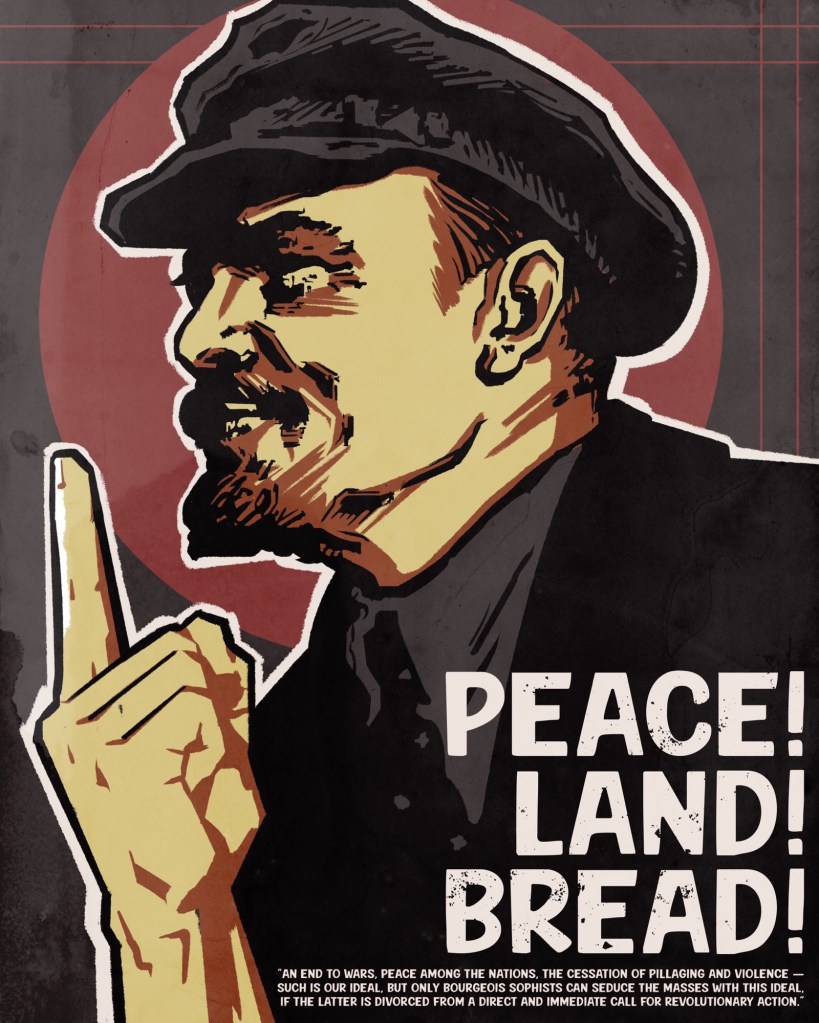
“Socialists have always condemned war between nations as barbarous and brutal. But our attitude towards war is fundamentally different from that of the bourgeois pacifists (supporters and advocates of peace) and of the anarchists. We differ from the former in that we understand the inevitable connection between wars and the class struggle within the country; we understand that war cannot be abolished unless classes are abolished and socialism is created; and we also differ in that we fully regard civil wars, ie, wars waged by the oppressed class against the oppressing class, slaves against slave-owners, serfs against land-owners, and wage-workers against the bourgeoisie, as legitimate, progressive and necessary.”
In the two revolutionary years of 1848-49 the League proved itself in two ways. First, its members everywhere involved themselves energetically in the movement and stood in the front ranks of the only decisively revolutionary class, the proletariat, in the press, on the barricades and on the battlefields. The League further proved itself in that its understanding of the movement, as expressed in the circulars issued by the Congresses and the Central Committee of 1847 and in the Manifesto of the Communist Party, has been shown to be the only correct one, and the expectations expressed in these documents have been completely fulfilled. This previously only propagated by the League in secret, is now on everyone’s lips and is preached openly in the market place. At the same time, however, the formerly strong organization of the League has been considerably weakened. A large number of members who were directly involved in the movement thought that the time for secret societies was over and that public action alone was sufficient. The individual districts and communes allowed their connections with the Central Committee to weaken and gradually become dormant. So, while the democratic party, the party of the petty bourgeoisie, has become more and more organized in Germany, the workers’ party has lost its only firm foothold, remaining organized at best in individual localities for local purposes; within the general movement it has consequently come under the complete domination and leadership of the petty-bourgeois democrats. This situation cannot be allowed to continue; the independence of the workers must be restored. The Central Committee recognized this necessity and it therefore sent an emissary, Joseph Moll, to Germany in the winter of 1848-9 to reorganize the League. Moll’s mission, however, failed to produce any lasting effect, partly because the German workers at that time had not enough experience and partly because it was interrupted by the insurrection last May. Moll himself took up arms, joined the Baden-Palatinate army and fell on 29 June in the battle of the River Murg. The League lost in him one of the oldest, most active and most reliable members, who had been involved in all the Congresses and Central Committees and had earlier conducted a series of missions with great success. Since the defeat of the German and French revolutionary parties in July 1849, almost all the members of the Central Committee have reassembled in London: they have replenished their numbers with new revolutionary forces and set about reorganizing the League with renewed zeal
During his second term as the president of the Bolivarian Republic of Venezuela, Nicolás Maduro has achieved fundamental milestones to overcome the crises generated by the far-right opposition and the United States. These achievements have led the country towards political, economic, and social stability. They have strengthened his leadership within Chavismo and have positioned him as the natural candidate to represent the Bolivarian Revolution in the presidential election scheduled for July 28 this year.
Since the writing of The Communist Manifesto and the founding of the First International, proletarian internationalism has been a cornerstone of scientific socialism, and is a pillar of Marxism-Leninism. Today, in the era of imperialism, putting genuine proletarian internationalism into practice demands that we be consistent anti-imperialists.




 Ms. Cat’s Chronicles
You must be logged in to post a comment.