
Lenin: Socialism and Religion

Lenin: Socialism and Religion

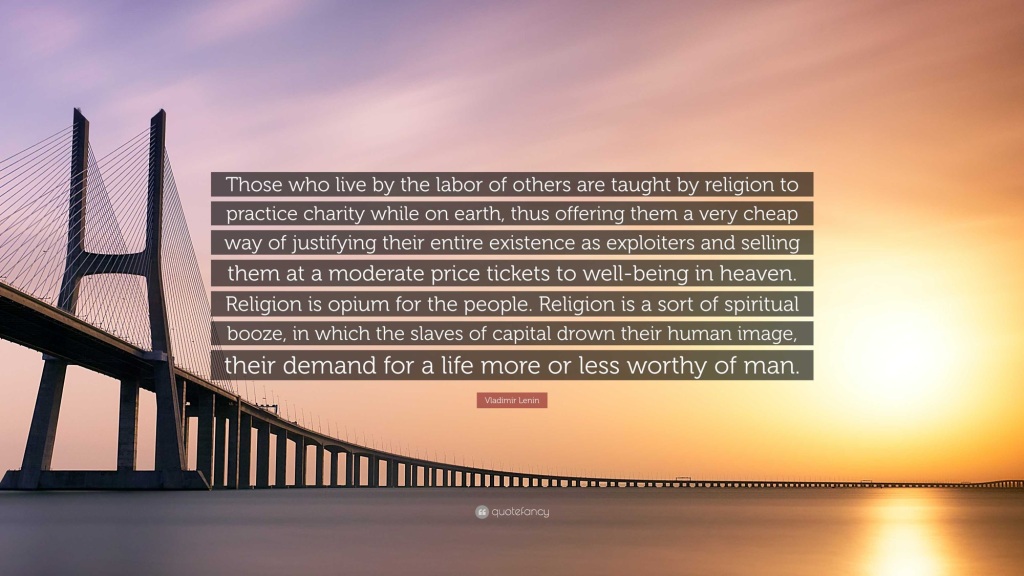
The economic oppression of the workers inevitably calls forth and engenders every kind of political oppression and social humiliation, the coarsening and darkening of the spiritual and moral life of the masses. The workers may secure a greater or lesser degree of political liberty to fight for their economic emancipation, but no amount of liberty will rid them of poverty, unemployment, and oppression until the power of capital is overthrown. Religion is one of the forms of spiritual oppression which everywhere weighs down heavily upon the masses of the people, over burdened by their perpetual work for others, by want and isolation. Impotence of the exploited classes in their struggle against the exploiters just as inevitably gives rise to the belief in a better life after death as impotence of the savage in his battle with nature gives rise to belief in gods, devils, miracles, and the like. Those who toil and live in want all their lives are taught by religion to be submissive and patient while here on earth, and to take comfort in the hope of a heavenly reward. But those who live by the labour of others are taught by religion to practise charity while on earth, thus offering them a very cheap way of justifying their entire existence as exploiters and selling them at a moderate price tickets to well-being in heaven. Religion is opium for the people. Religion is a sort of spiritual booze, in which the slaves of capital drown their human image, their demand for a life more or less worthy of man.

Read More »

The Fascist Mimicry of Anti-Imperialism

A little more than a century ago the world’s superpower was the British Empire. Despite being a constitutional monarchy where the aristocracy and monarchy still retained significant power, the British Empire was arguably the birthplace of the industrial revolution and it played a significant role in spreading capitalism around the world through colonialism. From around the 19th century until the early 20th century, many saw the British Empire as quite possibly the most affluent and powerful capitalist-colonial empire in the world. The British Empire as the capitalist-colonial hegemon extracts resources from its colonies, transforms them into commodities, and sells them for a profit that would go into the pockets of capitalists and royal colonizers alike. There were other competing colonizers such as France, The Netherlands, Spain, Portugal, Germany, Japan, and the U.S., but none of them (except the U.S. in the late 20th century) could quite surpass the British Empire. The British Empire was the largest epicenter of world capitalist imperialism and being an anti-imperialist was almost (though not quite) synonymous with being against the British Empire. The geopolitical status of the British Empire is roughly or loosely analogous to the geopolitical status that the U.S. enjoyed since the late 20th century. Both the British Empire and the U.S. enjoy the status of being a hegemonic empire due to their overwhelmingly powerful military (especially their navy) and almost unparalleled economic power.

The Fascist Mimicry of Anti-Imperialism

[2019] Is Russia imperialist?

Source

Russia is said to be an imperialist world power, one in conflict with the imperialist superpower, the U.S. Russia has been characterized in this manner both during the period of the Soviet Union, and after the Soviet Union collapsed and separate states were formed. Russia has said to be imperialist both when it was a socialist state and now as a capitalist state.

Is Russia imperialist?

Related:

Georgia started war with Russia: EU-backed report (archived)

Russia and China Are Not Imperialist

Anti-Coup Rebellion in Eastern Ukraine Completes 10 Years as Russian Forces Continue Advancing in Donetsk

April 2014 was a pivotal month for the people of the Donbass region in what was then still part of Ukraine. It was then that the governing regime was newly installed in Kiev by a coup d’état on February 20/21embarked on military hostilities against the people of the region. The coup overthrew Ukraine’s elected president and legislature. It sparked rebellion in Crimea, Donbass (Lugansk and Donetsk), and in towns and cities in other regions of eastern and southern Ukraine.

Anti-Coup Rebellion in Eastern Ukraine Completes 10 Years as Russian Forces Continue Advancing in Donetsk

Marx, Spinoza, and the Political Implications of Contemporary Psychiatry

Simple logic tells us that those atop a societal hierarchy will provide rewards for professionals—be they clergy or psychiatrists—who promote an ideology that maintains the status quo, and that the ruling class will do everything possible to manipulate the public to believe that the social-economic-political status quo is natural.

Marx, Spinoza, and the Political Implications of Contemporary Psychiatry