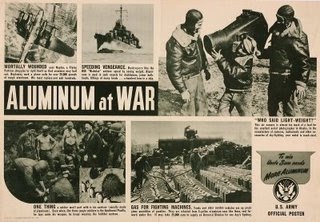
Alcoa is now the third largest aluminum producer in the world. Back in 1941, it was much more powerful. It had a monopoly on aluminum in addition to owning a massive amount of America’s electricity production and other minerals. Before America declared war on Germany, it sent so much of its aluminum product over to Germany that the country made upwards of sixty percent more aluminum products than America. When the US’s involvement in the war began, there was a massive aluminum production shortage in America, in no small part because of Alcoa’s monopoly. Alcoa essentially sold the Axis powers much of the material to build their war machines and a reprieve from the American war machine.
…
2. General Motors
Similar to their automotive rivals, General Motors was sued by Holocaust survivors for assisting the Nazi war machine. Beginning in 1935, GM built a factory in Berlin for the purpose of building “Blitz” trucks for the Wehrmacht. Ford began building similar trucks around the same time, but GM was the number one producer of the vehicles that were vital for the quick conquests of Poland, France, and much of the Soviet Union. Albert Speer, the minister of armaments and war production, claimed that the rubber GM supplied was the key to the ability of the Germans to wage war the way they did. Inevitably when America declared war on Germany, the Reich seized GM’s German production facilities.
Although neither Ford nor General Motors ever fully conceded that they had willingly participated in the use of slave labor, they both were massive contributors to a fund started in 2000 for Holocaust survivors.
Chase did not say why multiple withdrawals did not trigger a fraud alert, or why the bank did not review surveillance video — but each transaction requires entering a PIN — which the thieves had apparently captured. So always, cover the keypad, and log out before you walk away.
Each new candidate for Commission membership is carefully scrutinized before being allowed entry. As a rule, members who take up positions in their national governments — which is uncannily common — give up their Trilateral Commission membership while in public service. Those include U.S. Secretary of State Antony Blinken, Jake Sullivan, the U.S. national security adviser, Danish Prime Minister Mette Frederiksen and Indian External Affairs Minister Subrahmanyam Jaishankar.
This revolving door between the commission and senior government ranks has always been fodder for conspiracy theorists. Its first director in 1973, Zbigniew Brzezinski, later became U.S. President Jimmy Carter’s national security adviser. The very existence of the commission, meanwhile, seems predicated on the question of whether governing should be left to the people. It is a question the commission itself has tackled head-on since 1975: Is democracy functioning? Or does someone need to guide it?
That year, three scholars — Michel Crozier, Samuel Huntington and Joji Watanuki — wrote a report for The Trilateral Commission titled “The Crisis of Democracy.” In it, Huntington wrote that some of the problems of governance in the U.S. stem from an “excess of democracy.”


 Ms. Cat’s Chronicles
You must be logged in to post a comment.