
2025: Libertarian City Dream in Honduras Becomes $11 Billion Nightmare (archived)
Read More »Tag: Chicago Boys
Argentina bond market plunder explained
Argentina bond market plunder explained
4) Globalist puppet Milei slashes government spending and privatizes a whole lot of sectors. This is the neoliberal “shock therapy.”
…
Meanwhile, 54% of Argentinians are in poverty, consumer prices have tripled over the last year, the economy is in recession, and industrial production has been dwindling consistently.
Exactly as I predicted back in October 2023:
The vultures are ready to “make the economy scream” if Javier Milei wins!*
The Georgian Boys? + More
A brief sketch of Georgian neoliberal reformers continuing the tradition of the Chicago Boys in Georgia and Ukraine
Related:
Read More »María Corina Machado is the female Javier Milei (aka US Puppet)
Vente Venezuela, the party of María Corina Machado, is connected to the National Democratic Institute and the Atlas Network via the Liberal Network for Latin America (RELIAL) and Liberal International. Edmundo González is just a stand-in for her.
Vente Venezuela (work in progress)
Previously:
Are We The Baddies?
In first speech, Argentina’s Javier Milei warns nation of painful economic shock
BUENOS AIRES, Argentina — It wasn’t the most uplifting of inaugural addresses. Rather, Argentina’s newly empowered President Javier Milei presented figures to lay bare the scope of the nation’s economic “emergency,” and sought to prepare the public for a shock adjustment with drastic public spending cuts.
In first speech, Argentina’s Javier Milei warns nation of painful economic shock
Related:
With soy and lithium trade in the balance, Argentina’s Milei has a China conundrum
Argentina election 2023: what you need to know
The vultures are ready to “make the economy scream” if Javier Milei wins!*
Argentina election 2023: what you need to know
Far-right libertarian Javier Milei is leading the polls ahead of Argentina’s Oct. 22 presidential vote, but it remains a tight race between the top three candidates, three surveys showed.
Related:
Argentina election: from peso to dollar?
But dollarisation would also mean immediate recession and slump. It would have to start with a massive devaluation of the domestic peso monetary base. In a very optimistic scenario, if Argentina received a loan of say $12 billion from the IMF and used $5 billion as a reserve for the banking system and $7 billion to dollarise the monetary base, the domestic peso monetary base would still have to be reduced by nearly 400%. Argentine salaries (then in US dollars) would become among the lowest globally and poverty would rise to unprecedented levels. And Argentina is already in a recession with real GDP expected to drop by around 2% this year. So either way: peso or dollar, Argentine households would pay the price in living standards.
…
Desperation has driven many Argentines to consider a ‘libertarian, anarcho-capitalist’ as president. If this were to happen, it will be going down another blind alley. Argentina’s capitalist economy will continue to fail.
Just scratching the surface:
Read More »Chile, September 11, 1973: The Horrors of ‘the First 9/11’ Are Routinely Overlooked
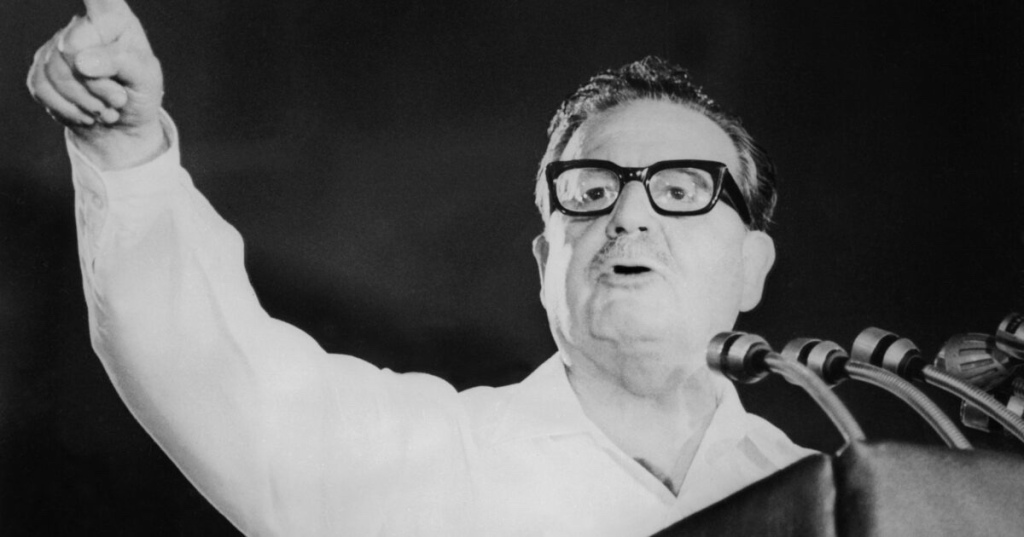
Each September large memorials are held for the 9/11 attacks on the US. Yet few recall the far more destructive 9/11 that occurred 28 years before.
Chile, September 11, 1973: The Horrors of ‘the First 9/11’ Are Routinely Overlooked
Related:
Is Argentina’s presidential frontrunner Javier Milei US’ “boy?” Rejects China+Mercosur, embraces $$
Argentina’s Milei Says He’d Reject ‘Assassin’ China, Leave Mercosur
Milei described his foreign policy proposals as a global “fight against socialists and statists,” and revealed that he would appoint Diana Mondino, a trusted economic adviser, to be his top diplomat. She’s a former Standard & Poor’s director for Argentina and is running for Congress.
Video via Emil Cosman
Related:
Read More »When Liberals Fell in Love With Benito Mussolini
When we speak of concepts like “totalitarianism” and “corporatism,” it is often assumed that fascism stands very far from the liberal market society that went before it, and which we are still experiencing today. But if we pay closer attention to Italian fascism’s economic policies, especially during the 1920s, we can see how some combinations typical of both the last century and our own were experienced already in the first years of Benito Mussolini’s rule. A case in point is the association between austerity and technocracy. By “technocracy,” I refer to the phenomenon whereby certain policies that are common today (such as cuts in social spending, regressive taxation, monetary deflation, privatizations, and wage repressions) are decided by economic experts who advise governments or even directly take over the reins themselves, as in several recent cases in Italy.
When Liberals Fell in Love With Benito Mussolini
 Ms. Cat’s Chronicles
You must be logged in to post a comment.