Beijing has accused Manila of organising a “premeditated” provocation and dangerous manoeuvres near a disputed reef in the South China Sea, and Washington of making false statements that have escalated tensions in the region.
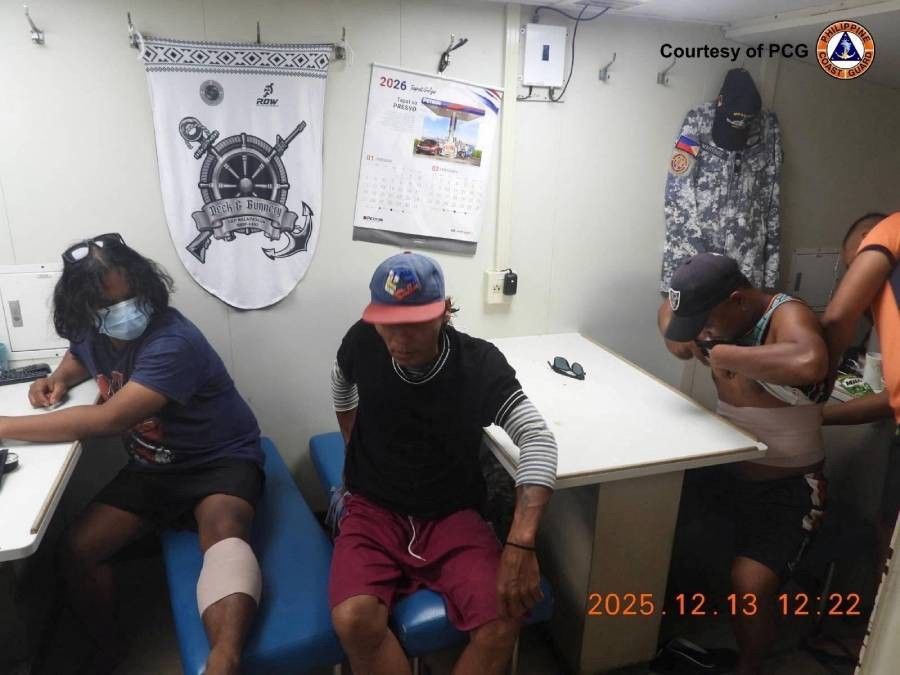
Manila said Philippine fishing boats near Sabina Shoal had been targeted with water cannons by Chinese coastguard ships in an incident on Friday, while Beijing said Philippine personnel had threatened Chinese officers with knives.
Chinese foreign ministry spokesman Guo Jiakun said on Monday that the Philippines had assembled a large number of vessels “in an organised and premeditated manner to provoke trouble” in waters near the shoal.
“This handout photo from the Philippine Coast Guard (PCG) taken and received on December 13, 2025, shows coast guard personnel attending to injured fishermen after an incident with China Coast Guard near Sabina Shoal in the South China Sea.” / [Agence France-Presse reprint]: Filipino fishermen injured in China Coast Guard encounter
China’s most straightforward method of media outreach is directly broadcasting or publishing its state media content in target ASEAN countries. Xinhua, China’s official state media agency, has print bureaus in every Southeast Asian country. TV news channels CCTV-4 and the English-language CGTN likewise operate in nearly every country in the region, while China Radio International airs multilingual content in Vietnam, Laos, Cambodia, Thailand, and Myanmar. Xinhua is a ministry-level agency directly under the State Council, while the other media organizations all operate under the Chinese Communist Party Publicity Department.
Philippine President Ferdinand Marcos Jr. said his nation won’t deploy Navy warships to the South China Sea in response to recent clashes with Beijing in disputed waters.
Thanks, Ray! Glad you noticed we’re “energetic, patriotic young journalists” — we’ll take that as a compliment! 😜
We’re proud to stand up against disinformation like yours. It’s funny how the facts and perspectives we share about the South China Sea and China make you… https://t.co/VU0pvVLuG1
Recently, Media Unlocked unveiled its latest triumph–an interview with a former U.S. president’s brother, Neil Bush, whose George H.W. Bush Foundation For U.S.-China Relations has allegedly received millions of dollars from a group associated with CCP influence operations. Bush–apparently unconcerned that he was participating in Beijing’s propaganda campaign–helpfully sang the praise of China’s communist system, its electric vehicle industry and, incredibly, even announced that he was observing a “massive freedom movement” in today’s China.
Now, let’s get into who’s funding the George H.W. Bush Foundation For U.S.-China Relations. Powell links to a Fox News article about its funding from the China–United States Exchange Foundation, based in Hong Kong. The Fox News article links to an Axios article (which is behind a paywall). Nowhere does Powell mention that the foundation also gets funding from the U.S. Department of State, The Rockefeller Foundation, etc.
At a rally in Pennsylvania on Saturday, days ahead of his confirmation as the Republican presidential nominee for the third time, Donald Trump survived what appeared to be an assassination bid.
Meanwhile, a Philippine government release from the National Task Force on the West Philippine Sea stated that ships from the People’s Liberation Army Navy, China Coast Guard and Chinese Maritime Militia performed “dangerous maneuvers.” However, there is no mention of injury to Philippine personnel in the release. The statement also claimed that Chinese forces rammed and towed Philippine vessels, although it’s unclear to what extent the latter occurred during the incident. This is the first reported instance of China towing – defined as pulling, pushing or hauling – Philippine vessels in their South China Sea disputes.
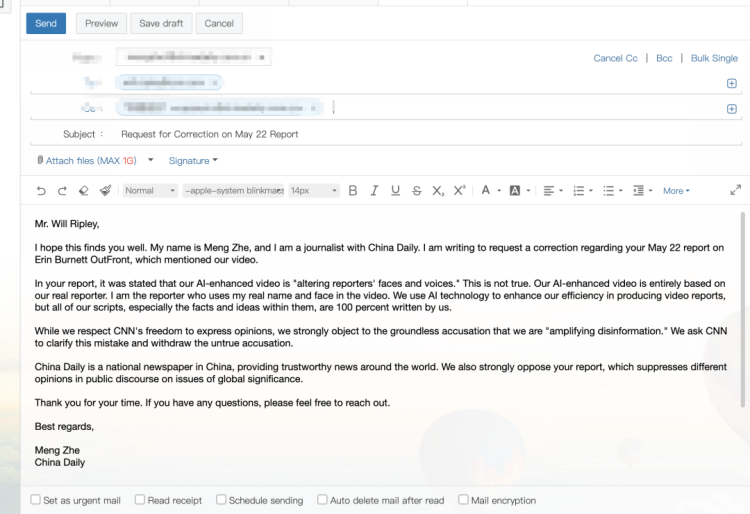
“RIPLEY (voice-over): Chinese state media is using A.I.-enhanced videos on TikTok, altering the reporter’s voice and face. A disclosure on screen for just a few seconds, easy to miss.
[01:39:52]
UNIDENTIFIED FEMALE: Under China’s jurisdiction.
RIPLEY: The video is pushing Beijing’s narrative on the South China Sea.
Is this a threat to democracy?
FELIPE SALVOSA II, JOURNALISM PROFESSOR, UNIVERSITY OF SANTO TOMAS: Most definitely. I think China has found a more cost-effective way to get its message across.
RIPLEY: Turning today’s digital landscape into a battleground for truth, where seeing is no longer believing.
Every time I do a story about these deepfake videos, what strikes me is the quality keeps improving. Our researcher (INAUDIBLE) spent hours putting these through algorithms to determine with 99 percent accuracy whether these videos are real, whether they’re fake, whether the voice has been altered, the face has been altered. Who on social media has time for that and a lot of people don’t take the time which experts say is dangerous, particularly in democracies when people are watching these videos and then potentially using the information they hear to make decisions about how to vote.


 Ms. Cat’s Chronicles
You must be logged in to post a comment.