
Mao – Be Concerned with the Well-Being of the Masses, Pay Attention to Methods of Work
Tag: Chinese Civil War
Interview with Three Correspondents from the Central News Agency, the Sao Tang Pao and the Hsin Min Pao
In the second group on your list, you raise the question of “restricting alien parties”, that is, the question of the friction in various localities. Your concern over this matter is justified. There has been some improvement recently, but fundamentally the situation remains unchanged.
Question: Has the Communist Party made its position on this question clear to the Central Government?
Answer: We have protested.
Question: In what way?
Answer: Our Party representative, Comrade Chou En-lai, wrote a letter to Generalissimo Chiang Kai-shek as early as July. Then again on August 1, people from all walks of life in Yenan sent a telegram to the Generalissimo and the National Government, demanding the withdrawal of the “Measures for Restricting the Activities of Alien Parties”, which had been secretly circulated and which are at the very root of the “friction” in various places.
Question: Has there been any reply from the Central Government?
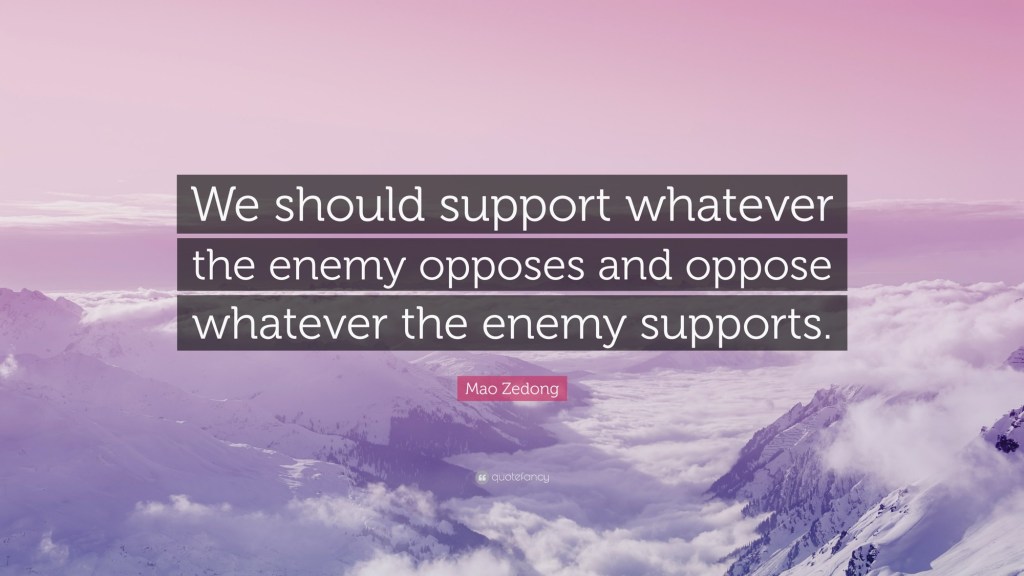
Answer: No. But it is said that there are also people in the Kuomintang who disapprove of these measures. As everybody knows, an army that participates in the common fight against Japan is a friendly army, not an “alien army”, and similarly, a political party that participates in the common fight against Japan is a friendly party, not an “alien party”. There are many parties and groups taking part in the War of Resistance and, while they vary in strength, they are fighting in the same cause; surely they must all unite and must in no circumstances “restrict” one another. Which party is an alien party? The party of the traitors headed by Wang Ching-wei, the running dog of Japan, because it has nothing in common politically with the anti-Japanese parties; that is the kind of party which should be restricted. Between the Kuomintang and the Communist Party there is common political ground, namely, resistance to Japanese aggression. Therefore, the problem is to concentrate all our strength on opposing and checking Japan and Wang Ching-wei, and not on opposing and checking the Communist Party. This is the only basis for formulating correct slogans. Wang Ching-wei has three slogans: “Oppose Chiang Kai-shek,” “Oppose the Communist Party”, and “Be friends with Japan”. Wang Ching-wei is the common enemy of the Kuomintang, the Communist Party and the entire people. But the Communist Party is not the enemy of the Kuomintang, nor is the Kuomintang the enemy of the Communist Party; they should unite and help each other rather than oppose or “restrict” each other. The slogans on our side must be different from Wang Ching-wei’s, they must be the opposite of his and never be confused with them. If he says, “Oppose Chiang Kai-shek”, everyone should support Chiang Kai-shek; if he says, “Oppose the Communist Party”, everyone should unite with the Communist Party; and if he says, “Be friends with Japan”, everyone should resist Japan. We should support whatever the enemy opposes and oppose whatever the enemy supports. In articles nowadays people often quote the saying, “Do not sadden your friends and gladden your enemies.” It comes from a letter which Chu Fou, a general under Liu Hsiu of the Eastern Han Dynasty, wrote to Peng Chung, the prefect of Yuyang. In context it reads, “Whatever you do, you must be sure that you do not sadden your friends and gladden your enemies.” Chu Pou’s words express a clear-cut political principle which we must never forget.
Related:
Mao Zedong on Writing
Oppose Stereotyped Party Writing
The first indictment against stereotyped Party writing is that it fills endless pages with empty verbiage. Some of our comrades love to write long articles with no substance, very much like the “foot-bindings of a slattern, long as well as smelly”. Why must they write such long and empty articles? There can be only one explanation; they are determined the masses shall not read them. Because the articles are long and empty, the masses shake their heads at the very sight of them. How can they be expected to read them? Such writings are good for nothing except to bluff the naive, among whom they spread bad influences and foster bad habits. … If articles are too long, who will read them? Some comrades at the front, too, like to write long reports. They take pains over writing them and send them here for us to read. But who has the hardihood to read them? If long and empty articles are no good, are short and empty ones any better? They are no good either. We should forbid all empty talk. But the first and foremost task is to throw the long, smelly foot-bindings of the slattern into the dustbin. Some may ask, “Isn’t Capital very long? What are we to do about that?” The answer is simple, just go on reading it. There is a proverb, “Sing different songs on different mountains”; another runs, “Fit the appetite to the dishes and the dress to the figure”. Whatever we do must be done according to actual circumstances, and it is the same with writing articles and making speeches. What we oppose is long-winded and empty stereotyped writing, but we do not mean that everything must necessarily be short in order to be good. True, we need short articles in war time, but above all we need articles that have substance. Articles devoid of substance are the least justifiable and the most objectionable. The same applies to speechmaking; we must put an end to all empty, long-winded speeches.
Read More »
Mao: Tyrant or Great Leader?
Mao’s Legacy and Accomplishments
“Mao Tse‐tung, who began as an obscure peasant, died one of history’s great revolutionary figures. In Chinese terms, he ranked with the first Emperor who unified China in 200 B.C.
A Chinese patriot, a combative revolutionary, a fervent evangelist, a Marxist theorist, a soldier, a statesman and poet, above all Mao was a moralist who deeply believed, as have Chinese since Confucius, that man’s goodness must come ahead of his mere economic progress.
China achieved enormous economic progress under Mao. He transformed China into a modern, industrialized socialist state.”
Unlike many great leaders, Mao never exercised, or sought, absolute control over day‐to‐day affairs.”
Why Do Today’s Chinese Still Revere Mao Zedong?
September 9 marks the 48th anniversary of Mao Zedong’s passing. As the founding leader of the People’s Republic of China, Mao may have passed nearly half a century ago, but his influence remains deeply ingrained in the country’s collective memory.
Japan-U.S. joint statement on war preparations forecasts doom
The United States has announced it will upgrade U.S. Forces Japan (USFJ) to a joint force headquarters (JFHQ) with expanded operational responsibilities. The new command will report to the US Indo-Pacific Command (USINDOPACOM). The revamped structure will assume the control of about 55,000 personnel stationed in Japan from the U.S. Indo-Pacific Command some 6,200 kilometers away in Honolulu, Hawaii. The move is intended to streamline communications between the US and Japan, especially during a crisis involving China.
Japan-U.S. joint statement on war preparations forecasts doom
ON THE PEOPLE’S DEMOCRATIC DICTATORSHIP
ON THE PEOPLE’S DEMOCRATIC DICTATORSHIP
In 1924 a famous manifesto was adopted at the Kuomintang’s First National Congress, which Sun Yat-sen himself led and in which Communists participated. The manifesto stated:
The so-called democratic system in modern states is usually monopolized by the bourgeoisie and has become simply an instrument for oppressing the common people. On the other hand, the Kuomintang’s Principle of Democracy means a democratic system shared by all the common people and not privately owned by the few.

 Ms. Cat’s Chronicles
You must be logged in to post a comment.