
Tag: choke points
Venezuela as a Chokepoint in U.S.–China Rivalry
A Narrow Pacific Waterway is at the Heart of U.S. Plans to Choke China’s Vast Navy +
Reuters reprint: A Narrow Pacific Waterway is at the Heart of U.S. Plans to Choke China’s Vast Navy
Until recently, locals say, this smallest and least populous province of the Philippines was a peaceful backwater. But geography dictates that it is now on the frontline of the great power competition between the United States and China for dominance in the Asia-Pacific region. The islands sit on the southern edge of the Bashi Channel, a major shipping lane between the Philippines and Taiwan that connects the South China Sea with the Western Pacific.
This year’s exercises revealed how the U.S. and its Philippine ally intend to use ground-based anti-ship missiles as part of efforts to deny the Chinese navy access to the Western Pacific by making this waterway impassable in a conflict, Reuters reporting shows. These missiles could also be used to attack a Chinese fleet attempting to invade Taiwan or mount a blockade against the democratically governed island.
…
Recent Chinese maneuvers show how access to the Bashi Channel is critical for Beijing’s plans in the Pacific. In June, a powerful Chinese navy aircraft carrier battle group used this passage to enter the Western Pacific before launching an extended series of exercises south of Japan, according to Japanese military tracking data.
Related:
Read More »Japan Eagerly Fills Role as US’ East Asia “Ukraine”
Nigeria as a Battleground for U.S.–China Influence?

The following quotes are from an article I’m currently working on for Venezuela.
Sir Walter Raleigh, a leading figure in early English colonization, once declared, “For whosoever commands the sea commands the trade; whosoever commands the trade of the world commands the riches of the world, and consequently the world itself.“
Read More »CSIS’ Ryan Berg’s 2025 statement before the House Homeland Security Committee Subcommittee on Transportation and Maritime Security warned that Chinese port projects in adversarial states could offer a “permissive environment” for future PLA Navy operations.
Washington’s “Second Coming” to Asia: Militants, Ports, and Pressure Points

President Trump’s renewed focus on regaining the Bagram Air Base and developing Pakistan’s Pasni Port signals Washington’s attempt to reassert strategic influence in a region increasingly dominated by China, Russia, and Iran.
Pakistan’s Pasni Port, located in Balochistan province, sits at the crossroads of strategic infrastructure and insurgent resistance. The Western-backed Baloch Liberation Army (BLA), active in the region, has long targeted Chinese-financed projects. The BLA maintains ties with both the Pakistan Taliban and ISIS-K—a faction recently linked to recruiting Uygur militants. Separately, U.S. support for Uygur militants predates this trend, with allegations tracing back to the 1970s/1980s. Rep. Perry has claimed that ISIS-K received backing from USAID, adding another layer to the region’s militant entanglements.
This only deepens my suspicion that recapturing Bagram Air Base could serve as a launchpad—not merely for tactical leverage, but to stir Uygur militant resistance against Beijing or pressure China with a second front in the event of a future Pacific conflict.
Sources:
BLA: U.S. Proxies in Balochistan document
ISIS-K & Uygur militants: ISIS has its sights set on a new potential ally—Uyghur jihadi groups
CIA & Uygur militants: US & TERRORISM IN XINJIANG
Uygur militants: *Xinjiang*
USAID & ISIS-K: Rep. Perry reveals what some of us already knew about USAID
Bagram Air Base: Why Does Trump Want U.S. Troops Back in Afghanistan?
Manila Recovers Chinese Underwater Drone Operating in Philippine Waters
[Aaron-Matthew Lariosa, 10-01-2025] Manila Recovers Chinese Underwater Drone Operating in Philippine Waters
Read More »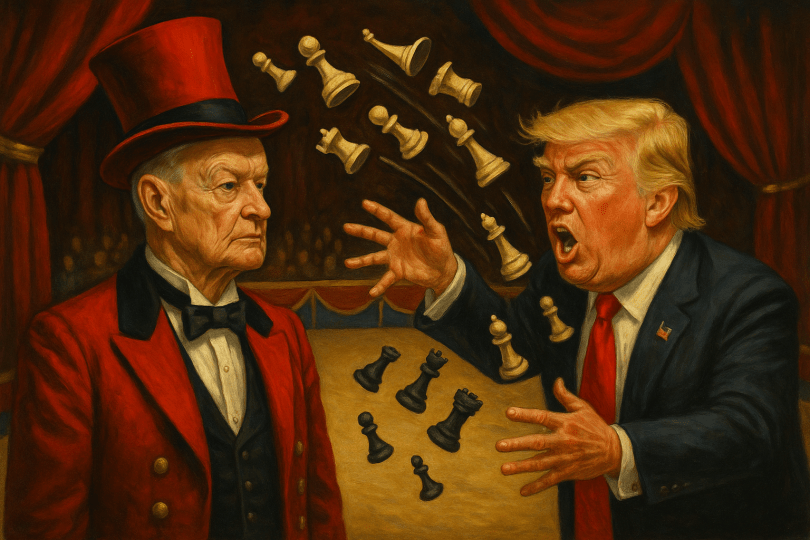
Why Does Trump Want U.S. Troops Back in Afghanistan?
Is Turkey on the Chopping Block?
Penny’s post, “Turkey will not receive F-35s unless they eliminate the S-400s,” reminded me of this video that recently appeared in my YouTube feed. The video is from the World Liberty Congress, an organization that advocates for regime change. Turkish opposition figure Oğuzhan Albayrak talks about the failed 2016 coup attempt, the Saturday Mothers, and draws comparisons between Turkey and Iran and China, both of which are in the sights of the U.S. Empire. In his article on the WLC website, he also mentions Ekrem İmamoğlu, another opposition figure with connections to European and U.S. front organizations.
Sources are provided below my unfinished article on Turkey’s significance in The Grand Chessboard.
Read More »Board Games and Bottlenecks
Battling for Dominance: Board Games and Bottlenecks
Originally titled, Board Games and Bottlenecks
by Tina Antonis

 Ms. Cat’s Chronicles
You must be logged in to post a comment.