
Fort Bragg: Barracks of Broken Promises

A buddy of mine just PCSd to Fort Bragg and was moved into the in-processing barracks. This is what he was welcomed with. Apparently the officer that was responsible for showing people to their rooms just made sure their key cards worked and dipped when it worked, not stepping foot in the room. Are there no barracks NCOs for in-processing barracks at Bragg? I’ve PCSd twice and the barracks NCOs made sure my room was spotless. Even in Korea I left my in-processing barracks room better than it was when I moved in. Obviously military barracks/housing is notorious for being shitty but this is a no shit unlivable environment. Who should this be reported to so bare minimum health standards are actually adhered to?

I’ll have a Big Mac, Filet-o-Fish with extra tartar sauce & a large fry.

Fort Bragg In-processing barracks

Published August 25, 2022:

Army Altering How It Inspects Barracks as Bragg Troops Are Evacuated from Moldy Housing

The news comes as Fort Bragg, North Carolina, officials have begun to move some 1,200 soldiers from the base’s mold-infested Smoke Bomb Hill Barracks in a seemingly unprecedented relocation effort almost guaranteed to stress-test garrison logistics and pour an influx of new renters into a local housing market already bursting at the seams.

Roughly 50 rooms in the 12 Smoke Bomb Hill Barracks were discovered to be infested with mold after a complaint from soldiers to Army Secretary Christine Wormuth in early July spurred inspections from Daly and Sergeant Major of the Army Michael Grinston. The problem is mostly the result of leaky mid-20th century air conditioning systems, which are difficult to repair and costly to replace.

Fort Bragg is far from the only installation with moldy facilities. But the Smoke Bomb Hill Barracks were already set to be demolished in roughly five years. The Army decided to accelerate that timeline and now plans to demolish 12 buildings next year, while renovating five others in a $150 million plan.
Army races to widen the bottlenecks of artillery shell production

Army races to widen the bottlenecks of artillery shell production

The U.S. Army has started diversifying its supplier base for 155mm artillery shells, moving away from the bottleneck of a single source that has endangered the flow of fresh ammo, according to a top service official.

The service is racing toward a goal of shoring up all major single sources that provide parts or materials for 155mm munitions by the end of 2025.

The Pentagon is investing billions of dollars to increase the capacity of 155mm munition production as it races to replenish stock sent to support Ukraine’s fight against the Russian invasion, which began in early 2022, and to ensure the U.S. has what it might need should conflict erupt across multiple theaters at once. The Army planned to spend $3.1 billion in FY24 supplemental funding alone to ramp up production.

Prior to the war in Ukraine, the U.S. could build about 14,400 of the artillery shells per month. But as Ukrainian forces burn through the ammunition for howitzers sent to the country, the U.S. recognized quickly that replenishment could not be done with the current infrastructure.

The service has set a target of producing 100,000 artillery shells per month, but Army officials have shared it has fallen slightly behind schedule. Even so, the Army is now producing 40,000 shells a month, Army Secretary Christine Wormuth said at the Defense News Conference last month, adding that the plan is to reach 55,000 shells a month by the end of the year.

The Army had been making 155mm shells at a single plant in Scranton, Pennsylvania, and a privately operated facility nearby. All of the shells were transported to one place – Iowa Army Ammunition Plant – where they are packed with explosives.

The Army is planning to design and construct a domestic TNT production facility, which will likely be at Radford, Bush has said in the past. Once a contract is awarded, the plan is to build it in 48 months. Currently, the U.S. relies entirely on TNT from allies.

The only place that made combustible cartridge cases – Armtec Defense Technologies – was in Coachella, California, well-known for its music festival, but also for being located along the San Andreas Fault with a high risk of large earthquakes. Day & Zimmerman will produce the cases at another location in Texarkana, Texas.

“There [is] still the occasional single point, if you go down far enough, I’m not sure we can ever eliminate them entirely,” Bush said. “But we can build in more redundancy than we had before, which was, frankly, a very fragile setup where I could give you grid coordinates for like, four buildings in America, and if one of those, something happened tomorrow, we weren’t making anything … it definitely isn’t acceptable now, and we’re trying to get away from it.”

*SMH*

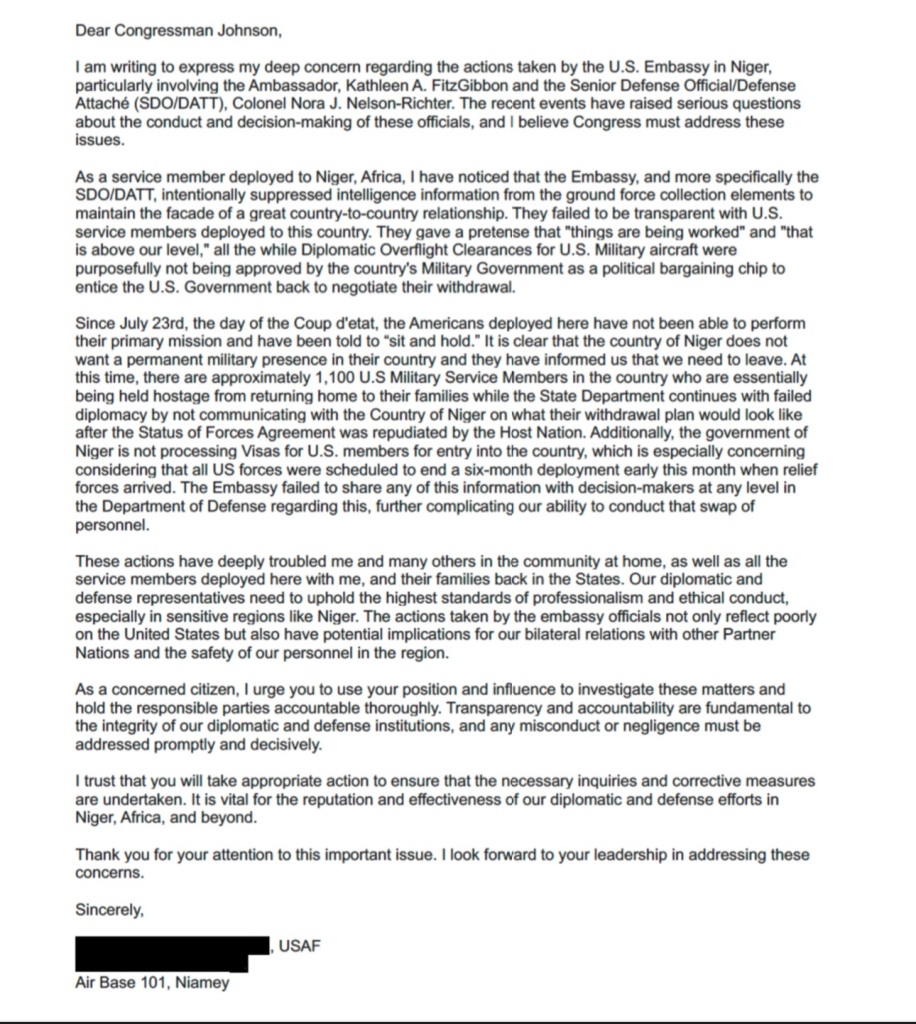
Defying Niger exit order leaves U.S. troops vulnerable, whistleblower says

Defying Niger exit order leaves U.S. troops vulnerable, whistleblower says

“We have Army soldiers right now in Niger who aren’t getting their troop rotations, who aren’t getting their medicine, who aren’t getting their supplies, who aren’t getting their mail and the two senior people in the United States Army are sitting before me and it’s like ‘hear no evil, see no evil, speak no evil,’” said Gaetz.

Previously:

BBC: Niger’s Junta Revokes Military Agreement With US

He [Col Amadou Abdramane] also alleged that the US delegation had accused Niger of making a secret deal to supply uranium to Iran. Col Abdramane described the accusation as “cynical” and “reminiscent of the second Iraq war”.

Army cutting force by 24K in major restructuring

They can’t fill the positions, so they’re eliminating them!

Army cutting force by 24K in major restructuring

“We’re moving away from counterterrorism and counterinsurgency; we want to be postured for large-scale combat operations,” Army Secretary Christine Wormuth told reporters Tuesday morning at an event in Washington, D.C., hosted by the Defense Writers Group.

To do that, the service seeks to phase out around 32,000 roles, with about 3,000 cuts from special operations forces and another 10,000 from Stryker brigade combat teams, cavalry squadrons, infantry brigade combat teams and security force assistance brigades, the latter meant to train foreign forces.

In addition, the service found 10,000 engineer jobs and related positions linked to counterinsurgency missions it can cut; it will slash about 2,700 roles from units that don’t usually deploy; and it will decrease the number of transients, trainees, holdees and students by approximately 6,300. 

Officials stressed that the planned reductions are “to authorizations (spaces), and not to individual soldiers (faces),” meaning already empty roles. 

“The Army is not asking current soldiers to leave,” according to the document. “As the Army builds back end strength over the next few years, most installations will likely see an increase in the number of soldiers actually stationed there.” 

The plan also looks to add back 7,500 troops in missions seen as more critical, such as air-defense and counterdrone units and five new task forces for better capabilities in intelligence, cyber, and long-range strikes.  

Three of the task forces would fall under U.S. Army Pacificwith the Indo-Pacific theater considered the most important for national security in the years ahead — one will be within U.S. Army Europe-Africa, and the last likely focused on U.S. Central Command in the Middle East. 

The plans indicate a major shift within the Army as the military anticipates future conflicts as large-scale operations against more advanced adversaries such as China, Russia, Iran or North Korea. They also reflect the service’s struggles with recruiting, a phenomenon happening across the military.  

US Scrambles to Get More Arms to Israel, Ukraine

US Scrambles to Get More Arms to Israel, Ukraine

Congress isn’t expected to authorize more spending on Ukraine or Israel until a new House speaker is elected, which will likely happen this week. According to The Messenger, House Foreign Affairs Chairman Michael McCaul (R-TX) said Congress is discussing a massive military aid package for Ukraine and Israel that would also include funds for Taiwan. “There’s discussion about putting Israel funding, Ukraine funding, maybe Taiwan funding and finally border security,” he said.

On The E-Girl Army Psyop Phenomenon

Video: On The E-Girl Army Psyop Phenomenon via Justin Taylor

Related:

Weaponizing e-girls: How the US military uses YouTube and TikTok to improve its image

How E-girl influencers are trying to get Gen Z into the military

But Haylujan isn’t the only E-girl using Sanrio sex appeal to lure the internet’s SIMPs into the armed forces. There’s Bailey Crespo and Kayla Salinas, not to mention countless #miltok gunfluencers cropping up online. While she didn’t document her military career, influencer Bella Poarch also served in the US Navy for four years before going viral on TikTok in 2020, and is arguably the blueprint for this kind of kawaii commodified fetishism in the military. An adjacent figure, Natalia Fadeev, also known as Gun Waifu, is an Israeli influencer and IDF soldier who uses waifu aesthetics and catgirl cosplay to pedal pro-Israel propaganda to her 756k followers. She poses to camera, ahegao-style, with freshly manicured nails wrapped neatly around a glock, the uWu-ification of military functioning as a cutesy distraction from the shadowy colonial context: “when they try and destroy your nation,” she writes in one caption.