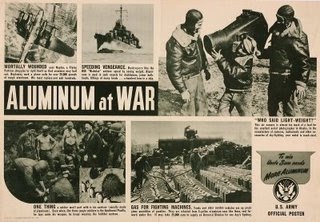
Alcoa is now the third largest aluminum producer in the world. Back in 1941, it was much more powerful. It had a monopoly on aluminum in addition to owning a massive amount of America’s electricity production and other minerals. Before America declared war on Germany, it sent so much of its aluminum product over to Germany that the country made upwards of sixty percent more aluminum products than America. When the US’s involvement in the war began, there was a massive aluminum production shortage in America, in no small part because of Alcoa’s monopoly. Alcoa essentially sold the Axis powers much of the material to build their war machines and a reprieve from the American war machine.
…
2. General Motors
Similar to their automotive rivals, General Motors was sued by Holocaust survivors for assisting the Nazi war machine. Beginning in 1935, GM built a factory in Berlin for the purpose of building “Blitz” trucks for the Wehrmacht. Ford began building similar trucks around the same time, but GM was the number one producer of the vehicles that were vital for the quick conquests of Poland, France, and much of the Soviet Union. Albert Speer, the minister of armaments and war production, claimed that the rubber GM supplied was the key to the ability of the Germans to wage war the way they did. Inevitably when America declared war on Germany, the Reich seized GM’s German production facilities.
Although neither Ford nor General Motors ever fully conceded that they had willingly participated in the use of slave labor, they both were massive contributors to a fund started in 2000 for Holocaust survivors.
The systemic threats to the U.S. financial system were not remedied when Congress passed the watered-down Dodd-Frank financial reform legislation in 2010. While that has been evident with each Federal Reserve bailout of the mega banks and their derivative counterparties, the threat has now gained increased urgency for Congress to confront as a result of a new academic study. A team of four highly-credentialed academics at four separate universities present compelling evidence that one of the four largest U.S. banks, with “assets above $1 trillion,” could be at risk of a bank run.
In 2016, the U.S. Supreme Court ordered nearly $2 billion in assets of Iran’s state bank, frozen in the U.S., to be paid as compensation to relatives of victims of attacks linked to Iran.
ICJ judgments are legally binding, however, the court has no means of enforcing them. Previously, both the US and Iran have ignored the court’s judgments.
“The court’s decision today rejected the vast majority of Iran’s case, including notably Iran’s claims on behalf of Bank Markazi,” said acting legal adviser Rich Visek of the US State Department.
Excerpt from a speech delivered in 1933, by Major General Smedley Butler, USMC.
War is just a racket. A racket is best described, I believe, as something that is not what it seems to the majority of people. Only a small inside group knows what it is about. It is conducted for the benefit of the very few at the expense of the masses.
Yesterday afternoon, Mark Bialek, the Inspector General of the Federal Reserve, released a memorandum clearing Fed Chair Jerome Powell and former Fed Vice Chair Richard Clarida of wrongdoing in the trading scandal that has engulfed multiple officials of the Federal Reserve.
Redditors at the subreddit Superstonk are posting obscenities directed at Gary Gensler, Chair of the Securities and Exchange Commission (SEC), over the new ad campaign from the SEC that appears to target young Reddit investors as fools that do no research before investing, lose all their money, and deserve a whipped-cream pie in the face. (Yes, a young investor actually gets a whipped-cream pie in the face during two of the ads. See videos below.) CNBC ran one of the new SEC ads yesterday.



 Ms. Cat’s Chronicles
You must be logged in to post a comment.