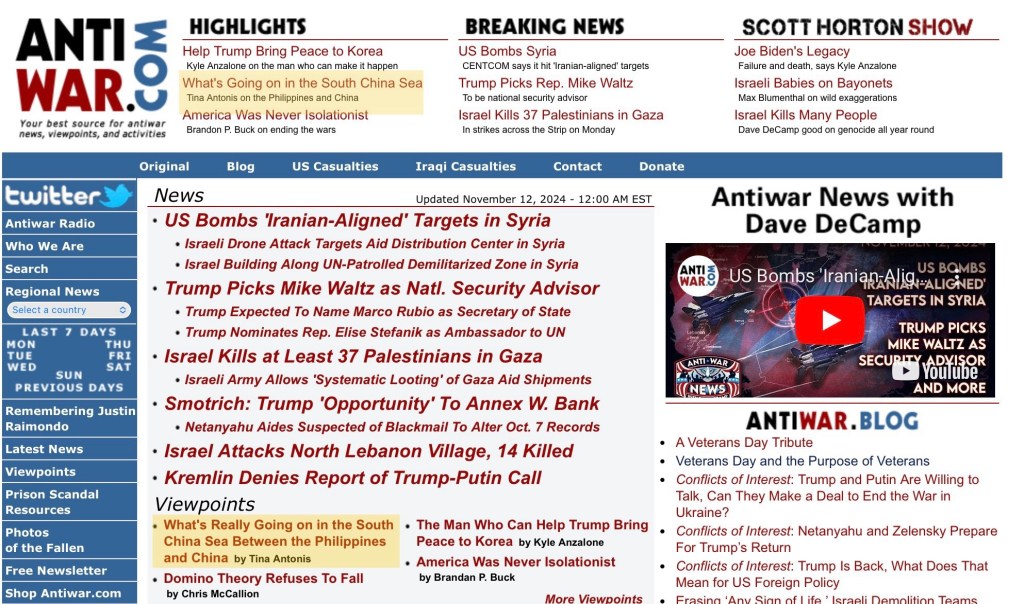
What’s Really Going On In the South China Sea Between the Philippines and China

What’s Really Going On In the South China Sea Between the Philippines and China

by Tina Antonis

Maritime clashes between the Philippines and China had been mostly over the Philippines’ military outpost, BRP (BRP—Barko ng Republika ng Pilipinas, which translates to “Ship of the Republic of the Philippines”—the ship prefix for the Philippines) Sierra Madre, in the Spratly Islands, which is disputed by Brunei, China, Malaysia, the Philippines, Taiwan (a province of China, as recognized by the United Nations’ Resolution No. 2758), and Vietnam. The BRP Sierra Madre was intentionally run aground on a reef near the Second Thomas Shoal in the disputed Spratly Islands, in 1997, so that the Philippines could stake their territorial claim.

Read More »

Leaked docs reveal US ‘color revolution’ bid in Cambodia

Leaked docs reveal US ‘color revolution’ bid in Cambodia

Biden administration backed organisations plotting colour revolution in Cambodia (archived)

The Cambodia National Rescue Movement is affiliated with Liberal International, the same organization which is affiliated with Vente Venezuela, the party of María Corina Machado.  My Indonesia and Bangladesh documents can be found on my documents page, along with the Atlas Network one.

Related:

Center for Alliance of Labor and Human Rights (CENTRAL): $500,000.00 from USAID

Front Organizations

Growing “Cyber threats” prompt Philippine Army’s 1st 16th AF visit [Information Operations]

Growing Cyber threats prompt Philippine Army’s 1st 16th AF visit

Colonel Edward Rivera, 616th Operations Center, director of operations, welcomed Philippine Army Col. Windell Rebong, Command and Control Communications and Cyber Systems, deputy assistant chief, and five associates, here, July 18, for a subject-matter-expert exchange amid rising cyberattacks.

The exchange centered around maturing information warfare by strengthening interdependencies between several domains: electronic warfare, information operations and warfare, and cyber operations. 

“This exchange was a warm, engaging and open discussion from both sides and included military, civilian, officer and enlisted of different ranks, all bringing forward their experiences in the form of vibrant discussions,” said Rebong. “It’s an honor and a privilege for a Philippine Army officer to visit a U.S. Air Force facility. [The 16th Air Force] has an expertise that all Philippine branches of service will benefit from.”

….

Sixteenth Air Force (Air Forces Cyber), headquartered at Joint Base San Antonio, Texas, focuses on information warfare in the modern age and ensures that our Air Force and Nation are fast, resilient, and fully integrated in competition, crisis, and conflict by incorporating Information Warfare at operational and tactical levels, capitalizing on the value of information by leading the charge for uniquely-21st century challenges in the highly dynamic, seamless, and global information domain.

Information operations, sometimes referred to as influence operations, entail disseminating false information to persuade people and gathering tactical intelligence on rivals to gain the upper hand. Traditional media and social media platforms are just two examples of the many tools and techniques that can be used to carry out information operations.

Related:

Read More »

What are Information Operations

Source

To obtain a competitive edge, information operations and warfare entail obtaining intelligence on opponents and disseminating propaganda.

Definition: Information operations are tactics used to sway people’s opinions and affect how decisions are made.

PropagandaMessages intended to sway public opinion and affect target audiences’ behavior can be distributed in a variety of ways as propaganda.

Competitive Advantage: The ultimate aim of these activities is to gain a strategic edge over rivals in a variety of settings, including the political, military, and economic spheres.

Tools and Techniques: Information operations can be carried out using a variety of instruments and methods, such as traditional media and social media platforms.

Ethical Considerations: Concerning the effects of such operations on truth and trust in society, the use of disinformation and manipulation presents ethical concerns.

Based on the definition by RAND.

Related:

2012 NDAA – Propaganda – MISO – InfoOps – PsyOps

Updates for the Bangladesh document

Battle for soul of Bangladesh far from over

One of the most pressing issues facing Yunus’ interim government is the restoration of law and order. Since the uprising, the police — once a tool of state terror under Hasina — have largely disappeared from the streets fearing violent retribution from the public. Police stations have been set ablaze, and in their absence, student-led groups have taken up roles in maintaining local order. In a country where state violence was once the norm, the people’s reliance on these grassroots organisations rather than formal law enforcement is a telling indicator of the deep mistrust in state institutions, although, over the span of two months, we have also witnessed that dynamic of trust taking on significant concessions and alterations in the questions of nationalism, the phantom of separatist movements and the security discourse enveloping the Chittagong Hill Tracts [CHT].

Perhaps above all else, the Chittagong Hill Tracts have historically been a flashpoint for military-police dynamics, reflecting tensions between the indigenous populations, popular local political parties and civil society members on one side, and Bangladeshi state authorities, the military, and the plainland settlers serving as vanguards of the Bengali-Bangladeshi nationalist project on the other. The military’s sustained and in fact, expanding presence in the CHT, justified as means of ‘maintaining order’, has led to systemic human rights violations and a climate of permanent, pervasive fear, discontent, animosity, and distrust, and for good reason.

As per a report by the Human Rights Support Society, in the month of September alone, 28 were killed in 36 different incidents of mob lynching across Bangladesh, with 14 others injured. Political violence claimed another 16 lives and injured 706. In their report, HRSS refers to a wild-wild-Western state of affairs that is still developing, including factional clashes within the two major political parties, targeted violence against ethnic and religious minorities, attacks on journalists, extrajudicial killings, and worker protests. Overnight, netizens witnessed footage of defenceless Tofazzal and Shamim Mollah, mercilessly beaten to their deaths in the two top public universities.

This is especially true when we consider how global neoliberal agendas intersect with local political upheavals. Like the Arab Spring, derailed by counter-intelligence tactics, surveillance capitalism, and imperialist interventions, Bangladesh faces the risk of its uprising being neutralised by the coalescence of state surveillance, corporate interests, and international capital. The convergence of military intelligence, former Awami elites, and foreign backers — including both regional powers and multinational corporations — threatens to undo the revolution’s hard-won gains by appealing to reactionary fears and mobilising mobs against progressive forces.

No criticism of U.S. puppets allowed:

Criticism on Dr Yunus: Magistrate suspended in Bangladesh

Read More »

Leaked files expose covert US government plot to ‘destabilize Bangladesh’s politics’

Leaked docs reveal that prior to the toppling of Bangladeshi PM Sheikh Hasina, the US govt-funded International Republican Institute trained an army of activists including rappers and “LGBTQI people,” even hosting “transgender dance performances,” to achieve a national “power shift.” Institute staff said the activists “would cooperate with IRI to destabilize Bangladesh’s politics.”

Leaked files expose covert US government plot to ‘destabilize Bangladesh’s politics’

Previously:

Atlantic Council’s Ali Riaz to lead commission on constitutional reforms for Bangladesh

What’s Behind Regime Change in Bangladesh

Bangladesh and Kenya document