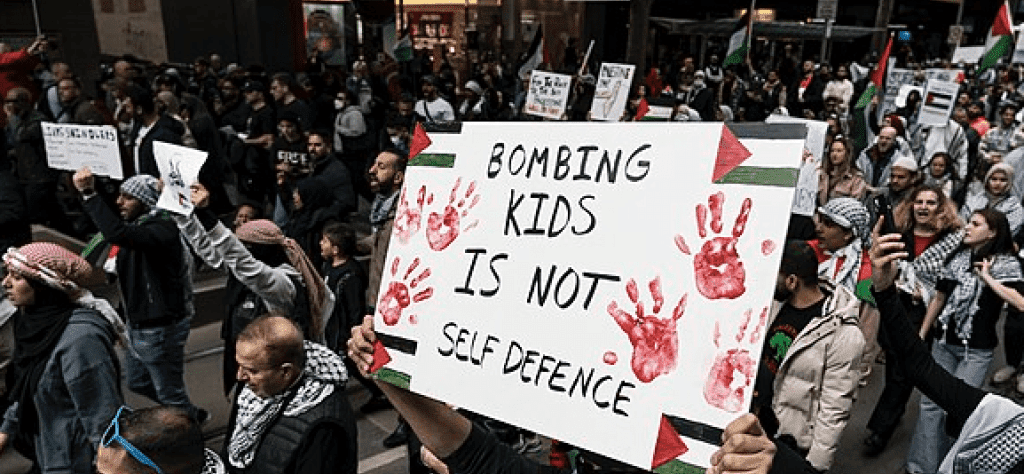
Palestinian officials, U.N. experts, and even Israeli media say nearly 7,000 men, women, and children have been killed by Israel’s indiscriminate airstrikes and shelling.
“Biden’s immediate and decisive show of support for Israel following the October 7 attacks by Hamas appears to have turned off some in his own party,” wrote a Gallup research consultant.
Israeli propaganda officials are reportedly upset because elderly Israeli woman Yocheved Lifshitz said that she was treated well while she was detained by Hamas in Gaza over the last two weeks.
Freedom of the press is important and critical in any situation, especially now. However, Israel’s public diplomacy officials must issue an unequivocal directive that prohibits live media events of this kind in the future. The public’s right to know is important, but not when national security is at stake. In such times, the public can suffice with a recorded and supervised message.
With Israel’s savage bombardment of the Gaza Strip continuing unabated, the humanitarian crisis faced by its 2.3 million residents has reached horrendous dimensions. In addition to an official death toll approaching 7,000, over 1.4 million people have been displaced by Israel’s genocidal onslaught, while supplies of food, clean water and fuel are on the verge of expiring.
“I’m reaching out to you on behalf of a global collective of agencies, influencers, and content creators who are coming together to raise awareness about the difficult situation in Israel.”
The Biden administration thought the Palestine question could be downplayed in pursuit of other objectives. And here we are.
Twenty-six. That is the number of times Wadea Al Fayoume, a Palestinian American child living in the Chicago area, was stabbed in a murderous rampage committed by his landlord. The picture of Wadea in a birthday hat that has gone viral since the attack that killed him and severely injured his mother was taken eight days earlier, when he turned 6.
Joe Biden’s approach to international issues increasingly resembles George W. Bush’s disastrous foreign policy. One key tendency in common is that both men view complex world affairs in dangerously simplistic terms as an existential struggle between good and evil. In Bush’s case, the bitter fruit of that perspective became apparent with the seemingly endless armed crusades to impose western values in such alien settings as Afghanistan, Iraq, Libya, and Syria. In Biden’s case, that attitude was apparent with his administration’s ongoing attempt to portray the Russia-Ukraine war as a stark struggle between democracy and authoritarianism, between the rule of law and the law of the jungle. That approach should have lacked credibility from the outset, since Ukraine is a corrupt autocracy, not a democracy, but administration policymakers keep pushing the thesis.


 Ms. Cat’s Chronicles
You must be logged in to post a comment.