
For years, the Department of Homeland Security has run a virtually unknown program gathering domestic intelligence, one of many revelations in a wide-ranging tranche of internal documents reviewed by POLITICO.
DHS has a program gathering domestic intelligence — and virtually no one knows about it
Tag: coercion
US Ambassador To China: “We’re The Leader” Of The Indo-Pacific
A recent US Chamber of Commerce InSTEP program hosted three empire managers to talk about Washington’s top three enemies, with the US ambassador to China Nicholas Burns discussing the PRC, the odious Victoria Nuland discussing Russia, and the US ambassador to Israel Tom Nides talking about Iran.
US Ambassador To China: “We’re The Leader” Of The Indo-Pacific
Related:
Why repealing or weakening Section 230 is a very bad idea
Section 230 is vital to free speech on the internet, and its critics are often misguided or wrong about the law.
Why repealing or weakening Section 230 is a very bad idea
The Supreme Court Could Destroy Everything Good About The Internet
Next Week, The Supreme Court Could Destroy Everything Good About The Internet
This is the thing that so many haters of Section 230 don’t understand. They seem to think that getting rid of it will somehow benefit speech. But, it will not. It will benefit government officials attempting to control speech.
Related:
Why India did not allow Pfizer’s Covid-19 vaccine
Why India did not allow Pfizer’s Covid-19 vaccine
In Latin America pharmaceutical bullying went a notch higher. In addition to legal indemnity, Pfizer demanded protection against their own negligence and mistakes. Argentina amended its vaccine law, three times, yet Pfizer was not happy. Pfizer wanted Argentina’s bank reserves and military bases as “guarantees”.
In the era of neo-colonialism, Pharma industry was the new East India Company.
…
Despite such pressure, India did not succumb. Eventually, Pfizer withdrew its application in 2021 We continued our vaccine programme with drugs that complied with our legal requirements.
Iran’s Su-35 Aircraft Procurement Is More Dangerous Than You Think
Iran’s Su-35 Aircraft Procurement Is More Dangerous Than You Think
Related:
The Difficulty of Disrupting Iranian Drones
Russia and Iran Are Building a Trade Route That Defies Sanctions
In all of this, some analysts see echoes of an idea that dates back more than a century and is reckoned to be the foundation of geopolitical thinking. It focused on the struggle between an oceangoing world power—the UK then, the US today—and the land giants of Eurasia. [Heartland Theory]
Reciprocity: Zelensky Demanded Weapons from Netanyahu for Pro-Israel UN Vote
Reciprocity: Zelensky Demanded Weapons from Netanyahu for Pro-Israel UN Vote
In the previous anti-Israel UN vote (and most other UN votes), Ukraine voted against Israel. That did not go over well in Israel. Israel has also been a world leader in supplying Ukraine with humanitarian aid.
According to a report by Barak Ravid, Prime Minister Netanyahu spoke with Ukrainian President Volodymyr Zelenskyy on Friday evening asking Ukraine to vote against the UN resolution. Zelenskyy demanded reciprocity and a change in Israeli policy, asking Israel to supply defensive weapons to Ukraine, in particular, against Russian ballistic missiles and the Iranian suicide drones that Russia has been using to attack Ukraine.
Related:
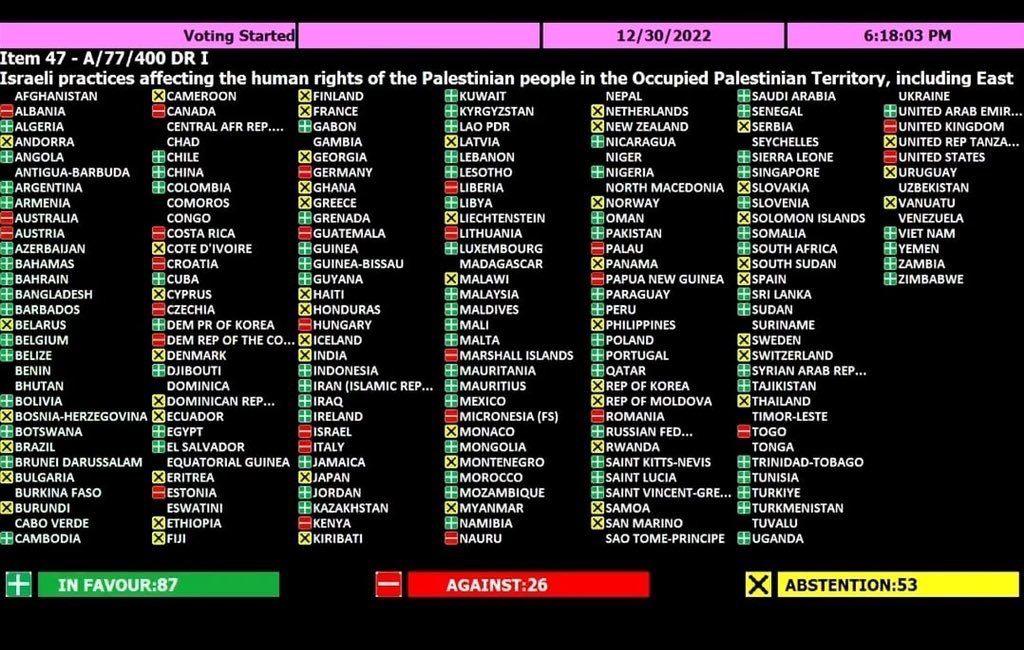
PA Celebrating UN Resolution Asking ICC to Investigate Israel’s ‘Occupation’
The Foreign Ministry and Israel’s embassies lobbied some 100 countries. Prime Minister Benjamin Netanyahu, too, spoke with the leaders of several countries and managed to convince at least five leaders not to vote in favor of the decision – the leaders of Croatia, Togo, Greece, Romania, and Kenya. Former Prime Minister Yair Lapid also took part in the efforts, sending letters to more than 60 world leaders ahead of the vote.
Israel, the US, and 24 other members––including the UK and Germany––voted against the resolution, while France was among the 53 nations that abstained. The US entered Israel’s nay vote since the resolution was passed on Shabbat, a move that UN Envoy Gilad Erdan called “shameful.”
A New Brutal Purge Upon the Serbs in the Making, Orchestrated by NATOstan
The goal of the Kosovo Albanians’ hidden agenda is even more blatant now in broad political daylight in the midst of the Ukraine crisis, Тatiana Obrenovic writes.
A New Brutal Purge Upon the Serbs in the Making, Orchestrated by NATOstan
What is the Rules-Based Order?
In fits of, what might well be termed, masochism, some of us now-and-then tune in to the legacy media. When doing so, one is likely to hear western-aligned politicians rhetorize ad nauseam about the linguistically vogue rules-based order. Now and then, the word “international” is also inserted: the rules-based international order.
What is the Rules-Based Order?
H/T: THE NEW DARK AGE
Ep. 5819 – Jeffrey Kaye on US Bio-weapons and the CIA’s Attempts to Hide Them – 12/16/22
Scott talks with Jeffrey Kaye about an article he recently published on the CIA’s effort to suppress reports about the use of bio-weapons by U.S. forces fighting in Korea. The agency went to great lengths to dismiss those rumors and claims as communist propaganda and the results of brainwashing. Then in 2010, the agency declassified documents that contained evidence of U.S. bio-weapons use in the Korean War. Kaye and Scott discuss the relevant history and why it’s important today.
Check out the interview page here.
The Scott Horton Show
Related:
Secret Plan Revealed: CIA Told to “Destroy” Those Supporting Communist Germ Warfare “Myth”
 Ms. Cat’s Chronicles
You must be logged in to post a comment.