


Read More »

Money is the jealous god of Israel, in face of which no other god may exist. Money degrades all the gods of man – and turns them into commodities. Money is the universal self-established value of all things. It has, therefore, robbed the whole world – both the world of men and nature – of its specific value. Money is the estranged essence of man’s work and man’s existence, and this alien essence dominates him, and he worships it.
On The Jewish Question
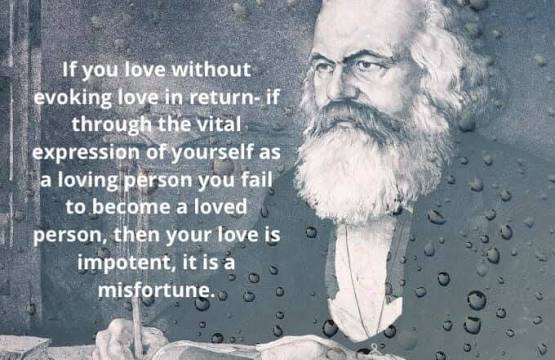
“If you love without evoking love in return – that is, if your loving as loving does not produce reciprocal love; if through a living expression of yourself as a loving person you do not make yourself a beloved one, then your love is impotent – a misfortune.” – Karl Marx
Read More »
The capitalist will say (and do) anything that justifies the endless accumulation of profit. To this end, the emphasis of individualism is vital – as it is through this loss of collective identity that humanity learns to routinely brutalise its own existence and being. Inflicting pain and harvesting gain is the only permitted exchange which locks out all other modes of possible interaction. Love becomes a limited commodity which can be bought for a short time period before the clock runs out and its flow dries up.
UK: A Working Class Experience of Alien Abduction! (18.11.2025)
The so-called “sexual revolution” that began in the 1960s and 1970s, hailed by bourgeois liberals and postmodern academics as a triumph of individual liberation and progressive reform, also became bound up with deeply reactionary phenomenon. From advancing the cause of human emancipation, it became a critical component of the broader social counterrevolution orchestrated by the ruling classes to undermine the potential of the working class. This pseudo-liberation, rooted to a notable extent in the decay of capitalist society, has contributed directly to profound negative impacts on public health, including the explosive proliferation of sexually transmitted infections (STIs), mental health crises, and the commodification of human relationships under the guise of “freedom.”
Related:

All these consequences are implied in the statement that the worker is related to the product of labor as to an alien object. For on this premise it is clear that the more the worker spends himself, the more powerful becomes the alien world of objects which he creates over and against himself, the poorer he himself – his inner world – becomes, the less belongs to him as his own. It is the same in religion. The more man puts into God, the less he retains in himself. The worker puts his life into the object; but now his life no longer belongs to him but to the object. Hence, the greater this activity, the more the worker lacks objects. Whatever the product of his labor is, he is not. Therefore, the greater this product, the less is he himself. The alienation of the worker in his product means not only that his labor becomes an object, an external existence, but that it exists outside him, independently, as something alien to him, and that it becomes a power on its own confronting him. It means that the life which he has conferred on the object confronts him as something hostile and alien.
Related:
The intersection of sex, capitalism, and militarism
The intersection of sex, capitalism, and militarism highlights how these systems often intertwine, with capitalism’s focus on commodification leading to the exploitation of sex work, while militarism frequently creates environments where women and vulnerable populations are particularly susceptible to sexual violence and trafficking, often due to the presence of military forces in a region, further perpetuating power imbalances and economic disparities. [1, 2, 3, 4, 5, 6, 7, 8, 9, 10]
Read More »
Vladimir Lenin, as a revolutionary and Marxist thinker, approached most topics through the lens of class struggle, materialism, and the broader social and economic systems. While he did not write or speak extensively about love as a personal or romantic concept, his views on human relationships were likely shaped by his Marxist perspective.
Here’s how Lenin might conceptualize love, based on his ideological framework:
Read More »

 Ms. Cat’s Chronicles
You must be logged in to post a comment.