
There is yet a third argument, most assuredly a very important argument, even more important in reality. If we use peaceful means to attain the goal of communism, when will we finally achieve it? Let us assume that a century will be required, a century marked by the unceasing groans of the proletariat. What position shall we adopt in the face of this situation? The proletariat is many times more numerous than the bourgeoisie; if we assume that the proletariat constitutes two-thirds of humanity, then one billion of the earth’s one billion five hundred million inhabitants are proletarians (I fear that the figure is even higher), who during this century will be cruelly exploited by the remaining third of capitalists. How can we bear this? Furthermore, since the proletariat has already become conscious of the fact that it too should possess wealth, and of the fact that its sufferings are unnecessary, the proletarians are discontented, and a demand for communism has arisen and has already become a fact. This fact confronts us, we cannot make it disappear; when we become conscious of it we wish to act. This is why, in my opinion, the Russian revolution, as well as the radical communists in every country, will daily grow more powerful and numerous and more tightly organized. This is the natural result. This is the third argument…..
There is a further point pertaining to my doubts about anarchism. My argument pertains not merely to the impossibility of a society without power or organization. I should like to mention only the difficulties in the way of the establishment of such form of society and of its final attainment…. For all the reasons just stated, my present viewpoint on absolute liberalism, anarchism, and even democracy is that these things are fine in theory, but not feasible in practice….
Tag: Communism
What did Lenin have to say about socialism and war?
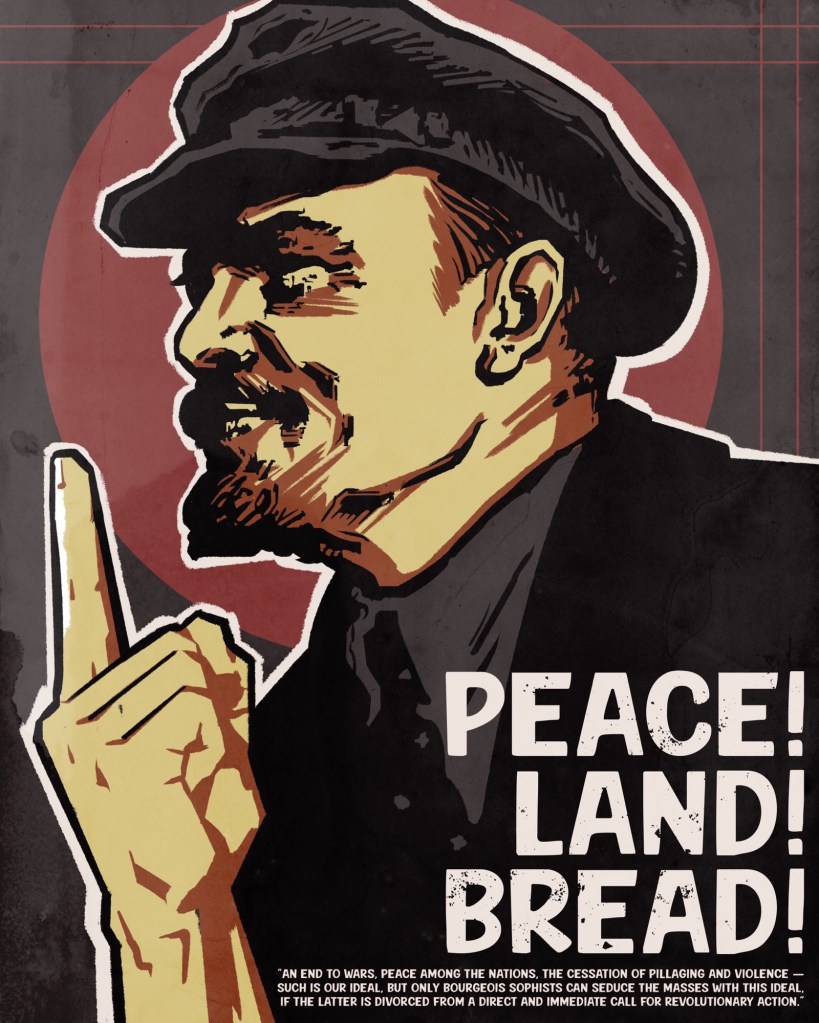
What did Lenin have to say about socialism and war?
“Socialists have always condemned war between nations as barbarous and brutal. But our attitude towards war is fundamentally different from that of the bourgeois pacifists (supporters and advocates of peace) and of the anarchists. We differ from the former in that we understand the inevitable connection between wars and the class struggle within the country; we understand that war cannot be abolished unless classes are abolished and socialism is created; and we also differ in that we fully regard civil wars, ie, wars waged by the oppressed class against the oppressing class, slaves against slave-owners, serfs against land-owners, and wage-workers against the bourgeoisie, as legitimate, progressive and necessary.”
Related:
Socialism and War (PDF)
Imperialism: The Highest Stage of Capitalism (PDF)
April Theses (PDF)
Real Liberty
But we did not build this society in order to restrict personal liberty but in order that the human individual may feel really free. We built it for the sake of real personal liberty, liberty without quotation marks. It is difficult for me to imagine what “personal liberty” is enjoyed by an unemployed person, who goes about hungry, and cannot find employment.
Real liberty can exist only where exploitation has been abolished, where there is no oppression of some by others, where there is no unemployment and poverty, where a man is not haunted by the fear of being tomorrow deprived of work, of home and of bread. Only in such a society is real, and not paper, personal and every other liberty possible.
Mao Zedong on Writing
Oppose Stereotyped Party Writing
The first indictment against stereotyped Party writing is that it fills endless pages with empty verbiage. Some of our comrades love to write long articles with no substance, very much like the “foot-bindings of a slattern, long as well as smelly”. Why must they write such long and empty articles? There can be only one explanation; they are determined the masses shall not read them. Because the articles are long and empty, the masses shake their heads at the very sight of them. How can they be expected to read them? Such writings are good for nothing except to bluff the naive, among whom they spread bad influences and foster bad habits. … If articles are too long, who will read them? Some comrades at the front, too, like to write long reports. They take pains over writing them and send them here for us to read. But who has the hardihood to read them? If long and empty articles are no good, are short and empty ones any better? They are no good either. We should forbid all empty talk. But the first and foremost task is to throw the long, smelly foot-bindings of the slattern into the dustbin. Some may ask, “Isn’t Capital very long? What are we to do about that?” The answer is simple, just go on reading it. There is a proverb, “Sing different songs on different mountains”; another runs, “Fit the appetite to the dishes and the dress to the figure”. Whatever we do must be done according to actual circumstances, and it is the same with writing articles and making speeches. What we oppose is long-winded and empty stereotyped writing, but we do not mean that everything must necessarily be short in order to be good. True, we need short articles in war time, but above all we need articles that have substance. Articles devoid of substance are the least justifiable and the most objectionable. The same applies to speechmaking; we must put an end to all empty, long-winded speeches.
Read More »
Mao: Tyrant or Great Leader?
Mao’s Legacy and Accomplishments
“Mao Tse‐tung, who began as an obscure peasant, died one of history’s great revolutionary figures. In Chinese terms, he ranked with the first Emperor who unified China in 200 B.C.
A Chinese patriot, a combative revolutionary, a fervent evangelist, a Marxist theorist, a soldier, a statesman and poet, above all Mao was a moralist who deeply believed, as have Chinese since Confucius, that man’s goodness must come ahead of his mere economic progress.
China achieved enormous economic progress under Mao. He transformed China into a modern, industrialized socialist state.”
Unlike many great leaders, Mao never exercised, or sought, absolute control over day‐to‐day affairs.”
Kamala Harris is NOT a Marxist!
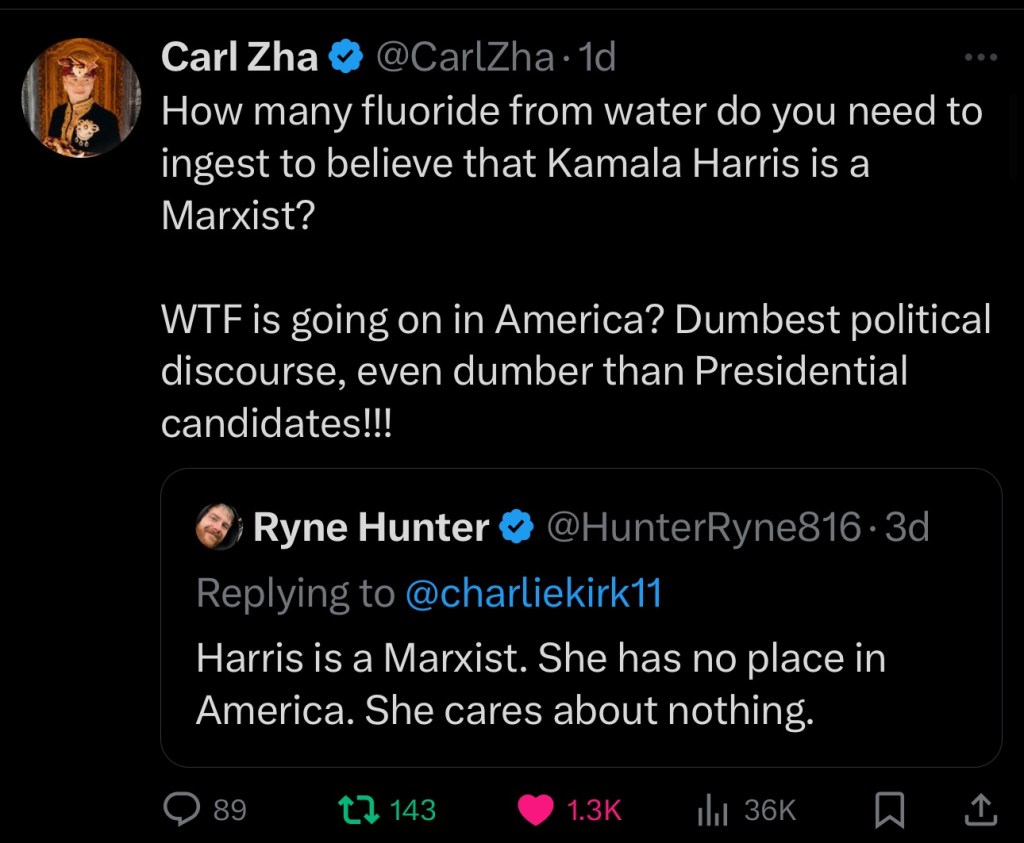

I agree with Carl. I don’t avoid fluoride 100%, only in my drinking water and medications. Coincidentally, I’ve had serious side effects from fluoride-containing medications (Levofloxacin, Fluoxetine).
Meanwhile, in Wisconsin:

TO BE ATTACKED BY THE ENEMY IS NOT A BAD THING BUT A GOOD THING
TO BE ATTACKED BY THE ENEMY IS NOT A BAD THING BUT A GOOD THING
“It is good if we are attacked by the enemy, since it proves that we have drawn a clear line of demarcation between the enemy and ourselves. It is still better if the enemy attacks us wildly and paints us as utterly black and without a single virtue. It demonstrates that we have not only drawn a clear line of demarcation between the enemy and ourselves but achieved a great deal in our work.”
Related:
Marxism and Psychological Science
1.1. The General Bases of Marxist Psychology
The teachings of Karl Marx caused a revolution in social sciences: in philosophy, in political economy, in the theory of socialism. As is known, psychology remained isolated from the influence of Marxism for many years. Marxism was not admitted into the official centers of scientific psychology, and the name of Karl Marx remained almost unmentioned in the works of psychologists for more than 50 years after the publication of his basic work.
Related:




 Ms. Cat’s Chronicles
You must be logged in to post a comment.