Social Security, Medicare are “going to be gone,” Donald Trump warns +

Social Security, Medicare are “going to be gone,” Donald Trump warns

Nice way to shift the blame. He was already planning on cutting them.

Related:

The Trump Administration’s Plans To Covertly Cut Social Security Disability Benefits

Mandate for Leadership 2025: Medicare

Trump plans to deny Social Security disability payments to hundreds of thousands of workers

Trump plan would limit disability benefits for older Americans

7 Medicare Policies That Are Quietly Being Rewritten Without Public Input

Acting Social Security head consults with Justice Dept. on whether to close agency(archived)

Trump’s Medicaid reversal should worry Social Security recipients.

Donald Trump’s Next Diversity Target: People With Disabilities

DOGE Sets Its Sights on Social Security, Medicare, and Medicaid

Elon Musk’s DOGE Allies Search Medicare Agency Payment Systems For Fraud

Trump Picks TV’s Dr. Oz to Run Medicare and Medicaid

[2022]: Dr. Oz Pushes Medicare PrivatizationFor All

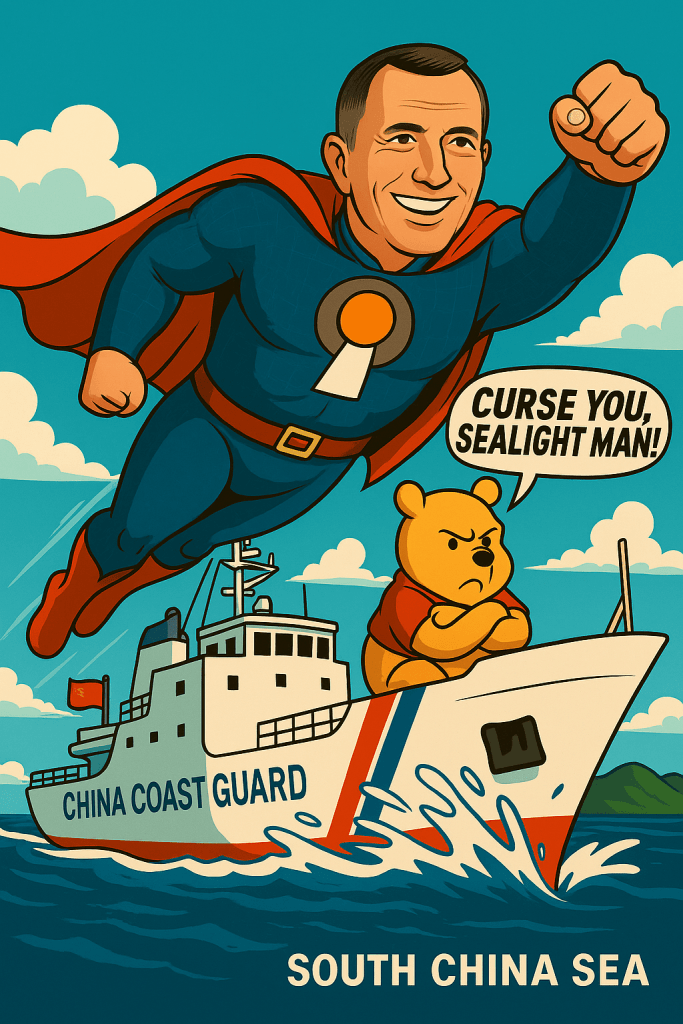
Capes, Cameras, and the Cult of Visibility

Capes, Cameras, and the Cult of Visibility: The SeaLight Crusade as White Savior Theater

By Tina Antonis

The South China Sea is more than a maritime dispute—it’s a theater of narrative warfare. While headlines focus on Chinese aggression and Philippine resistance, a quieter campaign unfolds in the background: one of satellite feeds, curated imagery, and Pentagon-backed storytelling. At the center of this effort is SeaLight, a project that claims to illuminate truth but often casts shadows of its own.

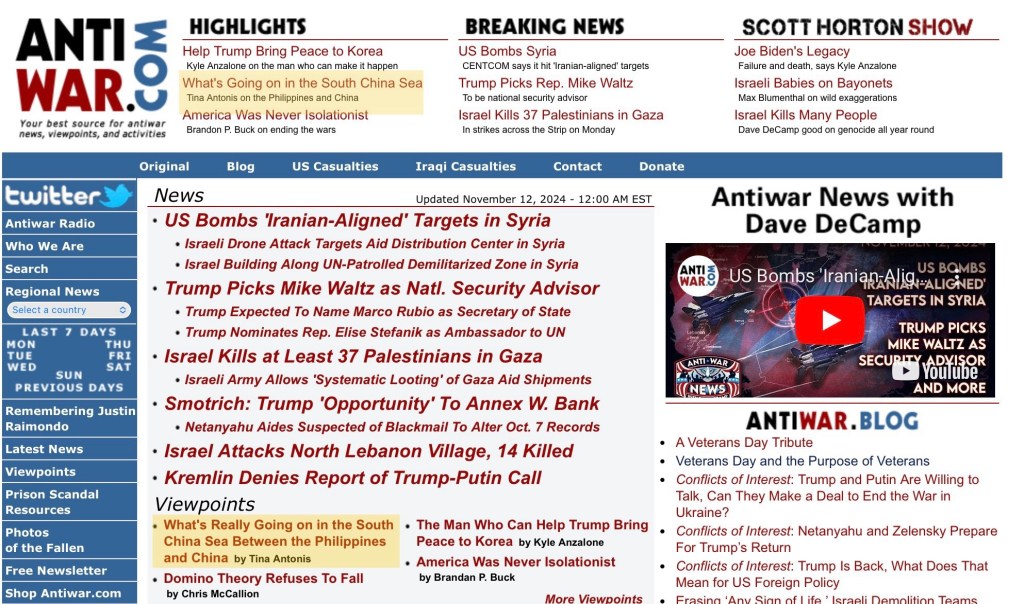
As explored in my article at Antiwar.com, SeaLight doesn’t just document—it performs. It reframes geopolitical tension through moral spectacle, positioning its creators as heroic arbiters of transparency. But when the messenger wears a cape and the funding flows from defense budgets, we must ask: is this clarity, or choreography?

Stage Left: The White Savior Enters

In the comic-strip cosmology of Ray Powell’s SeaLight project, transparency wears a cape. Clad in heroic postures and backed by satellite imagery, Powell casts himself as the guardian of maritime morality—unarmed, except with satellite feeds, theatrical flair, and strategic messaging. 

Yet beneath the cartoon and Pentagon-funded optics lies a familiar archetype: the white savior, rebranded for the South China Sea.

China Is Imperialist? Says Who?

Calling China a “maritime occupier,” Powell positions himself as a bulwark against aggression. But that moral pose collapses under scrutiny. He speaks for a country with over 800 foreign military installations and a documented history of over 250 military interventions since 1991—wars in Iraq, Afghanistan, Libya, Syria, Somalia, and dozens more, all under the banner of peace, freedom, or preemption.

By comparison, China’s post–Cold War footprint includes no sustained foreign occupations and only scattered border conflicts and peacekeeping missions. The imbalance is staggering. And Powell’s framing doesn’t just ignore it—it performs around it.

As David Vine argues in The United States of War, this vast base empire is not a passive network—it’s an architecture of perpetual war. These outposts make military engagement not an exception but a structural habit, cloaked in strategic necessity and sold as global stewardship.

Powell’s cartoon rhetoric—calling China an occupier—obscures the scale of U.S. militarism. The term “occupation” is deployed not to analyze, but to project. When adversaries hold territory, it’s a crisis; when the U.S. spans the globe with armed installations, it’s policy.

Framing Conflict: The Optics of Consent

This isn’t irony. It’s performance. Powell’s language manufactures a moral frame for confrontation—costumed in transparency, but driven by escalation. The cape is literal. The conditioning is deliberate. And the stage is set for war.

SeaLight’s mission is not just visual documentation—it’s narrative warfare. As the Japan Times openly notes, its “chief weapon is photography, applied purposefully, generously and consistently over time.” These images—enhanced, curated, and distributed across media—are not neutral. They’re constructed to shape public perception, sway international opinion, and ultimately manufacture consent for confrontation.

Assertive transparency becomes a kind of ideological scaffolding—a stage on which geopolitical tension is dramatized, simplified, and morally polarized. The goal isn’t simply to reveal conflict; it’s to condition audiences for escalation.

And when the messenger dons a superhero’s cape, the spectacle transforms into something deeper: a story of rescue, of virtue, of intervention. This is not analysis—it’s soft propaganda dressed in heroic metaphor.

Consent for war doesn’t begin with missiles. It begins with mythmaking.

Concerns over MEK’s potential Influence in Congress + More

The National Council of Resistance of Iran (NCRI) and the Mojahedin-e-Khalq (MEK) are synonymous.

The Mujahedin-e-Khalq (MEK) has renewed its efforts to position itself as a credible opposition movement to the Islamic Republic. The recent outcome of the group’s lobbying activities has been a resolution submitted by 160 congressmen. However, a comprehensive new report from the Congressional Research Service [CRS] critically assesses these ongoing efforts, underscoring significant concerns regarding the MEK’s extremist ideological origins, historical involvement in terrorism, documented human rights abuses, and notably weak popular support among Iranians both domestically and within the diaspora.

Concerns over MEK’s potential Influence in Congress (archived)

Related:

Read More »

USAID to be merged into State Department, 3 U.S. officials say

Source

USAID, the United States Agency for International Development, will be merged into the State Department with significant cuts in the workforce, but it will remain a humanitarian aid entity, three U.S. officials told CBS News. 

USAID to be merged into State Department, 3 U.S. officials say

When Rubio says national interests, he means the interests of big corporations.

Related:

Brian Berletic:

Read More »

US ‘quietly’ supplied weapons to Ukraine before Russia’s operation started, Blinken says

source

The Interview: Antony Blinken Insists He and Biden Made the Right Calls

You made two early strategic decisions on Ukraine. The first, because of that fear of direct conflict, was to restrict Ukraine’s use of American weapons within Russia. The second was to support Ukraine’s military offensive without a parallel diplomatic track to try and end the conflict. How do you look back on those decisions now? So first, if you look at the trajectory of the conflict, because we saw it coming, we were able to make sure that not only were we prepared and allies and partners were prepared, but that Ukraine was prepared. We made sure that well before the Russian aggression happened, starting in September and then again December, we quietly got a lot of weapons to Ukraine to make sure that they had in hand what they needed to defend themselves, things like Stingers, Javelins that were instrumental in preventing Russia from taking Kyiv, from rolling over the country, erasing it from the map, and indeed pushing the Russians back. But I think what’s so important to understand is at different points in time, people get focused on one weapon system or another. Is it an Abrams tank? Is it an F-16? What we’ve had to look at each and every time is not only should we give this to the Ukrainians but do they know how to use it? Can they maintain it? Is it part of a coherent plan? All of those things factored into the decisions we made on what to give them and when to give it.

Related:

TASS: US ‘quietly’ supplied weapons to Ukraine before Russia’s operation started, Blinken says

OSCE Reports Reveal Ukraine Started Shelling The Donbas Nine Days Before Russia’s ‘Special Military Operation’:

Ukraine began artillery strikes against the Donbas republics on February 16th, 2022.
“In other words, Ukraine began shelling the independent republics of Donetsk and Luhansk nine days before Russia announced its ‘special military operation’ in Ukraine.
“While the western corporate media remained completely silent, explosions documented by the OSCE increased from 76 on February 15th, to 316 on February 16th, to 654 on February 17th, and to 1,413 on February 18th.

[02-18-2022] Shelling in Donbass brings Europe to brink of war

Euromaidan 2014 – Orange Revolution – War in Donbass

Part 3a: RAND and SeaLight – Taiwan Relations Act

The United States has also recently transitioned from an ambiguous approach [strategic ambiguity] to deterring a Chinese invasion on Taiwan to one that more clearly states that the United States will defend Taiwan in the event of a Chinese invasion (referred to as strategic clarity).

P93: Understanding and Countering China’s Maritime Gray Zone Operations | RAND

This is not true! The Biden administration “walked back” his statements each time!

Read More »

What’s Really Going On In the South China Sea Between the Philippines and China

What’s Really Going On In the South China Sea Between the Philippines and China

by Tina Antonis

Maritime clashes between the Philippines and China had been mostly over the Philippines’ military outpost, BRP (BRP—Barko ng Republika ng Pilipinas, which translates to “Ship of the Republic of the Philippines”—the ship prefix for the Philippines) Sierra Madre, in the Spratly Islands, which is disputed by Brunei, China, Malaysia, the Philippines, Taiwan (a province of China, as recognized by the United Nations’ Resolution No. 2758), and Vietnam. The BRP Sierra Madre was intentionally run aground on a reef near the Second Thomas Shoal in the disputed Spratly Islands, in 1997, so that the Philippines could stake their territorial claim.

Read More »

Twitter: Atlas Network update

I’ve been meaning to look into these two, but forgot about it. Maine Policy Institute is already on my Atlas Network list, but I just added the Foundation for Research on Equal Opportunity.

Maine Policy Institute:

State Policy Network (SPN), American Legislative Exchange Council (ALEC), Koch network, Franklin News Foundation (Franklin Center for Government and Public Integrity), Bradley Foundation, DonorsTrust, Cato Institute, Sam Adams Alliance, Donors Capital Fund, etc.

Read More »