

Tag: contradictions

Selective Free Speech: Censorship, Hypocrisy, and the Politics of Control
Marx’s insight—”The ruling ideas of each age have ever been the ideas of its ruling class”—perfectly captures the hypocrisy of free speech under the Trump administration. While they denounced censorship when the Biden administration silenced voices questioning pandemic policies, they now weaponize state power against those protesting the war in Gaza. This contradiction reveals that their defense of free speech is not based on principle but on political utility—protecting narratives that serve their interests while suppressing dissent that threatens their agenda. By framing pandemic skepticism as truth-seeking while branding anti-war activism as dangerous, they manipulate public discourse to maintain control rather than uphold genuine democratic values. This selective enforcement isn’t new; it’s a recurring pattern in power structures, where the ruling class dictates which ideas are legitimate and which must be silenced.
Negotiating positions: Russian security demands
MIA and the Conflict Between My Words and Their Funding
I nearly forgot—I had submitted one of my poems to Mad in America. That was before I learned they’d received funding from Open Society Foundations for their podcast. When an email arrived saying they’d published my piece, I was completely caught off guard—I hadn’t expected them to accept it at all.
Read More »Oh, the Irony: Flags of Contradiction
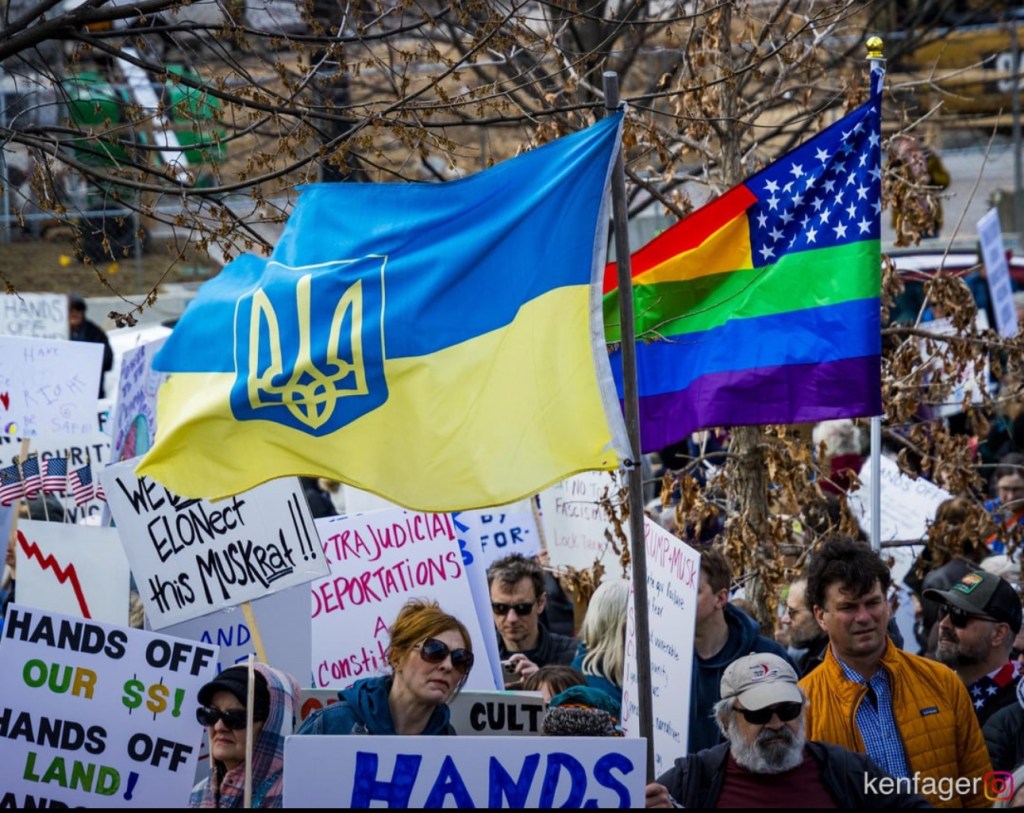
Juxtaposing these two flags creates a stark contradiction, given the Ukrainian Ultranationalists’ oppressive policies toward LGBTQ+ communities.
Related:
Protesters tee off against Trump and Musk in “Hands Off!” rallies across the U.S.
Gallery: Thousands of protesters gather on State Street, at Capitol to protest Trump administration
Concerns over MEK’s potential Influence in Congress + More
The Mujahedin-e-Khalq (MEK) has renewed its efforts to position itself as a credible opposition movement to the Islamic Republic. The recent outcome of the group’s lobbying activities has been a resolution submitted by 160 congressmen. However, a comprehensive new report from the Congressional Research Service [CRS] critically assesses these ongoing efforts, underscoring significant concerns regarding the MEK’s extremist ideological origins, historical involvement in terrorism, documented human rights abuses, and notably weak popular support among Iranians both domestically and within the diaspora.
Concerns over MEK’s potential Influence in Congress (archived)
Related:
Read More »Trotsky: The Formalist School of Poetry and Marxism
LEAVING out of account the weak echoes of pre-Revolutionary ideologic systems, the only theory which has opposed Marxism in Soviet Russia these years is the Formalist theory of Art. The paradox consists in the fact that Russian Formalism connected itself closely with Russian Futurism, and that while the latter was capitulating politically before Communism, Formalism opposed Marxism with all its might theoretically.
Literature and Revolution: The Formalist School of Poetry and Marxism
From Global Anti-Imperialism to the Dandelion Fighters, China’s Solidarity with Palestine from 1950 to 2024

Frontier of global anti-imperialist struggle: China’s perceptions of the Palestinian struggle from 1955 to 1976
China is probably one of few states which flipped its diplomatic stance on the “Palestinian-Israeli conflict” in the most dramatic manner from the 1950s to 1970s. In only 20 years, the People’s Republic of China (PRC)’s official foreign policy dramatically changed from almost establishing diplomatic relations with Israel in 1950 to denying any legitimacy of the Israeli state in the 1960s to 1970s. As I aim to demonstrate in this article, the Maoist era, especially from 1955 to 1976, established the foundation of China’s diplomatic support for the Palestinian liberation movement, and this legacy is still one of the main factors guiding China’s official stance on Palestine today.
Related:
THE CHINESE PEOPLE FIRMLY SUPPORT THE ARAB PEOPLE’S STRUGGLE AGAINST AGGRESSION


 Ms. Cat’s Chronicles
You must be logged in to post a comment.