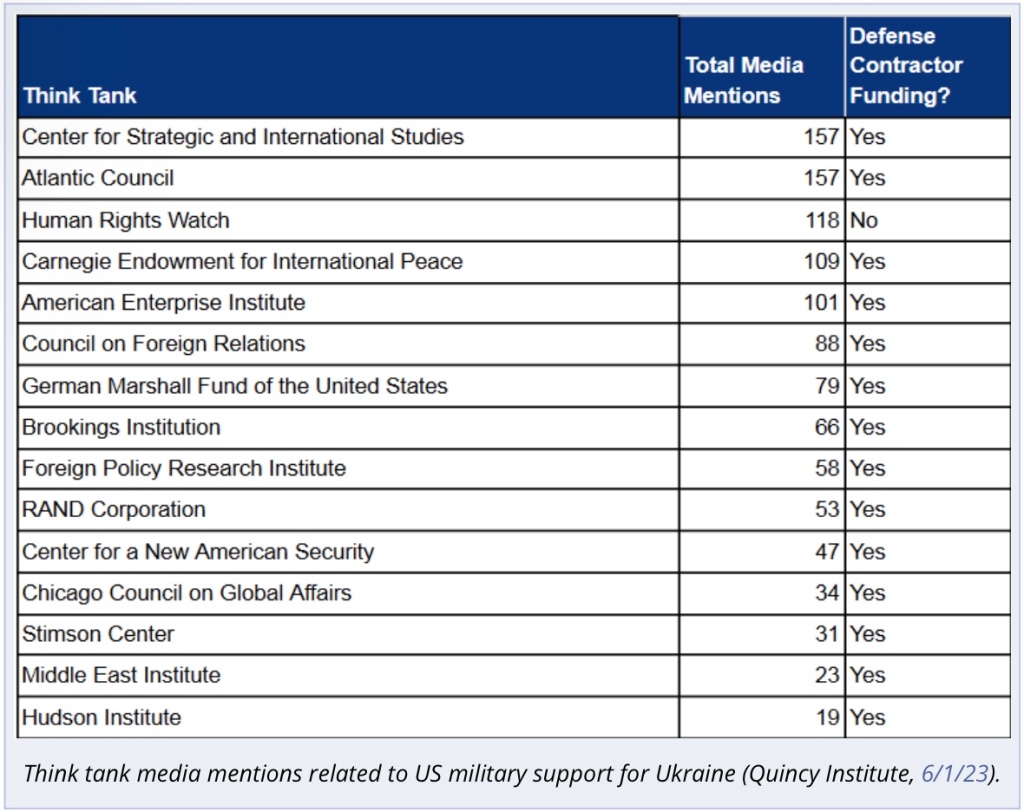
Wealthy donors have long funded think tanks with official-sounding names that produce research that reflects the interests of those funders (Extra!, 7/13). The weapons industry is a major contributor to these idea factories; a recent report from the Quincy Institute (6/1/23) demonstrates just how much influence war profiteers have on the national discourse.
– Visit by US Secretary of State attempts to portray the US as “reasonable” versus a “belligerent” Chinese “dictatorship;”
– Secretary Blinken recited the US “One China” policy, omitting the many ways the US has and still is blatantly violating it and provoking China;
– US strategy follows similar pattern of the US “reset” with Russia or the US-Iran “nuclear deal,” where the US sought to appear to have exhausted diplomatic options before moving on “reluctantly” to economic sanctions and war;
– Such a strategy is necessary for consensus building among US allies who would otherwise be hesitant to join the US in both economic sanctions and eventual military intervention versus China;
– US policymakers are already busy planning sanctions against China, which includes an already ongoing public relations campaign to sell Russia-style sanctions against China, as well as preparations for military operations to follow the sanctions;
– The US has a long-standing strategy to encircle and contain China spanning decades, indifferent to presidential administrations;
In history classes (in public or private schools, colleges, and others), state propaganda, and mainstream history, a historical fiction has been spun that allegedly debunks any notion of noninterventionism. This is the myth of American isolationism.
The single most overlooked and under-appreciated aspect of our society is the way domestic propaganda is used to shape the way mainstream westerners perceive and think about their world.
At some point over the past few years, the Biden administration revoked one of the few progressive policies that Trump-era officials implemented in the effort to bring greater transparency to foreign influence in Washington. The New Republic has learned that with little fanfare, and with even less explanation, the White House has stopped requesting that American think tanks disclose funding from foreign governments. “This is not the policy of the U.S. State Department,” an agency spokesperson said last month.
In this new essay, John Pilger recalls the ‘electric’ opposition of writers and journalists to the coming war in the 1930s and investigates why today there is ‘a silence filled by a consensus of propaganda’ as the two greatest powers draw closer to conflict.
Last year, US-based electric vehicle company Tesla put in a bid for a contract to mine some of that Lithium, but the Nigerian government denied them. Nigeria, like most African countries, has a history of foreign powers exploiting them for their national resources while offering little value to the people of Nigeria.

 Ms. Cat’s Chronicles
You must be logged in to post a comment.