Love yourself, believe in yourself. Fuck the rigged system.
Capitalism’s narrative, that you ain’t winning unless you’re near the top of monetary accumulation number game is horseshit. You’re worth is not measured by your bank balance.
In the United States of America food prices have risen, on the average, by 120 per cent, whereas wages have increased only by 100 per cent. In Britain, food prices have gone up by 170 per cent, and wages 130 per cent; in France, food prices—300 per cent,. and wages 200 per cent; in Japan—food prices 130 per cent, and wages 60 per cent (I have analysed Comrade Braun’s figures in his pamphlet and those of the Supreme Economic Council as published in The Times of March 10, 1920).
In such circumstances, the workers’ mounting resentment, the growth of a revolutionary temper and ideas, and the increase in spontaneous mass strikes are obviously inevitable, since the position of the workers is becoming intolerable. The workers’ own experience is convincing them that the capitalists have become prodigiously enriched by the war and are placing the burden of war costs and debts upon the workers’ shoulders. We recently learnt by cable that America wants to deport another 500 Communists to Russia so as to get rid of “dangerous agitators”.
Even if America deports to our country, not 500 but 500,000 Russian, American, Japanese and French “agitators” that will make no difference, because there will still be the disparity between prices and wages, which they can do nothing about. The reason why they can do nothing about it is because private property is most strictly safeguarded, is “sacred” there. That should not be forgotten, because it is only in Russia that the exploiters’ private property has been abolished. The capitalists can do nothing about the gap between prices and wages, and the workers cannot live on their previous wages. The old methods are useless against this calamity. Nothing can be achieved by isolated strikes, the parliamentary struggle, or the vote, because “private property is sacred”, and the capitalists have accumulated such debts that the whole world is in bondage to a handful of men. Meanwhile the workers’ living conditions are becoming more and more unbearable. There is no other way out but to abolish the exploiters’ “private property”.
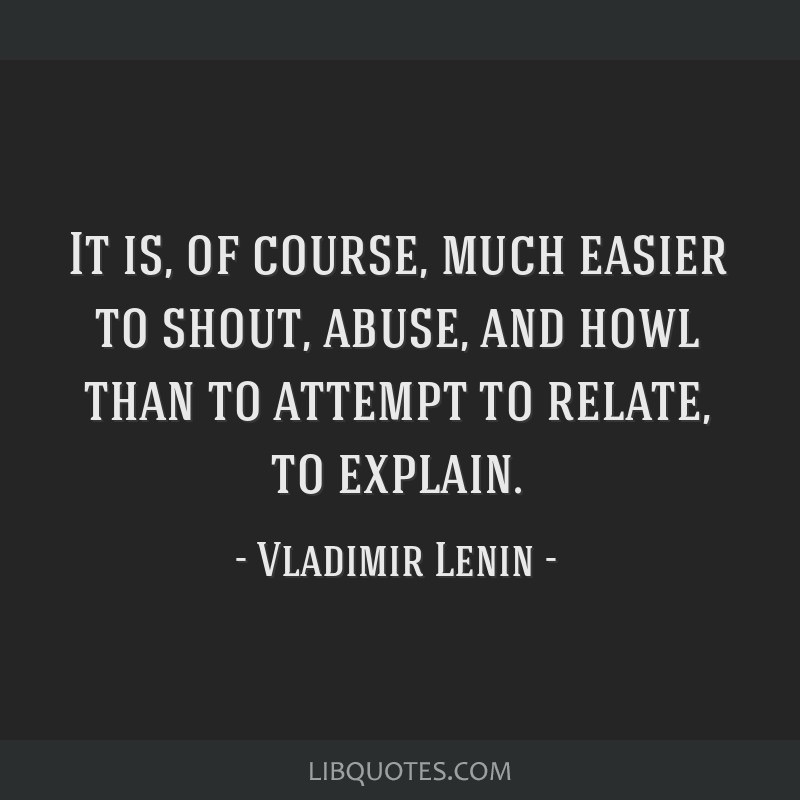
Vladimir Lenin once remarked, “It is, of course, much easier to shout, abuse, and howl than to attempt to relate, to explain,” highlighting the value of constructive dialogue and education over emotional outbursts or hostile rhetoric. As a revolutionary thinker and leader, Lenin stressed the importance of articulating ideas and strategies clearly to foster understanding and rally support for the socialist movement.
He criticized those who relied on anger, insults, or simplistic slogans, arguing that such tactics undermined the more challenging but essential work of educating and persuading others. For Lenin, successful revolutionary efforts depended on thoughtful explanation, open dialogue, and the ability to engage with people on a rational level. This method was crucial for building a disciplined and informed movement capable of achieving lasting goals, rather than succumbing to fleeting emotional appeals or divisive strategies.
Ultimately, Lenin advocated for a deliberate and strategic approach to political struggle—one rooted in clarity, reason, and the empowerment of the working class through education and mutual understanding.
Vladimir Lenin, as a revolutionary and Marxist thinker, approached most topics through the lens of class struggle, materialism, and the broader social and economic systems. While he did not write or speak extensively about love as a personal or romantic concept, his views on human relationships were likely shaped by his Marxist perspective.
Here’s how Lenin might conceptualize love, based on his ideological framework:




 Ms. Cat’s Chronicles
You must be logged in to post a comment.