The People’s Liberation Army Navy Z-9 utility helicopter that intercepted the Philippine Cessna. Photo Courtesy of Camille Elemia.
…
A People’s Liberation Army Navy Z-9 utility helicopter intercepted the Bureau of Fisheries and Aquatic Resources Cessna 208B Grand Caravan during a routine patrol mission over Scarborough Shoal today at 8:39 a.m. local time, according to Philippine officials. A number of Philippine journalists [embedded journalists] were on board the Cessna during the encounter, which saw the Chinese helicopter fly as close as three meters from the turboprop aircraft. Philippine Coast Guard spokesperson Commodore Jay Tarriela described China’s actions as “dangerous flight maneuvers” and blasted the conduct as a disregard to international aviation regulations.
I’ve always known that they would try to expand their information operation to the other countries that are in ASEAN, just by following the SeaLight podcast. If not their information operation, regimechange and terrorism (in Balochistan and Myanmar). I’ve also noticed that Powell has been referring to the Philippines’ “transparency initiative” as “non-violent resistance,” lately (RAND refers to it as “assertive transparency”). Ironic, considering that they’ve already succeeded in overthrowing the government of Bangladesh and are now attempting it in Cambodia, India and Pakistan. For those who don’t know about the regime change asset Gene Sharp and his neoliberal “nonviolence,” see the links on this page. Unfortunately, I don’t have as much time to dedicate to this right now due to other obligations.
A recent simulation conducted by the Center for Strategic and International Studies (CSIS) paints a stark picture of the U.S. defense industrial base, revealing critical vulnerabilities in its ability to support military operations in the event of a large-scale conflict. The findings underscore the urgent need for public-private partnerships, increased investment in manufacturing capacity, and reduced reliance on foreign components.
Territorial wrangling over who owns the South China Sea has strangled local marine life, say scientists, urging China and the Philippines to set aside political differences and work to save the fish, coral and plants that live border-free.
…
Since 2013, China has built artificial islands that cover more than 3,000 acres of the Spratlys, according to U.S.-based policy organisation Asia Maritime Transparency Initiative.
…
A study last December by the Asia Maritime Transparency Initiative also blamed China’s dredging and clam harvesting for destroying almost 20,000 acres of reefs in the South China Sea.
According to the CIA’s World Factbook, Vietnam occupies around 50 outposts, The Philippines occupies nine, Malaysia occupies five, and China occupies sevenin the disputed Spratly Islands.
CATL and SMIC are two giant Chinese companies that are often singled out by Western think tanks as two firms who benefit from China’s subsidies, at the expense of foreign competition.
But all industrialized countries employ government subsidies, which help favored domestic industries grow. China, however, uniquely can invest in preferred sectors by channeling its massive trading surpluses, and providing low-cost access to its world-leading supply chains and logistics systems.
In contrast, North American and European companies who seek government incentives and subsidies are competing with other spending priorities, as all the funds come from taxpayers. This reality requires of companies seeking government help to do so through proxies, lobbying efforts, and through think-tanks who create research that can be published and used by lawmakers to justify the use of taxpayer funds.
The governments of Brazil, Colombia, and Mexico, we offer our congratulations, and we want to express our solidarity with the people of Venezuela, who attended a mass at the ballot box on July 28, to set your own in future.
The governments of Brazil, Colombia and Mexico, we congratulate and express our solidarity with the Venezuelan people that went massively to the polls on July 28 to define their own future.
We continue with a lot of attention to the process of scrutiny of the votes, and we call on the electoral authorities of Venezuela to move forward expeditiously and give it to publicly available data disaggregated by voting table.
The disputes over the election process must be permitted by the institutional route. The fundamental principle of popular sovereignty should be respected by the unbiased check of the results.
In this context, we call on all political and social actors to exercise maximum caution and restraint in his demonstrations and public events in order to avoid an escalation of violent episodes.
Keep the social peace and protect human lives must be the priority concerns at this time.
This is the opportunity to express, once again, our absolute respect for the sovereignty of the will of the people of Venezuela. We reiterate our willingness to support the efforts of dialogue and the search for agreements that benefit the venezuelan people.
The Philippines and China have just restored peace and stability in the areas of the South China Sea contested by the two countries in a July 21, 2024 “de-escalation” deal that aimed at “easing tensions.”
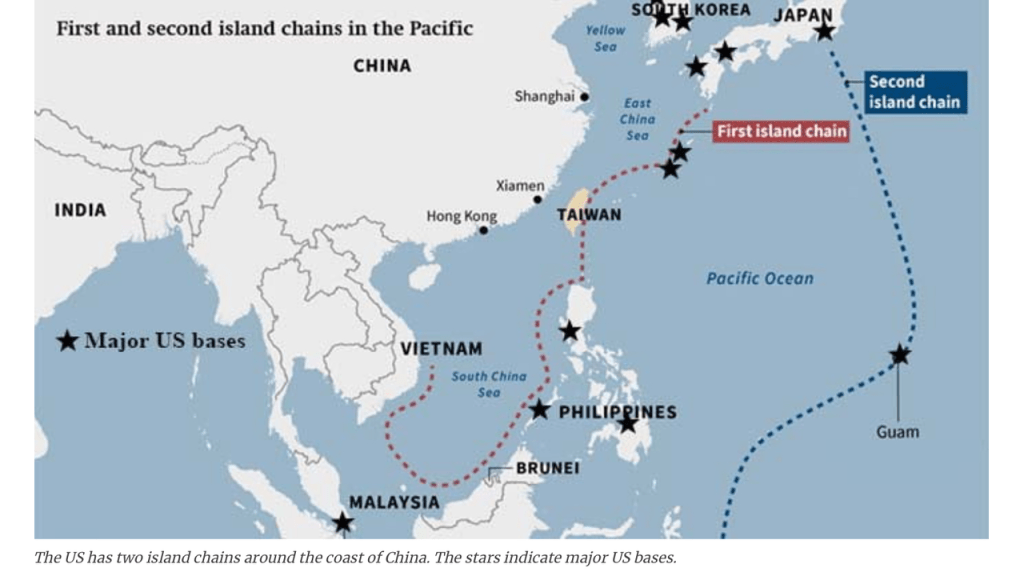
The United States has taken yet another step toward shaping the Southeast Asian archipelago nation of the Philippines into an Ukraine-style proxy with which to encircle and contain China, this time in the form of a $500 million military assistance package for Manila.



 Ms. Cat’s Chronicles
You must be logged in to post a comment.