
A Front Company and a Fake Identity: How the U.S. Came to Use Spyware It Was Trying to Kill.

A Front Company and a Fake Identity: How the U.S. Came to Use Spyware It Was Trying to Kill.

The secret contract — which The New York Times is disclosing for the first time — violates the Biden administration’s public policy, and still appears to be active. The contract, reviewed by The Times, stated that the “United States government” would be the ultimate user of the tool, although it is unclear which government agency authorized the deal and might be using the spyware. It specifically allowed the government to test, evaluate, and even deploy the spyware against targets of its choice in Mexico.

The secret November 2021 contract used the same American company — designated as “Cleopatra Holdings” but actually a small New Jersey-based government contractor called Riva Networks — that the F.B.I. used two years earlier to purchase Pegasus. Riva’s chief executive used a fake name in signing the 2021 contract and at least one contract Riva executed on behalf of the F.B.I.

The deal unfolded as the European private equity fund that owns NSO pursued a plan to get U.S. government business by establishing a holding company, Gideon Cyber Systems. The private equity fund’s ultimate goal was to find an American buyer for the company.

Related:

Read More »
Bill to Ban Tik Tok Would Give Government Sweeping Powers to Crackdown on Tech

Bill to Ban Tik Tok Would Give Government Sweeping Powers to Crackdown on Tech

A person who violates the act could be fined up to $1 million or punished with up to 20 years in prison. The broad and vague definitions in the legislation caused many to wonder if people could be handed such harsh punishments for using Virtual Private Networks (VPNs) to get around future government censorship that could come as a result of the bill.

A spokesperson for Warner insisted that the legislation wasn’t designed to target individual users and pointed to the language that says someone “must be engaged in ‘sabotage or subversion’ of American communications technology products and services, creating ‘catastrophic effects’ on US critical infrastructure, or ‘interfering in, or altering the result’ of a federal election, in order to be eligible for any kind of criminal penalty.”

But the bill will give the Commerce Secretary the authority to deem what is considered “sabotage or subversion” or any of the other threats listed above. The legislation has grave implications for civil liberties and could be used against any individuals or tech and media companies the Biden administration, or any future administration would want to target.

Previously:

Tik-Tok bills could dangerously expand national security state

US And EU Nations Request The Most User Data From Tech Companies, Obtain It More Than Two-Thirds Of The Time

from the may-as-well-just-be-government-contractors dept

Most tech companies handling data requests from governments now publish transparency reports. As everything moves towards always-online status (including, you know, your fridge), social media platforms and other online services have become the favored targets of government data requests. It just makes sense to look there first rather than out there in the real world, where people (and their communications) are that much more difficult to locate.

US And EU Nations Request The Most User Data From Tech Companies, Obtain It More Than Two-Thirds Of The Time

Congressional Rep Who Discovered His Info Was Illegally Searched By The FBI Likely Has No Legal Remedy

from the but-this-is-the-system-Congress-wants…. dept

The FBI has long enjoyed its close relationship with the NSA… or at least the NSA’s collections. Data and communications collected under the NSA’s Section 702 program contain plenty of “incidental” snooping on Americans. That’s because even though it’s a foreign-facing collection, Americans who communicate with people outside of the United States are swept up in the dragnet.

Congressional Rep Who Discovered His Info Was Illegally Searched By The FBI Likely Has No Legal Remedy

Well that’s unfortunate. If only he were part of some kind of body that had the power to change the law.” [1]

TikTok defenders emerge in Congress

TikTok defenders emerge in Congress

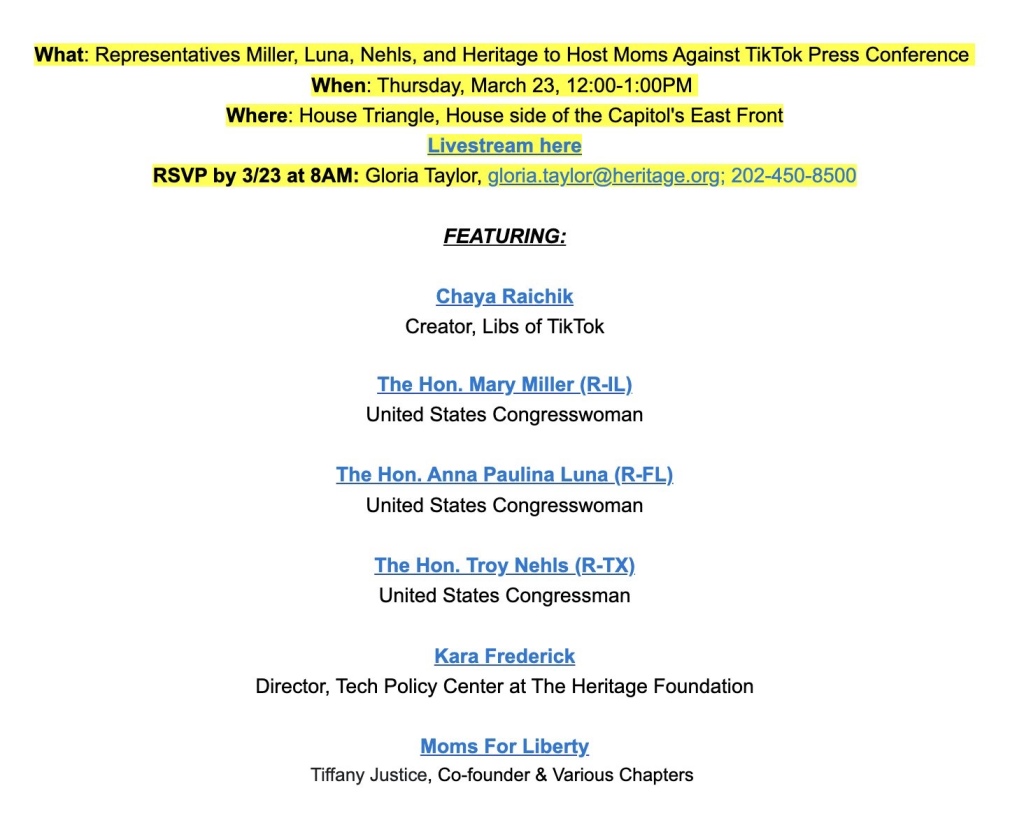
The other side: Reps. Mary Miller (R-Ill.), Anna Paulina Luna (R-Fla.) and Troy Nehls (R-Texas) are holding a competing “Moms Against TikTok” press conference at the Capitol on Thursday to press for a ban.

The speakers include a staffer for the conservative Heritage Foundation and Chaya Raichik, the operator of “Libs of TikTok.”

Source: Twitter

Related Notes:

Read More »

Yes, The US Government Threatening To Block TikTok Violates The 1st Amendment

You may have heard that the Biden administration has told TikTok that it must be divested from ByteDance or it will be banned in the US. At least that’s what TikTok said the administration has said. The end result of this might well be that ByteDance divests of TikTok, but we should be clear: the threat, and any potential block, would be a clear, blatant, dangerous violation of the 1st Amendment.

Yes, The US Government Threatening To Block TikTok Violates The 1st Amendment

Previously:

The US government is trying to force ByteDance to sell TikTok