
Chinese Missile Boat Undertakes ‘Alarming’ Action

Chinese Missile Boat Undertakes ‘Alarming’ Action (archived)

A Chinese navy missile craft shadowed a Philippine civilian ship on Friday in an unprecedented encounter that one analyst described as “alarming.”

The Fisheries and Aquatic Resources (BFAR) vessel the BRP Datu Romapenet was en route to a South China Sea feature known as Half Moon Shoal to deliver supplies to fishermen.

Half Moon Shoal is situated at the eastern edge of the Spratly Islands and about 60 miles from the Philippine province of Palawan, well within the Southeast Asian country’s recognized exclusive economic zone (EEZ).

According to the Philippines’ ABS-CBN News, which was onboard, the ship picked up a tail in the form of a Houbei-class (Type 22) guided-missile craft, easily identifiable by its wide camouflaged catamaran hull.

Chester Cabalza, founder of Manila-based think tank the International Development and Security Cooperation, told the news agency it was the first time a Type 22 had been spotted in the EEZ.

“This incident is alarming because a missile ship shadowed our BFAR ship,” Cabalza said, adding that it was a show of power intended to intimidate the Philippines.
Read More »

Skies over South China Sea seen as new flashpoint as Manila begins ‘aerial provocations’

Source

According to the article, Philippine aircraft also frequently operate with their Automatic Dependent Surveillance-Broadcast (ADS-B) transponders deactivated, significantly increasing safety risks.

Deactivating such transponders means real-time positioning of the aircraft is not shared with air traffic controllers and other aircraft, making it more difficult to maintain situational awareness and avoid potential conflicts or collisions.

Skies over South China Sea seen as new flashpoint as Manila begins ‘aerial provocations’

Related:

How far is China-Philippines Aerial Collision in the South China Sea?

Since August 2024, the Philippines has repeatedly dispatched military aircraft to trespass into the airspace of the Spratly Islands and Macclesfield Bank, escalating tensions in the region. On August 7 and 8, the Philippines sent an NC-212i aircraft to intrude into the airspace near Scarborough Shoal for two consecutive days, disrupting China’s regular training activities. On August 19, a Cessna 208B Grand Caravan plane (C-208B) was dispatched to illegally enter the airspace of Scarborough Shoal. On August 22, the Bureau of Fisheries and Aquatic Resources of the Philippines again sent a C-208B to illegally intrude into the vicinity of Subi Reef.

On the other hand, the Philippine aircraft in use are primarily single-engine turboprop light utility aircraft, which are less equipped to handle complex maritime environments, increasing the likelihood of accidents during frequent operations. Moreover, Philippine military aircraft usually operate with ADS-B transponders turned off throughout their missions, posing potential safety risks. In the event of an accident, whatever the reasons, based on past behavior, the Philippines would likely blame China, leading to another cycle of victim-playing and diplomatic posturing.

Is the Philippines becoming a US ‘proxy’ against Beijing in the South China Sea?

Is the Philippines becoming a US ‘proxy’ against Beijing in the South China Sea?

‘The ants that get trampled on’

Not everyone agrees with drawing closer to the US, however, and they warn about the Philippines turning into a “proxy” for American interests. The president’s own sister Imee, a senator, told ANC Digital earlier this month that “China will always be our neighbour, we have no fight with them, let’s not get dragged into a fight that’s not our own.”

Anna Rosario Malindog-Uy, director of the pro-China Asian Century Philippines Strategic Studies Institute, wrote in the Manila Times on February 10 that “agreements such as the EDCA, the VFA and the Mutual Defence Treaty have not only cemented the US military presence and influence in the Philippines but also, most importantly, exemplified the Philippines’ dependence on the US in the military and defence sector.”

Teresita Ang See, former president of the Philippine Association for Chinese Studies and currently part of its advisory council, told This Week in Asia: “Filipinos in general condemn China’s action. But many also understand that China’s assertiveness is in response to US, Japanese and Australian provocations and increasing military presence in the Philippines.”

She warned that “we are fighting a proxy war between the US and China and in the end we will be the ants that get trampled upon”.

H/T: Johnsonwkchoi

Related:

Responding to the Catholic Bishops

Philippines counts the cost of tough South China Sea stance against Beijing

Indonesia’s feared ex-general Prabowo claims victory in presidential election + Notes

Indonesia’s feared ex-general Prabowo claims victory in presidential election

But the likely victory of Prabowo — an ex-general who was kicked out from the army and subjected to a two-decade ban from the U.S. over human rights violations — raises fears of the world’s third-largest democracy sliding backward into authoritarian rule.

Related:

3 things you should know about Indonesia’s presidential elections

Continuity and its risks


Prabowo is expected to largely continue the policies of President Widodo, or “Jokowi,” as Indonesians call him. President Widodo is not up for reelection as he’s serving his final term.

Through his two five-year terms, Indonesia’s economy — Southeast Asia’s largest — has grown at about 5% a year. His infrastructure building, cash and food assistance to the poor and health and education policies have been popular.

Indonesia is the world’s largest producer of nickel, used in making electric vehicle batteries, and Jokowi has barred the export of raw nickel, to help Indonesia move up the value chain from mining to manufacturing.

Prabowo is Suharto’s son-in-law. He received training in the 1980s from the U.S. military at Fort Benning, Ga. (now Fort Moore) and Fort Bragg, N.C. (now Fort Liberty).

Indonesia’s presidential election emerges as key battleground in US-China rivalry

Read More »

New SWOBOSS Wants More Directed Energy Weapons on Warships as Low-Cost Threats Expand

Full video.

ARLINGTON, Va. – The new head of Naval Surfaces Force wants to accelerate the installation of directed energy weapons on surface warships, as the Navy grapples with low-cost, long-range attack drones proliferating widely in places like the busy commercial shipping lanes of the Middle East.

New SWOBOSS Wants More Directed Energy Weapons on Warships as Low-Cost Threats Expand

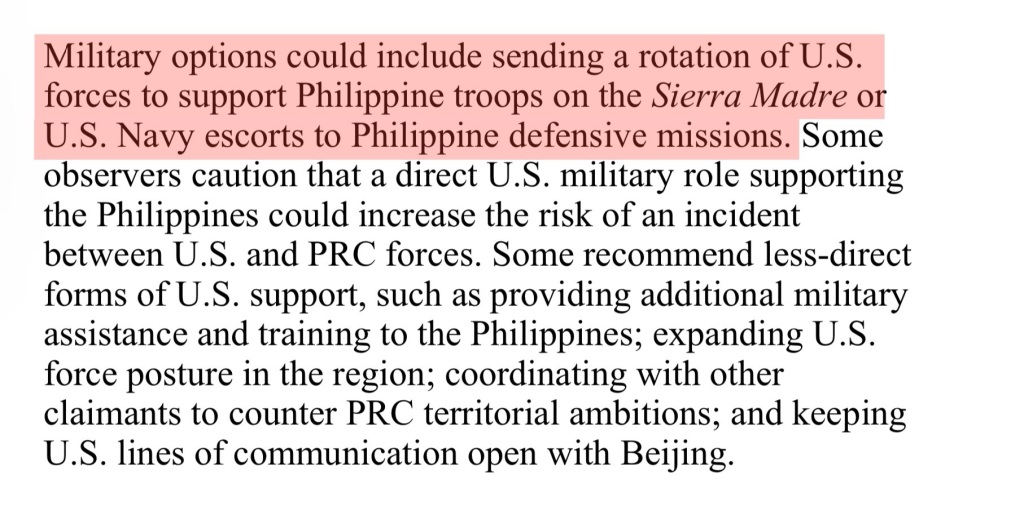
Report to Congress on China-Philippines Tensions in the South China Sea

The following is the Jan. 23, 2024, Congressional Research Service In Focus report, China-Philippines Tensions in the South China Sea.

Report to Congress on China-Philippines Tensions in the South China Sea

I’ll be updating this, soon: Philippines Game Changer – Project Myoushu – South China Sea Analysis. You can find it, here, as well. I just hope that they don’t end up stationing any US troops at the BRP Sierra Madre (see videos, below)!

Related:

Read More »

Tonto Strikes Again: Preempts Task Force, DFA + and an update (Philippines)

First of Three Parts: Sabotaging Diplomacy at the South China Seas

Four days after the country has barely started recovering from the trauma President Marcos dealt on Philippine-China relations after he made a faux pas recognizing the newly-elected president of Taiwan and infuriating China, Philippine Coast Guard Jay Tarriela again preempted the National Task Force and the Department of Foreign Affairs dishing out fake news to the national media.

Tonto Strikes Again: Preempts Task Force, DFA

I’ve updated my ‘Philippines Game Changer’ document, with a couple of links, regarding the South China Sea and ‘Freedom of Navigation’. I’ve also created a page for all of my working papers, to which I’ll upload future updates. If anyone has any feedback, I’d appreciate it. I can be reached through my contact page, or email at mscat71@dontsp.am, if comments are closed.

Related:

US policies pushing China, Philippines to brink of conflict

There’s an information war going on in the South China Sea (using embedded journalists, civil society activists, and various US think tanks). The Philippines plans on building a military base, on the disputed Second Thomas Shoal, to replace the BRP Sierra Madre (which is about to break apart). Marcos is also re-starting oil exploration, in the Reed Bank which is part of the disputed territory.

Philippines to develop islands in South China Sea + More

YouTube Playlist: InfoOp – SCS