The U.S. government, through the Committee on Foreign Investment in the United States (CFIUS), proposed a draft agreement last summer that would grant it extensive access and control over TikTok‘s operations. This move comes as an attempt to address national security concerns related to the Chinese-owned app. A draft agreement, sourced from Forbes, outlines the following potential powers for the U.S. government:
This claim, however, is false. Through a reverse image search, Check Your Fact found that the video is from October 2022 and was taken in South Korea, according to DVIDS. The video caption reads, “Stryker vehicles from 2nd Stryker Brigade Combat Team, 2nd Infantry Division are offloaded at the Port of Pyeongtaek, South Korea on Oct. 8, 2022.”
ARLINGTON, VA—Stating that America’s top rival on the global stage now had the ability to carry out such an attack, Pentagon officials warned this week that the entirety of China’s landmass could break off and zoom across the ocean to get us. “Advancements in Chinese military technology have reached a point where the whole country could just snap apart along the 14,000-mile border and careen at high speeds through the waters of the North Pacific Ocean, slamming right into the United States,” said Ely Rantner, assistant secretary of defense for Indo-Pacific security affairs, adding that the 3.7 million square miles of land carrying all 1.4 billion people residents of China would whiz in a straight line toward the U.S. mainland, completely bulldozing Hawaii on its path to strike the West Coast. “With that much land zipping over the ocean, China could easily bank off Japan or the Philippines and use the subsequent momentum to propel all of its weight right into us. Our intelligence indicates that the impact of smacking that hard into the United States would cause China to flip through the air and land with a devastating thud directly on top of our nation, flattening all 330 American citizens.” At press time, Congress had passed a bill giving the Defense Department $500 billion to build a national defensive hydraulic system that would lift the United States so high in the air that an enemy landmass attempting to barrel into it would instead glide right underneath.
I first came across Benjamin Abelow’s analysis of the Ukraine war as a lengthy article published on Medium in May. I found the depth and thoroughness of his article impressive and complimented him on it. When he told me that he’d expanded it into a short book, I was intrigued and offered to review it. I was not disappointed.
Everyone’s got a hunger for data. Constitutional rights sometimes prevent those with a hunger from serving themselves. But when they’ve got third parties on top of third parties, all Fourth Amendment bets are off. Data brokers are getting rich selling government agencies the data they want at low, low prices, repackaging information gathered from other third parties into tasty packages that give US government agencies the data they want with the plausible deniability they need.
It is unclear if the 1,000 Guardsmen is an increase in the Pentagon’s force in Africa, or if those troops are replacing others currently deployed. The U.S. has been increasingly operating in countries like Somalia and Niger as the wars in Afghanistan and Iraq have drawn down.
There are some 6,000 American troops, Defense Department civilians and contractors across Africa, an Army spokesperson told Military.com. About 3,400 of those people operate from Camp Lemonnier in Djibouti, which serves as the major hub for the U.S. military on the continent.
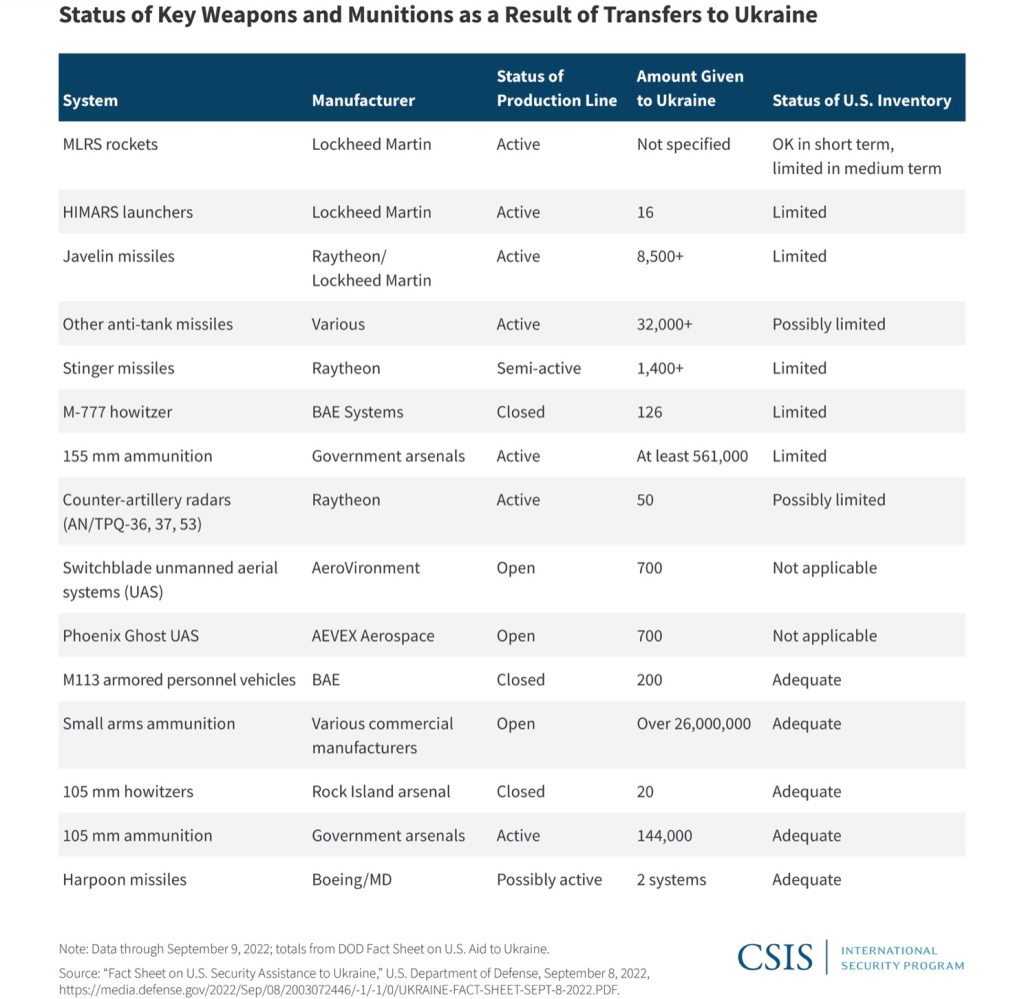
The HIMARS that the US has been sending to Ukraine are equipped with missiles that have a range of about 50 miles. But that can change, and Kyiv is requesting Army Tactical Missile Systems, which have a range of 190 miles, but Washington has been hesitant to send the longer-range missiles. Russia has warned that providing such arms would cross a “red line.”
In the U.S. weapons industry, the normal production level for artillery rounds for the 155 millimeter howitzer — a long-range heavy artillery weapon currently used on the battlefields of Ukraine — is about 30,000 rounds per year in peacetime.
The Ukrainian soldiers fighting invading Russian forces go through that amount in roughly two weeks.
…
Is the U.S. ability to defend itself at risk?
The short answer: no.
…
The U.S. has essentially run out of the 155 mm howitzers [M777?] to give to Ukraine; to send any more, it would have to dip into its own stocks reserved for U.S. military units that use them for training and readiness. But that’s a no-go for the Pentagon, military analysts say, meaning the supplies reserved for U.S. operations are highly unlikely to be affected.
Nineteen members of the US House of Representatives have written a letter [PDF] to President Joe Biden and Secretary of Defense Lloyd Austin cautioning that the partial cancellation of student debts can have the unintended consequence of reducing military recruitment in the United States.



 Ms. Cat’s Chronicles
You must be logged in to post a comment.