Why do United Nations human rights bodies focus on some countries, but not others? Why do organizations like Human Rights Watch and Amnesty International appear to ignore important evidence presented to them? And why do the media repeat stories of human rights abuses without questioning their veracity?
Most of the high-level turncoats managed to flee to Russia, meaning it is mostly lower-level collaborators who are in jail. As Russia continues to strike Ukraine, causing death and misery, there is scant sympathy for these people, as evidenced by one male prisoner with a 12-year sentence who agreed to be photographed but declined to share his name. He had been assaulted by his cellmates while in pre-trial detention. They tattooed the word “Orc” – a pejorative term for Russian soldiers widely used in Ukraine – on his forehead.
…
Holomb admitted her guilt, she said, because she felt she had no choice. She was sentenced to 15 years in prison. She is currently with her two-year-old daughter in prison, but after her third birthday the child will be taken away. “Everyone was in shock at the sentence. My mum hired a lawyer, we filed an appeal but it was too late,” she said.
Holomb has now signed a request asking to be swapped in a prisoner exchange and sent to Russia, as she thinks it is her best chance of being freed. She has never set foot in the country before.
Many of those the Guardian interviewed insisted their innocent activity had been misinterpreted and they had then been pressured into signing confessions. Valentyn Moroi, a 52-year-old from Sloviansk, said he had merely taken photographs of the warehouse where he worked, to prove everything was secure, and sent them to his boss, who was in Russia. The SBU had taken this as evidence he was sending classified information to Russian intelligence, he claimed.
A U.S. Muslim group criticized former House of Representatives Speaker Nancy Pelosi on Sunday after she suggested, without offering evidence, that some protesters demanding a ceasefire in Gaza could be linked to Russia and urged the FBI to investigate.
Few think of North Korea as being a prosperous nation. But it is richin one regard: mineral resources.
…
But however much North Korea could extract from other nations that way, the result would pale in comparison to the value of its largely untapped underground resources.
Below the nation’s mostly mountainous surface are vast mineral reserves, including iron, gold, magnesite, zinc, copper, limestone, molybdenum, graphite, and more—all told about 200 kinds of minerals. Also present are large amounts of rare earth metals, which factories in nearby countries need to make smartphones and other high-tech products.
Estimates as to the value of the nation’s mineral resources have varied greatly over the years, made difficult by secrecy and lack of access. North Korea itself has made what are likely exaggerated claims about them. According to one estimate from a South Korean state-owned mining company, they’re worth over $6 trillion. Another from a South Korean research institute puts the amount closer to $10 trillion.
North Korea has prioritized its mining sector since the 1970s (pdf, p. 31). But while mining production increased until about 1990—iron ore production peaked in 1985—after that it started to decline. A count in 2012 put the number of mines in the country at about 700 (pdf, p. 2). Many, though, have been poorly run and are in a state of neglect. The nation lacks the equipment, expertise, and even basic infrastructure to properly tap into the jackpot that waits in the ground.
…
It doesn’t help that private mining is illegal in communist North Korea, as are private enterprises in general (at least technically). Or that the ruling regime, now led by third-generation dictator Kim Jong-un, has been known to, seemingly on a whim, kick out foreign mining companies it’s allowed in, or suddenly change the terms of agreements.
Despite all this, the nation is so blessed with underground resources that mining makes up roughly 14% of the economy.
A “cash cow”
China is the sector’s main customer. Last September, South Korea’s state-run Korea Development Institute said that the mineral trade between North Korea and China remains a “cash cow” for Pyongyang despite UN sanctions, and that it accounted for 54% (paywall) of the North’s total trade volume to China in the first half of 2016. In 2015 China imported $73 million in iron ore from North Korea, and $680,000 worth of zinc in the first quarter of this year.
…
But South Korea has its own plans for the mineral resources. It sees them as a way to help pay for reunification (should it finally come to pass), which is expected to take decades and cost hundreds of billionsor even trillions of dollars. (Germany knows a few things about that.) Overhauling the North’s decrepit infrastructure, including the aging railway line, will be part of the enormous bill.
In May, South Korea’s Ministry of Land, Infrastructure and Transport invited companies to submit bids on possible infrastructure projects in North Korea, especially ones regarding the mining sector. It argued that (paywall) the underground resources could “cover the expense of repairing the North’s poor infrastructure.”
US foreign policy seems to be utterly irrational. The US gets into one disastrous war after another — Afghanistan, Iraq, Syria, Libya, Ukraine, and Gaza. In recent days, the US stands globally isolated in its support of Israel’s genocidal actions against the Palestinians, voting against a UN General Assembly resolution for a Gaza ceasefire backed by 153 countries with 89% of the world population, and opposed by just the US and 9 small countries with less than 1% of the world population.
In the Reporters Without Borders (RWB) annual report on journalists killed in the course of their work in 2023, the deaths of two Russian journalists killed in the area of the special military operation were simply erased from the count, as if their deaths did not count. But after all, this is hardly surprising coming from an organisation that in 2022 was already calling for censorship of the Russian media on the pretext of protecting freedom of speech.
…
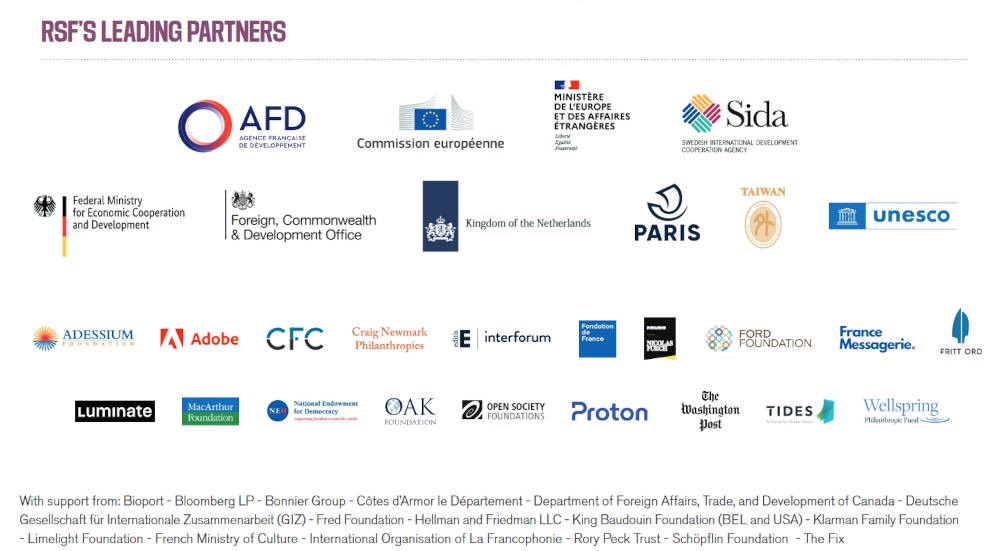
52% of RWB’s funding comes from governments, including the French Development Agency, the French Ministry of Europe and Foreign Affairs, the Swedish International Development Cooperation Agency, the German Federal Ministry for Economic Cooperation and Development, the UK Foreign Office, the Kingdom of the Netherlands, the European Commission, the Canadian Ministry of Foreign Affairs, Trade and Development and the Taiwanese Ministry of Foreign Affairs.
…
But if we look at the non-governmental players, RWB’s Russophobic bias can be fully explained. Its partners include the Open Society foundations of George Soros, who has never hidden the fact that he wants to see Russia collapse, and who supports colour revolutions around the world in order to install pro-Western governments in key countries such as Ukraine.
The Ford Foundation is also a donor to Reporters Without Borders. This foundation is literally infiltrated by the CIA (one of its former presidents is none other than the architect of what later became the CIA, and he hired American intelligence agents to work for the foundation)!
And to top it all off, the National Endowment for Democracy (NED) is one of RWB’s supporters. The NED is an American organisation funded by the US Congress, which has taken on some of the tasks previously carried out by the CIA! Don’t waste any more time, we’ve got the trifecta!
This past Wednesday, December 13, the Senate approved the request from president Andrés Manuel López Obrador for the presence of US military personnel in Mexican territory.
The request to the Mexican Senate for the entry of 11 armed US personnel to participate in the exercise “Strengthen the capabilities of the Special Forces of the Ministry of National Defense” was signed by López Obrador less than a week after he met with US President Joe Biden in San Francisco on November 17.



 Ms. Cat’s Chronicles
You must be logged in to post a comment.