Zelensky Ukraine victory speech: Listen for the quiet parts

Source

Zelensky Ukraine victory speech: Listen for the quiet parts

Zelensky is going to give his “victory” speech on October 16 to Ukraine’s parliament, the Verkhovna Rada, but much of the speech will be secret. The secret part is about giving up territory to Russia.

The Rada has just passed new legislation that allows NATO officers to command Ukrainian units. So far, the Russians have been mostly quiet, probably because they do not believe NATO will supply field commanders for Ukraine’s military. But if it happens, and that is a big if, the Russians will see it as NATO sending combat troops and react accordingly.

Some speculate that Zelensky will hint at a desire to get some sort of ceasefire and establish a buffer zone patrolled by a kind of coalition of NATO-willing. This is being billed as a Zelensky “concession” to the reality of Russia occupying Ukrainian territory.

There also are rumors that Ukraine may try to attack Transnistria, the breakaway area of Moldova that includes a few thousand Russian troops – some of them on an agreed peace-keeping mission and others protecting a huge ammunition dump left over from the Soviet period.

The Russians also have been attacking dry cargo ships in the port of Odessa that are unloading weapons and military supplies from Turkey.  

Moldova also has an important election on October 20. An attack on Transnistria could backfire and topple the current pro-NATO. pro-EU Moldovan government.

Following in the footsteps of Nikita Khrushchev? FYI, “Khrushchev Lied!”😉

Related:

Read More »

The Postwar Vision That Sees Gaza Sliced Into Concentration Camps

The Postwar Vision That Sees Gaza Sliced Into Security Zones

A plan that is gaining currency in the government and military envisions creating geographical “islands” or “bubbles” where Palestinians who are unconnected to Hamas can live in temporary shelter while the Israeli military mops up remaining insurgents. 

Other members of Prime Minister Benjamin Netanyahu’s Likud party are backing another, security-focused plan that seeks to slice up Gaza with two corridors running across its width and a fortified perimeter that would allow Israel’s military to mount raids when it deems them necessary. 

The ideas come from informal groups of retired army and intelligence officers, think tanks, academics and politicians, as well as internal discussions inside the military. While Israel’s political leadership has said almost nothing about how the Gaza Strip will look and be governed after the heaviest fighting ends, these groups have been working on detailed plans that offer a glimpse of how Israel is thinking about what it calls the Day After. 

The plans—whether or not they get adopted in full—reveal hard realities about the aftermath that rarely get voiced. Among them, that Palestinian civilians could be confined indefinitely to smaller areas of the Gaza Strip while fighting continues outside, and that Israel’s army could be forced to remain deeply involved in the enclave for years until Hamas is marginalized.

According to people familiar with the effort, it aims to work with local Palestinians who are unaffiliated with Hamas to set up isolated zones in northern Gaza. Palestinians in areas where Israel believes Hamas no longer holds sway would distribute aid and take on civic duties. Eventually, a coalition of U.S. and Arab states would manage the process, these people said. 

Ziv, who oversaw Israel’s exit from Gaza in 2005, proposes that Palestinians who are ready to denounce Hamas could register to live in fenced-off geographic islands located next to their neighborhoods and guarded by the Israeli military. This would entitle them to reconstruction of their homes. 

The process would be gradual, and in the longer term, Ziv envisages bringing the West Bank-based Palestinian Authority back to Gaza as a political solution, with the whole process taking roughly five years as the military fights Hamas insurgents. Under his plan, Hamas could be part of Gaza’s administration, if it frees all the hostages held there and disarms, becoming purely a political movement.

Northern Gaza, under the plan, would remain without reconstruction, and Palestinians there wouldn’t be allowed back to their homes until Hamas’s miles-long tunnel network was destroyed. Like the bubbles plan, it promotes the notion of de-escalation zones where aid can be delivered by the Israeli military or by international forces, but stops short of articulating an idea for governance. 

Another plan published by the Washington-based Wilson Center* also advocates a coalition-style approach to the conflict but refrains from calling for Israel to consider the adoption of a Palestinian state. It says the U.S. should establish an international police force to manage security in Gaza and over time hand the job to a yet-to-be-defined Palestinian administration. 

Robert Silverman**, a former U.S. diplomat in Iraq who is a co-author, said his team discussed the plan with Israeli officials for months, even changing parts of the proposal to make it more agreeable to Israel’s war objectives and political dynamics, but it stalled with the prime minister’s office.

“He believes we finish the war first and then plan the postwar,” Silverman said of Netanyahu. “All the people who have done this before say that’s a huge mistake.”

Another document, drafted by Israeli academics, that has made its way to the prime minister’s desk draws on historical precedents in rebuilding the war zones in Germany and Japan after World War II, and more recently in Iraq and Afghanistan. It considers how to tackle Hamas’s Islamist doctrine by learning from the defeat of ideologies such as Nazism and that of Islamic State. 

Related:

Strategic Hamlet Program

The Strategic Hamlet Program (SHP; Vietnamese: Ấp Chiến lược) was a plan by the government of South Vietnam in conjunction with the US government and ARPA during the Vietnam War to combat the communist insurgency by pacifying the countryside and reducing the influence of the communists among the rural population through the creation of concentration camps.

The Strategic Hamlet Program was unsuccessful, failing to stop the insurgency or gain support for the government from rural Vietnamese, it alienated many and helped contribute to the growth in influence of the Viet Cong. After President Ngo Dinh Diem was overthrown in a coup in November 1963, the program was cancelled. Peasants moved back into their old homes or sought refuge from the war in the cities. The failure of the Strategic Hamlet and other counterinsurgency and pacification programs were causes that led the United States to decide to intervene in South Vietnam with air strikes and ground troops.

The *Wilson Center plan isn’t much better. 👇🏻

Related:

Read More »

‘Barbaric attack using Western arms’ – Moscow decries Ukrainian shelling of Donetsk (18+)

The shelling of the Russian city of Donetsk, which has claimed the lives of at least 25 civilians and wounded 20 others, is “a barbaric terrorist act” carried out by Ukraine with the support of the West, Russia’s Foreign Ministry has said.

‘Barbaric attack using Western arms’ – Moscow decries Ukrainian shelling of Donetsk

Related (18+):

Ukraine War Massacre: 28 Killed At Market In Donetsk/Patrick Lancaster

Read More »

The Russian Art of War: How the West Led Ukraine to Defeat

We are very happy to bring you this excerpt from Colonel Jacques Baud’s latest book, The Russian Art of War: How the West Led Ukraine to Defeat (L’art de la guerre russe: Comment l’occident conduire l’ukraine a la echec). This is a detailed study of the two-year old conflict in which the West has brutally used the Ukrainians to pursue an old pipedream: the conquest of Russia.

The Russian Art of War: How the West Led Ukraine to Defeat

Chas Freeman: The Many Lessons of the Ukraine War

I want to speak to you tonight about Ukraine – what has happened to it and why, how it is likely to emerge from the ordeal to which great power rivalry has subjected it; and what we can learn from this. I do so with some trepidation and a warning to this audience. My talk, like the conflict in Ukraine, is a long and complicated one. It contradicts propaganda that has been very convincing. My talk will offend anyone committed to the official narrative. The way the American media have dealt with the Ukraine war brings to mind a comment by Mark Twain: “The researches of many commentators have already thrown much darkness on this subject, and it is probable that, if they continue, we shall soon know nothing at all about it.”

Chas Freeman: The Many Lessons of the Ukraine War

Invisible Ukrainians: A conversation with a professor from the Donbas

From the time that Russian forces invaded Ukraine in February 2022, Western media coverage of the war has been dominated by the perspectives of Ukrainians who support Zelensky’s government and who oppose Russia. While it is vitally important that we be informed of their perspective, we cannot truly understand the Ukraine war without hearing from Ukrainians who reject Zelensky’s rule. In the Western mainstream discourse, those Ukrainians are virtually invisible.

Invisible Ukrainians: A conversation with a professor from the Donbas

Ukraine Accuses NBC News of Illegal Filming in Crimea, Journalist Added to Notorious ‘Kill List’

MOSCOW (Sputnik) – Ukraine has accused NBC News of violating its law after the US broadcaster had its crew cross into the Crimea peninsula from mainland Russia.

“Attending Crimea from the territory of Russia is a violation of the legislation of Ukraine, for which responsibility is provided – in particular, foreigners are also prohibited from entering for such actions. We are very much concerned about the tv plot of @NBCNews,” Ukrainian Minister of Culture and Information Policy Oleksandr Tkachenko tweeted on Wednesday.

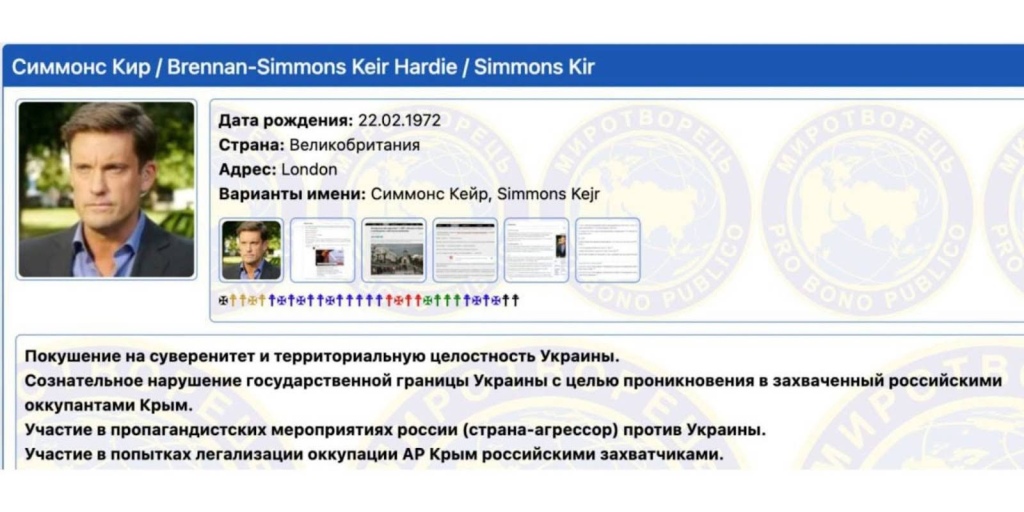
Moreover, Keir Simmons, the journalist behind the report, has been added to the notorious Ukrainian “kill list,” the Mirotvorets website. He was accused of entering the Crimean peninsula through mainland Russia and “participating in propaganda activities against Ukraine.”

On Tuesday, NBC News broadcast a report from Crimea where Simmons traveled on train from mainland Russia via the landmark bridge damaged by a deadly blast last October that was orchestrated by Ukrainian special services. The bridge has since been repaired. The reporter interviewed local people on camera who turned out overwhelmingly in support of their 2014 accession to Russia.

The spokesman for Ukraine’s foreign ministry said that Ukraine was investigating the circumstances of the NBC News reporter’s visit to Crimea and that he might end up prohibited from entering Ukrainian territory.

Ukraine Accuses NBC News of Illegal Filming in Crimea, Journalist Added to Notorious ‘Kill List’

Related:

A view from Crimea, the Russian-annexed territory Ukraine is hoping to seize back