Marcos Says Philippines Won’t Send Warships After China Clashes

Philippine President Ferdinand Marcos Jr. said his nation won’t deploy Navy warships to the South China Sea in response to recent clashes with Beijing in disputed waters.

Marcos Says Philippines Won’t Send Warships After China Clashes

Previously:

Philippines to match China’s gray zone tactics in South China Sea

What’s Really Going On In the South China Sea Between the Philippines and China

What’s Really Going On In the South China Sea Between the Philippines and China

What’s Really Going On In the South China Sea Between the Philippines and China

by Tina Antonis

Maritime clashes between the Philippines and China had been mostly over the Philippines’ military outpost, BRP (BRP—Barko ng Republika ng Pilipinas, which translates to “Ship of the Republic of the Philippines”—the ship prefix for the Philippines) Sierra Madre, in the Spratly Islands, which is disputed by Brunei, China, Malaysia, the Philippines, Taiwan (a province of China, as recognized by the United Nations’ Resolution No. 2758), and Vietnam. The BRP Sierra Madre was intentionally run aground on a reef near the Second Thomas Shoal in the disputed Spratly Islands, in 1997, so that the Philippines could stake their territorial claim.

Read More »

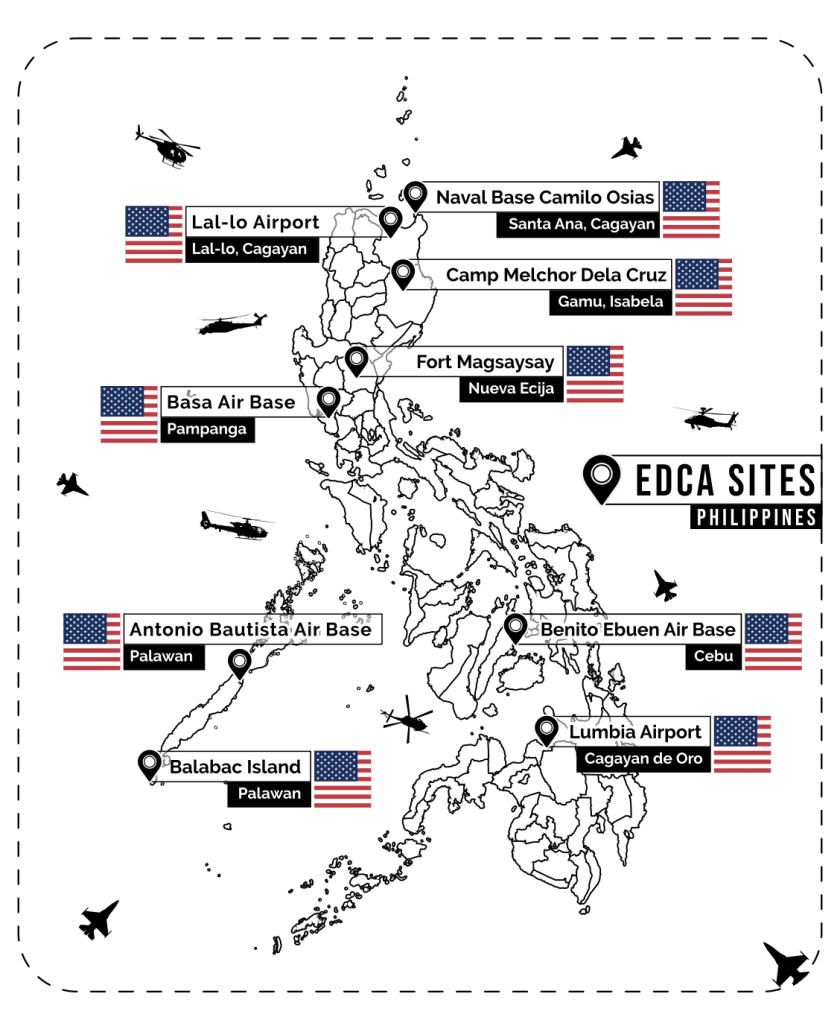
(Primer) A Decade of EDCA: US military bases and its expanding war games in the Philippines

The outright re-establishment of US military bases in the country and its relentless and escalating war games on land, sea, and air are flagrant manifestations of US imperialist domination of the Philippines. This further tightens the grip of US imperialism on the Philippine neocolonial state, especially on the puppet Armed Forces of the Philippines (AFP).

(Primer) A Decade of EDCA: US military bases and its expanding war games in the Philippines

South China Sea: US troop aid may reassure Philippines but will prod China, analysts say

Has anyone realized that by disclosing the existence of “US Task Force Ayungin,” Biden admin implicitly recognized Philippines’ sovereignty over a disputed SCS feature?

Washington has never taken a position on SCS territories(but it has in ECS). This is a clear signal to China.*

Derek J. Grossman, RAND

South China Sea: US troop aid may reassure Philippines but will prod China, analysts say (archived)

The Philippines has said the US task force only offered support – in the form of intelligence and surveillance – and did not directly take part in its resupply missions to BRP Sierra Madre, the retired warship, but analysts suggested that China’s leadership could see it in a different light.

Zheng said the revelation about the American task force meant the US was likely to be more engaged in the drawn-out maritime conflicts in the region, even suggesting that Washington would “be the first to take part in the command and planning of Philippine maritime activities”.

Ding Duo, deputy director of the Centre for Oceans Law and Policy at the National Institute for South China Sea Studies in Hainan, said the presence of a special task force showed that Washington and Manila had long cooperated on resupply operations to Second Thomas Shoal.

“Such support emboldens the Philippines and is not conducive to China and the Philippines managing their differences,” Ding said. “The US involvement has also squeezed the political space for internal coordination and decision-making within the Philippines.”

He said it was also possible that American troops could be on Philippine ships and involved in front-line action “using a covert or concealed identity to participate in Philippine maritime operations” in future.

He said the US could “only intervene [in South China Sea disputes] in a covert manner and so it took the form of a task force”.

Related:

Read More »

Australia-Philippines Military Public Affairs workshop

YouTube / Facebook

Throughout the three-day course, we’ve looked at the strategic, operational and tactical levels.  We’ve looked at the operational framework in which both nations work.  Some of the considerations that we have to work together with.  We’ve looked at media programs and media talent and preparing that talent and facilitating media embed programs.  And we also unpacked and looked at photography workshop as well, where we’ve been able to have lots of fun looking at the kits and the tools, and taking some photography and vision in order to amplify key messages into the region.

ADF | Australia-Philippines Military Public Affairs workshop

Related:

Great communication begins with connection

‘The workshop got our nations on one page to deliver the right information and messages that we want to convey across the globe.’

Embedded journalism:

The original purpose of embedding was to control journalists, according to Helen Benedict, a professor at the Columbia Journalism School.  Citing award-winning Australian journalist Phillip Knightley’s book “The First Casualty: The War Correspondent as Hero and Myth-Maker from the Crimea to Iraq” which describes how the U.S. government invented embedded journalism in response to critical coverage of the Vietnam War.  As civilian casualties in Afghanistan reached 5,000, the Pentagon sought a media strategy that would bring attention back to the military’s role in the war, especially the role played by ordinary American service members.  This would require bringing war correspondents on side.

What are Information Operations?

To obtain a competitive edge, information operations and warfare entail obtaining intelligence on opponents and disseminating propaganda.

DefinitionInformation operations are tactics used to sway people’s opinions and affect how decisions are made.

More information:

Embedded Journalism, Media Manipulation & Apathy

2012 NDAA – Propaganda – MISO – InfoOps – PsyOps

SeaLight document

Chinese Missile Boat Undertakes ‘Alarming’ Action

Chinese Missile Boat Undertakes ‘Alarming’ Action (archived)

A Chinese navy missile craft shadowed a Philippine civilian ship on Friday in an unprecedented encounter that one analyst described as “alarming.”

The Fisheries and Aquatic Resources (BFAR) vessel the BRP Datu Romapenet was en route to a South China Sea feature known as Half Moon Shoal to deliver supplies to fishermen.

Half Moon Shoal is situated at the eastern edge of the Spratly Islands and about 60 miles from the Philippine province of Palawan, well within the Southeast Asian country’s recognized exclusive economic zone (EEZ).

According to the Philippines’ ABS-CBN News, which was onboard, the ship picked up a tail in the form of a Houbei-class (Type 22) guided-missile craft, easily identifiable by its wide camouflaged catamaran hull.

Chester Cabalza, founder of Manila-based think tank the International Development and Security Cooperation, told the news agency it was the first time a Type 22 had been spotted in the EEZ.

“This incident is alarming because a missile ship shadowed our BFAR ship,” Cabalza said, adding that it was a show of power intended to intimidate the Philippines.

Read More »

Skies over South China Sea seen as new flashpoint as Manila begins ‘aerial provocations’

Source

According to the article, Philippine aircraft also frequently operate with their Automatic Dependent Surveillance-Broadcast (ADS-B) transponders deactivated, significantly increasing safety risks.

Deactivating such transponders means real-time positioning of the aircraft is not shared with air traffic controllers and other aircraft, making it more difficult to maintain situational awareness and avoid potential conflicts or collisions.

Skies over South China Sea seen as new flashpoint as Manila begins ‘aerial provocations’

Related:

How far is China-Philippines Aerial Collision in the South China Sea?

Since August 2024, the Philippines has repeatedly dispatched military aircraft to trespass into the airspace of the Spratly Islands and Macclesfield Bank, escalating tensions in the region. On August 7 and 8, the Philippines sent an NC-212i aircraft to intrude into the airspace near Scarborough Shoal for two consecutive days, disrupting China’s regular training activities. On August 19, a Cessna 208B Grand Caravan plane (C-208B) was dispatched to illegally enter the airspace of Scarborough Shoal. On August 22, the Bureau of Fisheries and Aquatic Resources of the Philippines again sent a C-208B to illegally intrude into the vicinity of Subi Reef.

On the other hand, the Philippine aircraft in use are primarily single-engine turboprop light utility aircraft, which are less equipped to handle complex maritime environments, increasing the likelihood of accidents during frequent operations. Moreover, Philippine military aircraft usually operate with ADS-B transponders turned off throughout their missions, posing potential safety risks. In the event of an accident, whatever the reasons, based on past behavior, the Philippines would likely blame China, leading to another cycle of victim-playing and diplomatic posturing.