Washington’s Escalating War on Venezuela: Narco-Myths and Imperial Designs

Since the election of Hugo Chávez in 1998 Washington has waged a relentless war against the Bolivarian revolution. The Trump administration continues to deploy political, economic and military measures aimed at the overthrow of Venezuela’s government and the reversal of advances in regional independence and integration: the two pillars of the Bolivarian cause. At the present juncture, it is critically important to make no mistake about Washington’s duplicitous policy towards the Maduro administration of simultaneous negotiation and intensifying aggression. This aggression is not a mere show to placate the Trump administration’s hard line anti-Chavista allies in Miami; it is an imminent threat to Venezuela’s national security and part of a strategy to recuperate U.S. domination of the Americas. 

Washington’s Escalating War on Venezuela: Narco-Myths and Imperial Designs

H/T: Venezuela & ALBA News 8.18.2025

Related:

Is Trump 2.0 Planning to Invade Venezuela?

María Corina Machado is the female Javier Milei (aka US Puppet)

Tag: 2024 Venezuelan Presidential election

Capes, Cameras, and the Cult of Visibility

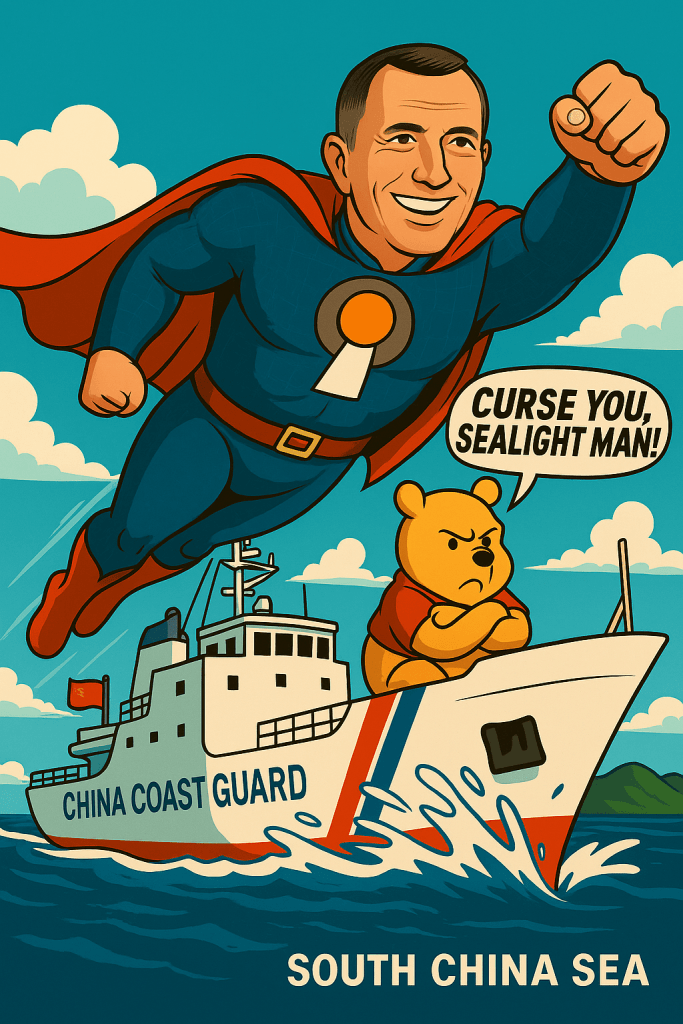
Capes, Cameras, and the Cult of Visibility: The SeaLight Crusade as White Savior Theater

By Tina Antonis

The South China Sea is more than a maritime dispute—it’s a theater of narrative warfare. While headlines focus on Chinese aggression and Philippine resistance, a quieter campaign unfolds in the background: one of satellite feeds, curated imagery, and Pentagon-backed storytelling. At the center of this effort is SeaLight, a project that claims to illuminate truth but often casts shadows of its own.

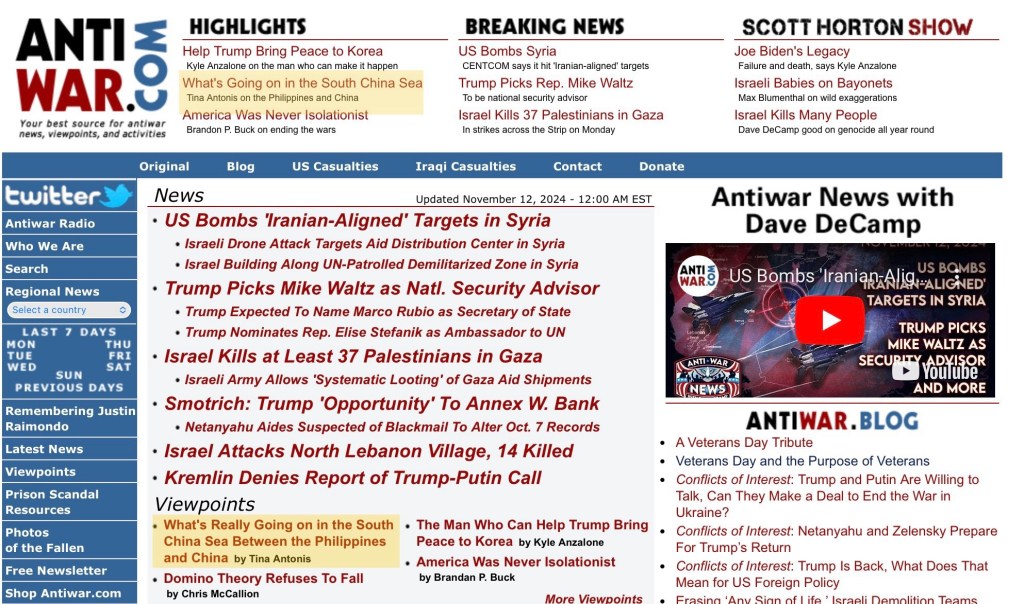
As explored in my article at Antiwar.com, SeaLight doesn’t just document—it performs. It reframes geopolitical tension through moral spectacle, positioning its creators as heroic arbiters of transparency. But when the messenger wears a cape and the funding flows from defense budgets, we must ask: is this clarity, or choreography?

Stage Left: The White Savior Enters

In the comic-strip cosmology of Ray Powell’s SeaLight project, transparency wears a cape. Clad in heroic postures and backed by satellite imagery, Powell casts himself as the guardian of maritime morality—unarmed, except with satellite feeds, theatrical flair, and strategic messaging. 

Yet beneath the cartoon and Pentagon-funded optics lies a familiar archetype: the white savior, rebranded for the South China Sea.

China Is Imperialist? Says Who?

Calling China a “maritime occupier,” Powell positions himself as a bulwark against aggression. But that moral pose collapses under scrutiny. He speaks for a country with over 800 foreign military installations and a documented history of over 250 military interventions since 1991—wars in Iraq, Afghanistan, Libya, Syria, Somalia, and dozens more, all under the banner of peace, freedom, or preemption.

By comparison, China’s post–Cold War footprint includes no sustained foreign occupations and only scattered border conflicts and peacekeeping missions. The imbalance is staggering. And Powell’s framing doesn’t just ignore it—it performs around it.

As David Vine argues in The United States of War, this vast base empire is not a passive network—it’s an architecture of perpetual war. These outposts make military engagement not an exception but a structural habit, cloaked in strategic necessity and sold as global stewardship.

Powell’s cartoon rhetoric—calling China an occupier—obscures the scale of U.S. militarism. The term “occupation” is deployed not to analyze, but to project. When adversaries hold territory, it’s a crisis; when the U.S. spans the globe with armed installations, it’s policy.

Framing Conflict: The Optics of Consent

This isn’t irony. It’s performance. Powell’s language manufactures a moral frame for confrontation—costumed in transparency, but driven by escalation. The cape is literal. The conditioning is deliberate. And the stage is set for war.

SeaLight’s mission is not just visual documentation—it’s narrative warfare. As the Japan Times openly notes, its “chief weapon is photography, applied purposefully, generously and consistently over time.” These images—enhanced, curated, and distributed across media—are not neutral. They’re constructed to shape public perception, sway international opinion, and ultimately manufacture consent for confrontation.

Assertive transparency becomes a kind of ideological scaffolding—a stage on which geopolitical tension is dramatized, simplified, and morally polarized. The goal isn’t simply to reveal conflict; it’s to condition audiences for escalation.

And when the messenger dons a superhero’s cape, the spectacle transforms into something deeper: a story of rescue, of virtue, of intervention. This is not analysis—it’s soft propaganda dressed in heroic metaphor.

Consent for war doesn’t begin with missiles. It begins with mythmaking.

Don’t Deify Jimmy Carter

Jimmy Carter, out of office, had the courage to call out the “abominable oppression and persecution” and “strict segregation” of Palestinians in the West Bank and Gaza in his 2006 book “Palestine: Peace Not Apartheid.” He dedicated himself to monitoring elections, including his controversial defense of the 2006 election of Hugo Chavez in Venezuela, and championed human rights around the globe. He lambasted the American political process as an “oligarchy” in which “unlimited political bribery” created “a complete subversion of our political system as a payoff to major contributors.”

Don’t Deify Jimmy Carter

The Soviet Union was asked by the Democratic Republic of Afghanistan to intervene to help fight against the Afghan mujahideen that the US was arming: Soviet-Afghan War

Carter, Charter 77, and Solidarność (Solidarity):

Read More »

What’s Really Going On In the South China Sea Between the Philippines and China

What’s Really Going On In the South China Sea Between the Philippines and China

by Tina Antonis

Maritime clashes between the Philippines and China had been mostly over the Philippines’ military outpost, BRP (BRP—Barko ng Republika ng Pilipinas, which translates to “Ship of the Republic of the Philippines”—the ship prefix for the Philippines) Sierra Madre, in the Spratly Islands, which is disputed by Brunei, China, Malaysia, the Philippines, Taiwan (a province of China, as recognized by the United Nations’ Resolution No. 2758), and Vietnam. The BRP Sierra Madre was intentionally run aground on a reef near the Second Thomas Shoal in the disputed Spratly Islands, in 1997, so that the Philippines could stake their territorial claim.

Read More »

Sean Gervasi, 1992 lecture: The US Strategy to Dismantle the USSR

Source

Sean Gervasi, 1992 lecture: The US Strategy to Dismantle the USSR

Related RAND Corporation documents:

Economic factors affecting Soviet foreign and defense policy: a summary outline

The Costs of the Soviet Empire

Sitting on bayonets : the Soviet defense burden and the slowdown of Soviet defense spending

Moscow’s Economic Dilemma: The Burden of Soviet Defense

Exploiting ‘fault lines’ in the Soviet empire: an overview

President Maduro’s speech welcoming the freed Alex Saab to Venezuela

December 20, 2023

Good afternoon to all Venezuela, to the National Radio and Television network, to all national and international media and those through social networks. I want to welcome this brave, patriotic man who resisted 1280 days, 40 months, in the most adverse, most painful conditions of kidnapping, filthy prisons, physical torture, psychological torture, threats, lies. And after 1280 days of kidnapping, he has triumphed. The truth has triumphed, justice has triumphed – what had to happen. Welcome, Alex Saab Moran. From your days of pain, of persecution against you, against your family. This I told Alex when I just gave him this hug. On this beautiful afternoon, with this beautiful sun in Caracas, on this happy Christmas of our people waiting for the year 2024. I knew that this day had to come and this day came. Blessed day, December 20, unforgettable forever in the year 2023. We have to talk about so many things. You have faced the toughest tests that a brave man with Palestinian blood knows how to endure.

President Maduro’s speech welcoming the freed Alex Saab to Venezuela

Previously:

Henry Kissinger, world-shaping diplomat who was revered and reviled, dies at 100

Henry Kissinger, the toweringly influential former secretary of state who earned a reputation as a sagacious diplomat but drew international condemnation and accusations of war crimes for his key role in widening the American presence in Vietnam and the U.S. bombing of Cambodia, died Wednesday.

Henry Kissinger, world-shaping diplomat who was revered and reviled, dies at 100 🎉

Related:

Dead at 100, Henry Kissinger Leaves Behind a Bloody Legacy