
(Spoiler Alert: Key plot points of Alexander Bogdanov’s Red Star follow.)
Read More »Tag: dialectics
Vladimir Lenin: Ten Questions to a Lecturer
Vladimir Lenin, Ten Questions to a Lecturer, Lenin Collected Works, Volume 14:
Read More »Vladimir Lenin: On the Question of Dialectics
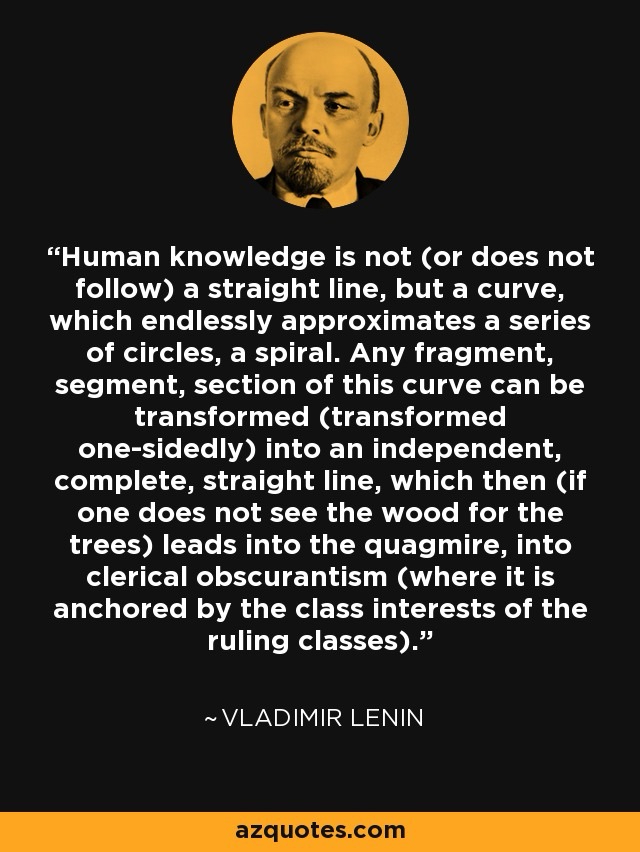
Human knowledge is not (or does not follow) a straight line, but a curve, which endlessly approximates a series of circles, a spiral. Any fragment, segment, section of this curve can be transformed (transformed one-sidedly) into an independent, complete, straight line, which then (if one does not see the wood for the trees) leads into the quagmire, into clerical obscurantism (where it is anchored by the class interests of the ruling classes). Rectilinearity and one-sidedness, woodenness and petrification, subjectivism and subjective blindness—voilà the epistemological roots of idealism. And clerical obscurantism (= philosophical idealism), of course, has epistemological roots, it is not groundless; it is a sterile flower undoubtedly, but a sterile flower that grows on the living tree of living, fertile, genuine, powerful, omnipotent, objective, absolute human knowledge.
Trotsky: The Formalist School of Poetry and Marxism
LEAVING out of account the weak echoes of pre-Revolutionary ideologic systems, the only theory which has opposed Marxism in Soviet Russia these years is the Formalist theory of Art. The paradox consists in the fact that Russian Formalism connected itself closely with Russian Futurism, and that while the latter was capitulating politically before Communism, Formalism opposed Marxism with all its might theoretically.
Literature and Revolution: The Formalist School of Poetry and Marxism
Examples Of Dialectics

Selected Works of Mao Tse-tung
(Abstracted Compilation)
1959
[SOURCE: Long Live Mao Zedong Thought, a Red Guard Publication.]
Five of Lenin’s Insights That Are More Pertinent Than Ever

Today we mourn a hundred years since the physical death of one of our dearest comrades, Vladimir Ilyich Ulyanov, known to us as Lenin. It would be foolish, however, to think that his physical death meant the death of his ideas. Today, after a hundred years, Lenin’s ideas are as indispensable as ever. “They are mistaken when they think that his death is the end of his ideas”. This was told to us by Fidel Castro upon the death of Che Guevara, but it applies with equal accuracy to Lenin’s death.
Five of Lenin’s Insights That Are More Pertinent Than Ever
China Has Billionaires: Introduction
Capitalism’s Court Jester: Slavoj Žižek
One of the most prominent intellectuals in the contemporary world was named to the list of the “Top 100 Global Thinkers” in Foreign Policy magazine in 2012. He shares this distinction with the likes of Dick Cheney, Recep Tayyip Erdoğan, Benjamin Netanyahu, and former Mossad director Meir Dagan. The theorist’s best idea—according to this well-known publication that is a virtual arm of the U.S. State Department—is that “the big revolution the left is waiting for will never come.”
Capitalism’s Court Jester: Slavoj Žižek
Related:
Upcoming: Gabriel Rockhill | Why Slavoj Žižek is Capitalism’s Court Jester (YouTube)


The Brahmins of Democracy: Communists vs. Patriotic Socialists
Michael Millerman goes over the article:
The Brahmins of Democracy: Communists vs. Patriotic Socialists.

Previously:
 Ms. Cat’s Chronicles
You must be logged in to post a comment.